Best Consensus Alternatives in 2026
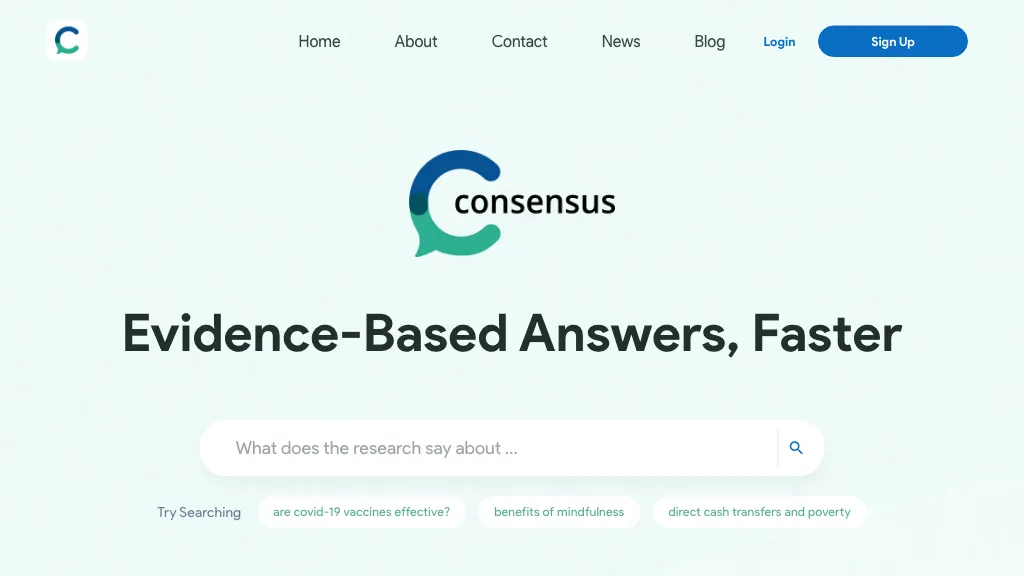
70% positive · 20 user reviews FreemiumConsensus is an AI‑powered academic search engine indexing 250 million peer‑reviewed papers. Its Deep Search expands terms, applies filters for time, design, and population, visualizes study agreement, and offers medical‑focused evidence for rapid literature reviews.
We've ranked 29 Consensus alternatives, including 24 with a free plan. Rankings are based on feature coverage and user feedbacks.
Top-rated alternatives include Semanticscholar, Seaml.es, and Paper Digest.
29 Consensus Alternatives & Competitors, Ranked by User Reviews
Click Compare on any tool to compare it side-by-side with Consensus.
#1
Semanticscholar
Semantic Scholar indexes 230 million papers, offering AI‑powered semantic search that prioritizes relevance and citation impact. It provides contextual PDF annotations, a developer API, and export options for literature reviews, grant research, and teaching.
#2
Seaml.es
Seamless AI Literature Review Tool automates literature reviews by retrieving relevant papers from Semantic Scholar and integrating them with user context. It also offers AI‑powered scholarship search, application support, and real‑time essay enhancement for research workflow.
#3
Paper Digest
Paper Digest is an AI-powered research platform that facilitates literature reviews, deep research, and report generation. It features an AI reader for PDF analysis, an AI writer for content drafting, and a question-answering tool for scientific literature.
#4
OpenRead
OpenRead centralizes research by letting users upload documents, search 20,000+ journals, compare papers, generate Q&A, graphs, notes, and chat with AI models. It also offers diagram creation, image editing, and homework help, with frequent model updates.
#5
Epsilon
Epsilon is an AI‑powered search engine indexing over 200 million academic papers, retrieving the top 100 results per query. It uses GPT‑4 to provide concise, citation‑rich summaries, supports batch data extraction, private libraries, and aids meta‑analyses and proposal drafting.
#6
Cure AI
Cure AI is a medical research tool that provides access to over 26 million PubMed articles, offering advanced search options and AI-generated insights to streamline scientific inquiries and enhance evidence-based discoveries.
- Personalized recommendations
- Custom collections
- Save favorites
Already a member? Sign in
#7
ResearchPal
ResearchPal automates literature reviews, summarizing PDFs and extracting key insights. It offers citation management, integrates with Zotero/Mendeley, writes structured academic drafts, supports paraphrasing, translation, tone adjustment, domain‑specific search, and real‑time collaborative editing.
#8
iAsk.ai
iAsk.Ai delivers instant, factual answers to natural‑language questions from authoritative web sources, and offers essay drafting, advanced grammar checks, academic summarization, PDF analysis, image generation, URL bullet‑point briefs, and one‑click grammar correction. Accessible via browser extension or mobile app.
#9
ThesisAI
ThesisAI generates papers up to 80 pages from a single prompt, integrating inline citations and up to 500 reference files. It supports Semantic Scholar searches, multiple citation styles, 30+ languages, and exports to PDF, Word, LaTeX, BibTeX, and Overleaf.
#10
Dr.Oracle
Dr.Oracle is an AI platform that supplies evidence‑based differential diagnoses and treatment plans derived from up‑to‑date guidelines and peer‑reviewed literature. Its Research Mode synthesizes up to 25 journal articles for rapid literature reviews.
#11
MediSearch
MediSearch delivers AI‑driven, evidence‑based medical answers via a structured query interface and advanced filters for topics such as cancer risk and medication side effects. It offers a downloadable app and business solutions, focusing on up‑to‑date, accurate content.
#12
Scite_
Scite indexes 280 million peer‑reviewed articles, preprints, books, patents, and datasets, enabling full‑text search. It classifies each citation as supportive, neutral, or contradictory with confidence scores and lets users view original context and citation reports.
#13
AI-Writer
AI‑Writer.com generates concise, cited answers to academic questions from 100 million open‑science papers, shows source paragraphs, offers BibTeX, supports APA/MLA/Chicago, and lets users build structured reviews via drag‑and‑drop and download them as HTML.
#14
Resea AI
Resea AI is a research agent that autonomously conducts in-depth investigations across academic databases and generates detailed reports with accurate citations. It supports large-scale document creation (30,000+ words), multilingual editing, and delivers refined outputs via a user-friendly interface.
#15
Scisummary
SciSummary extracts abstracts, methods, results, and conclusions from scientific papers, supports bulk summarization and comparative overviews, provides AI‑generated figure statistics, and indexes up to 1,000 documents for semantic search to aid researchers in managing literature.
#16
WisPaper
Wispaper is an AI-driven research tool that simplifies academic literature reviews by filtering relevant studies and offering personalized alerts. Upcoming features include project organization tools and AI-generated summaries to streamline knowledge building.
#17
Find Your Next Book
BookFindy.AI is an AI search engine indexing millions of titles, offering advanced filters by genre, date, author, language, and format. It provides personalized recommendations, adaptive e‑book styling, citation support, and integrates with libraries and bookstores.
#18
Paper pilot
Paper Pilot uses AI to search 220 million papers, produce concise summaries, and provide linked citations. It lets users organize up to 50 papers on interactive boards, annotate, and receive AI‑assisted writing and real‑time research help.
#19
Insightai.dev
Insight streamlines medical research by guiding users from a defined objective through tailored tasks, automating literature and database data collection. It enables iterative review, collaboration, and integration into research portals, all without a subscription.
#20
Sourcely
Sourcely is an AI academic search assistant that lets users paste text to retrieve relevant sources from a 200‑million‑paper database. It highlights citation sections, summarizes findings, offers free PDFs, supports multiple citation styles, and provides filtering and conversational clarification tools.
#21
Sharly AI
Sharly AI extracts insights, summarizes documents, and generates verified metrics with source links and citation support. It compares data across files, detects patterns, enables collaborative Q&A, role‑based permissions, and protects data with AES‑256/TLS across PDFs, Excel, Docs, and Notion.
#22
Paperguide
Paperguide is an AI research assistant that searches 200 million papers, delivers cited answers, and automates literature reviews with structured summaries, tables, and figures. It offers a full‑document writer, reference manager, OCR, citation formatting, and collaboration tools.
#23
MyLens.AI
MyLens.ai: Powerful AI tool for generating detailed mind maps & extracting insights from docs. Suitable for research, business & learning purposes. Promoting user privacy. Easy application across various uses.
#24
Detecting-AI.com
Detecting‑AI scans text in 50+ languages, marking AI‑generated sentences with probability scores. It integrates with Chrome, Moodle, Zapier, and offers an API, delivering up to 98% accuracy and low false‑positives while protecting user privacy.
#25
HeyScience
HeyScience assists students, tutors, and researchers by gathering sources, outlining essays, and generating drafts. It tracks assignment progress, highlights key concepts, offers citation suggestions, and integrates with LMS for reference import. Users refine drafts with AI feedback.
#26
Addlly AI
Addlly AI audits generative model citations across ChatGPT, Gemini, Perplexity, and Claude, producing prioritized GEO plans that align content, structure, and technical signals. Automated agents perform audits, create content, and amplify, with centralized governance, cloud scalability, and secure, LLM‑agnostic deployment.
#27
The-good-AI
AI Essay Writer is a web‑based tool that generates academic essays, outlines, and paragraph suggestions based on topic, type, tone, and citations. It includes grammar checks, AI detection, and reference formatting, aiding students and researchers.
#28
Txyz.ai
TXYZ offers AI‑powered help for reading, problem solving, and knowledge workflows, with file upload and analysis of academic papers, a searchable scholarly library, a writing agent for up to five pages, precise document citations, and private data handling.
#29
PaperLens
PaperLens is an AI-driven research platform that enhances literature reviews by providing semantic search, summarizing papers through an AI chatbot, and offering smart filtering options for efficient access to peer-reviewed research.
Frequently Asked Questions
Why look for Consensus alternatives?
Common reasons users switch from Consensus:
- User satisfaction: Consensus holds a 70% positive rating — some users report unmet expectations.
- Feature gaps: teams needing specific capabilities like Analyze Research Papers may find a more focused alternative better suited to their workflow.
- Flexibility: exploring alternatives helps find tools that better match your team size, integrations, and budget.
What is the best alternative to Consensus?
Based on 11 user reviews, Semanticscholar (72.7% positive) ranks as the top Consensus alternative. Semantic Scholar indexes 230 million papers, offering AI‑powered semantic search that prioritizes relevance and citation impact. It provides contextua It is available on a Free plan.
How do the top Consensus alternatives compare?
| Tool | Pricing | Starting Price | User Rating |
|---|---|---|---|
| Consensus this tool | Freemium | — | 70% (20) |
| Semanticscholar | Free | — | 72.7% (11) |
| Seaml.es | Paid | — | — |
| Paper Digest | Free | — | — |
| OpenRead | Freemium | $5/mo | 100% (1) |
| Epsilon | Freemium | — | 100% (1) |
Are there free Consensus alternatives?
Yes, 24 free alternatives found in our list: Semanticscholar, Paper Digest, OpenRead. and 21 more — use the pricing filter above to see them all.
What should I look for in a Consensus alternative?
- Core capabilities: confirm the tool supports Analyze Research Papers, Extract Clinical Guidelines, Generate Evidence Based Answers.
- Pricing transparency: look for clear free plan, trial period, or tiered pricing — avoid tools that hide costs.
- User reviews: check both the satisfaction percentage and the number of reviews; a high score from few users is less reliable.
- Integrations: verify it connects with your existing stack before committing.
- Support and updates: active development and responsive support are strong signals of a maintained product.
Which Consensus alternative has the highest user rating?
OpenRead has the highest satisfaction score among Consensus alternatives, with 100% positive from 1 user review. It is available on a Freemium plan starting from $5/mo.
What are Consensus alternatives used for?
- Analyze Research Papers
- Extract Clinical Guidelines
- Generate Evidence Based Answers
- Organize Citation Networks
- Visualize Study Agreements