
What is Acade AI?
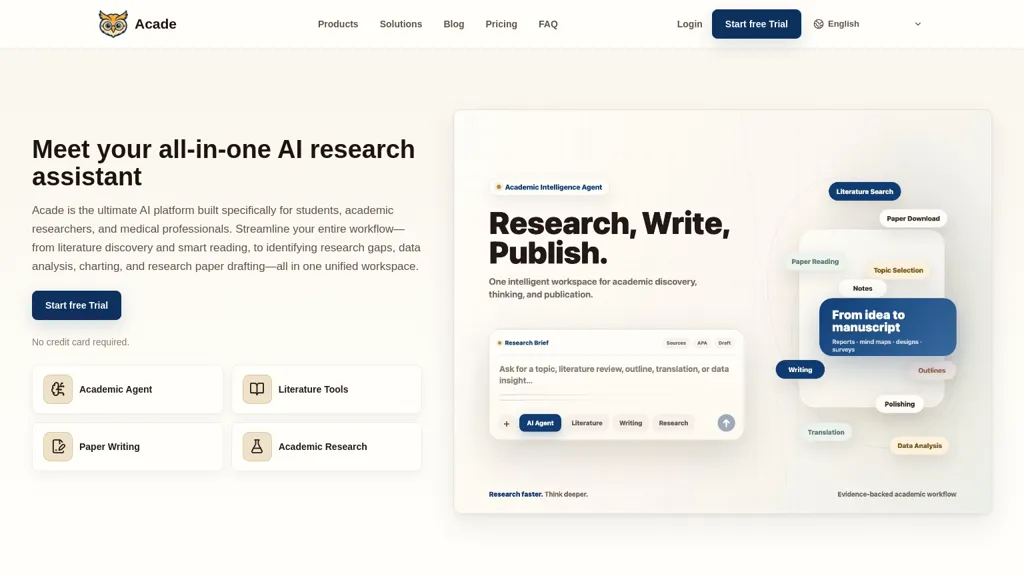
Acade is an AI research assistant and academic writing platform that combines literature search, PDF parsing, citation generation, data analysis, drafting, formatting, and translation in a single workspace.
The tool connects to Google Scholar and PubMed for source-verified literature retrieval and supports APA, IEEE, and Harvard citation formats to minimize unverifiable references.Acade’s semantic search, PDF extraction, and summarization streamline literature review generation, gap analysis, and side-by-side reading of full texts.
Built-in reference management and an AI citation generator automate bibliography creation and journal-compliant formatting to reduce citation and formatting-related desk rejections.Python-enabled data analysis, charting, and multimodal outputs support quantitative research workflows and evidence-based manuscript drafting.
Target users include undergraduates, graduate students, PhD candidates, academic researchers, and clinicians seeking efficient literature discovery, thesis and paper drafting, and publication-ready outputs.
Acade AI details
- Built for
- Individuals
- Data residency
- United States
Acade AI pricing
Free trial- Auto-renewal
- Yes
Verify on the official pricing page.
Start free trialAcade AI's key features
-
Connects to Google Scholar and PubMed and provides semantic literature search
-
Parses PDFs with extraction, summarization, and side-by-side full-text reading
-
Built-in reference management and AI citation generator supporting APA, IEEE, and Harvard with journal-compliant formatting
-
Python-enabled data analysis, charting, and multimodal output generation
-
Integrated drafting, formatting, and translation workspace for academic writing
Acade AI use cases
-
Perform a fast, source-verified literature review by running semantic searches across Google Scholar and PubMed, automatically parsing PDFs to extract key findings and methods, generating concise annotated summaries, and building a citation-ready bibliography for manuscript background sections
-
Draft high-quality research manuscripts by converting semantic summaries and extracted PDF evidence into coherent introduction, results and discussion sections, managing references with automated citation and reference generation, and exporting formatted drafts for journal submission
-
Integrate reproducible data analysis and reporting by running Python analyses on experimental datasets within the workspace, producing figures and tables linked to source PDFs, and embedding code, results, and reference-managed citations for transparent, reproducible manuscripts
Acade AI user reviews
Based on 2 reviews, 100% of users recommend Acade AI, rated highly for ease of use.
Liked for
Would you recommend Acade AI?
Who is Acade AI for?
-
Undergraduate students
-
Graduate students
-
Phd candidates
-
Academic researchers
-
Medical clinicians
Acade AI FAQ
Is Acade AI free?
Not permanently. Acade AI gives you a free trial, after which a paid plan is required. Plans include Plus at $14.99/mo and Pro at $49.99/mo.
What are the best alternatives to Acade AI?
The closest alternatives to Acade AI are Semanticscholar, Paperguide, ResearchPal, AI-Writer and Aithor. You can compare them side by side in the alternatives section further down this page.
What does Acade AI do with my data?
Acade AI states that customer content is not used to train its models. Its privacy policy states that personal data is not sold or shared for marketing purposes. Data may be shared with third-party service providers that help run the product. Customer data is held in United States.
Does Acade AI auto-renew or offer refunds?
Acade AI subscriptions renew automatically until you cancel.
Compliance, privacy and billing terms are as stated in each product's own published documentation and have not been independently verified by TopAI.tools.


Can i add offline sources and papers as well ?
Yes, you can.