
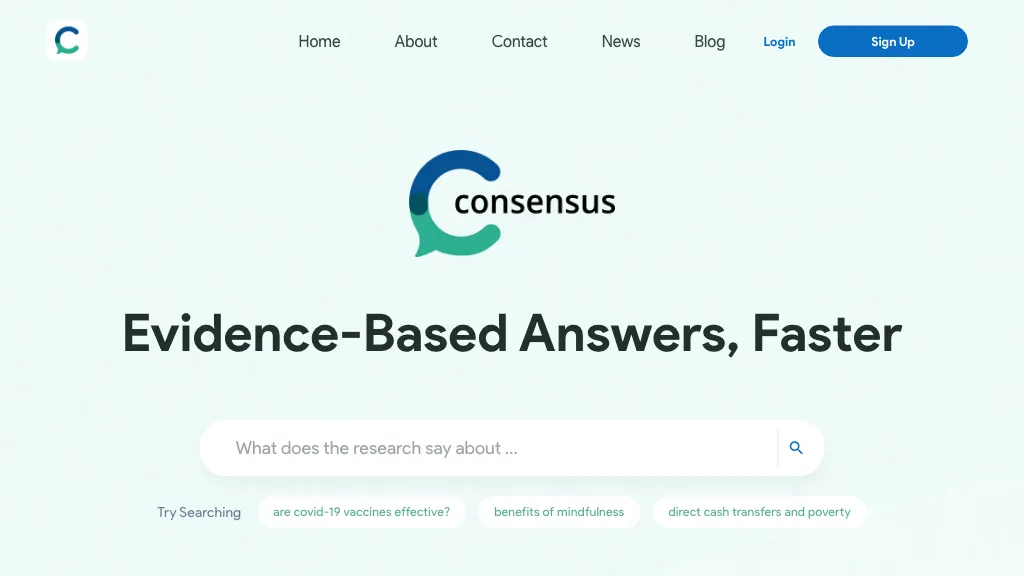
What is Consensus?
Consensus is an AI‑driven academic research platform that indexes and analyzes more than 250 million peer‑reviewed research papers, including licensed full‑text from leading publishers.Its Deep Search feature automatically expands search terms, maps citation networks, and applies natural‑language filters for timeframes, study designs, and populations, converting weeks of literature review into minutes.
In Medical Mode, users can focus on the top 50 000 clinical guidelines and 8 million articles from premier medical journals to obtain trusted, evidence‑based clinical answers.The Consensus Meter visualizes the agreement or disagreement among studies for a clear yes‑or‑no assessment of any research question.
Consensus pricing
FreemiumConsensus offers a free plan with paid upgrades available.
Verify on the official pricing page.
View plansConsensus's key features
-
Search over 200M papers
-
Deep Search expands terms
-
Medical mode filters top journals
-
Natural language filter application
-
Consensus Meter visual agreement
-
Citation graph exploration
-
Auto-apply filters via prompt
Consensus use cases
-
Develop rapid evidence‑based clinical guideline updates for hypertension management, using Consensus’s deep search and study‑agreement visualization to quickly identify high‑quality, recent peer‑reviewed trials
-
Map citation networks of machine learning applications in oncology to reveal emerging consensus and pinpoint under‑studied research gaps, aiding grant proposal development
-
Perform time‑filtered systematic review on COVID‑19 vaccine efficacy in immunocompromised patients, leveraging Consensus’s filters for study design and population to ensure comprehensive, up‑to‑date evidence
Consensus user reviews
Based on 20 reviews, 70% of users recommend Consensus, rated highly for quality results.
Liked for
Disliked for
Would you recommend Consensus?
Consensus playbooks
1Step-by-step guides to get the most out of Consensus
Main competitors of Consensus
Here are some of the major competitors comparisons vs. Consensus.


Who is Consensus for?
-
Academic researchers
-
Scientific scientists
-
Policy makers
-
Media journalists
-
Data analysts
Consensus FAQ
Is Consensus free?
Partly. Consensus has a free plan with usage limits, and paid plans unlock the full feature set.
Is Consensus safe to use?
Consensus carries the TopAI.tools verified mark, which we award after a manual review of pricing transparency, published terms, public following and working functionality. It has a substantial audience that is independently measured month to month.
Is Consensus good?
Consensus has a 70% recommendation rate from 20 reviewers on TopAI.tools. Reviewers rate it highest on quality of results and value for money.
What are the best alternatives to Consensus?
The closest alternatives to Consensus are Semanticscholar, Paperguide, Epsilon, Paper Digest and Sourcely. You can compare them side by side in the alternatives section further down this page.


