
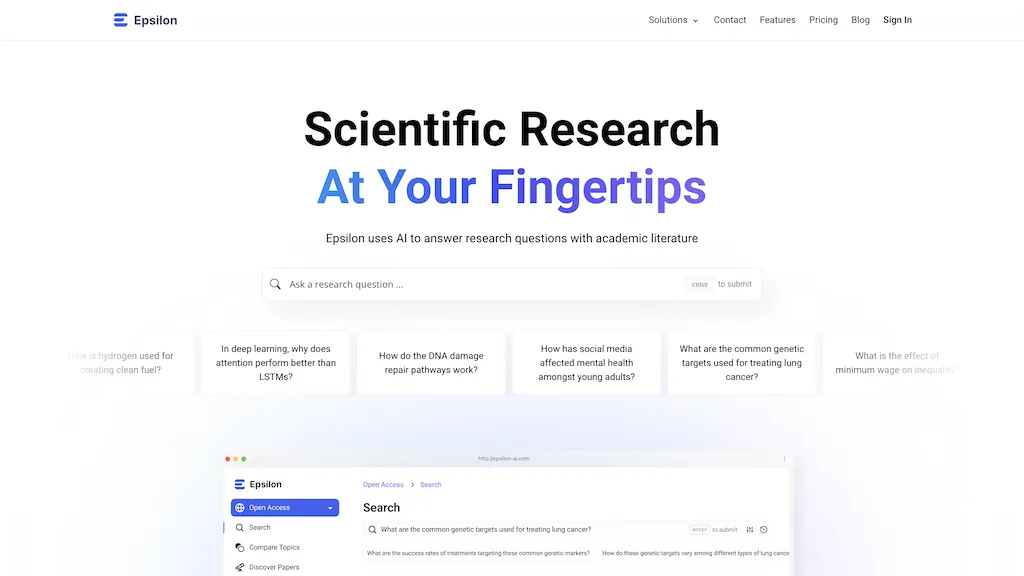
What is Epsilon?
Epsilon is an AI‑powered search engine that indexes over 200 million academic papers from sources such as PubMed, arXiv, and Semantic Scholar.
The platform retrieves the top 100 relevant documents for any query and uses GPT‑4 to generate concise summaries that include inline citations to the original literature.
Users can search for publications, patents, and key texts, then group results by relevance and recency, or directly open PDFs if publicly available.
The tool allows batch extraction of data across multiple papers, facilitating meta‑analyses, evidence verification, and literature reviews.
Researchers, students, and professionals can create private libraries, run searches across their collections, and synthesize findings across multiple sources.
Epsilon supports a range of research activities—including evidence searches, grant writing, proposal drafting, and project execution—within a single, searchable environment.
Epsilon pricing
FreemiumVerify on the official pricing page.
View plansEpsilon's key features
-
Scan millions of papers
-
Summarize passages with citations
-
Group search results by relevance
-
Save PDFs to personal library
-
Extract info from multiple documents
-
Generate literature reviews
-
Compare findings across articles
Epsilon use cases
-
Compile a comprehensive literature review for a PhD dissertation by querying Epsilon, instantly receiving citation‑rich GPT‑4 summaries of the most relevant 200 million academic papers, eliminating the need to sift through PDFs manually
-
Conduct a systematic meta‑analysis with batch PDF extraction: upload multiple full‑text articles, let Epsilon extract key variables and outcomes, then use its citation‑aware summaries to validate data consistency
-
Draft a competitive grant proposal by leveraging Epsilon’s research evidence search—pull the top 100 peer‑reviewed studies per keyword, get concise summaries and citations, and integrate them directly into proposal sections
Epsilon user reviews
Based on 1 review, 100% of users recommend Epsilon, rated highly for ease of use.
Liked for
Would you recommend Epsilon?
Who is Epsilon for?
-
Academic researchers
-
Academic scholars
-
University students
-
Content creators
-
Data analysts
Epsilon FAQ
Is Epsilon free?
Partly. Epsilon has a free plan with usage limits, and paid plans unlock the full feature set. Plans include Student at $9, Professional at $19, Student (annually) at $4.08 and Professional (annually) at $10.75.
What are the best alternatives to Epsilon?
The closest alternatives to Epsilon are Semanticscholar, Scisummary, ResearchPal, Consensus and Linnk.AI. You can compare them side by side in the alternatives section further down this page.


