Best Semanticscholar Alternatives in 2026
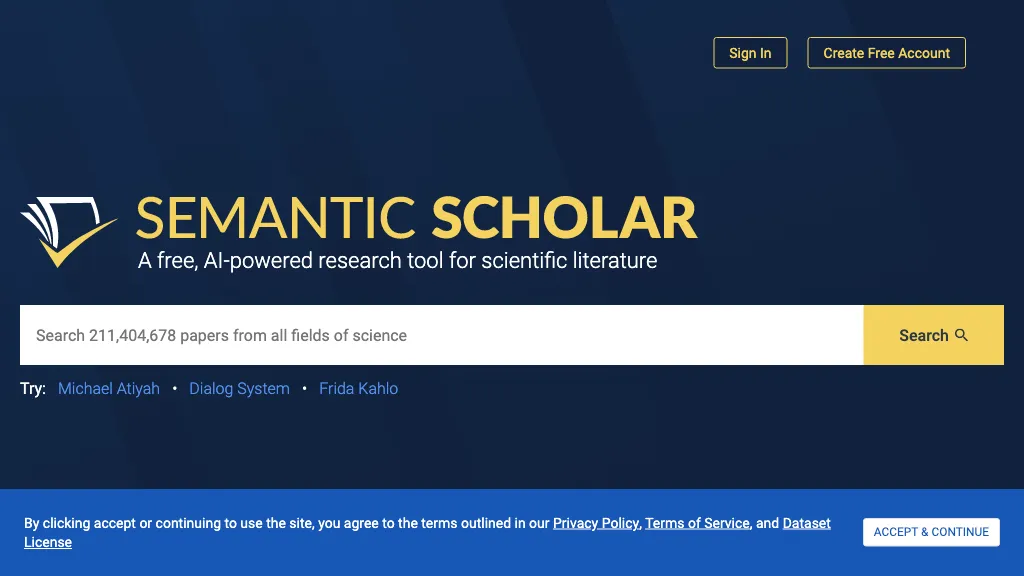
72.7% positive · 11 user reviews FreeSemantic Scholar indexes 230 million papers, offering AI‑powered semantic search that prioritizes relevance and citation impact. It provides contextual PDF annotations, a developer API, and export options for literature reviews, grant research, and teaching.
We've ranked 29 Semanticscholar alternatives, including 22 with a free plan. Rankings are based on feature coverage and user feedbacks.
Top-rated alternatives include Seaml.es, ThesisAI, and Scisummary.
29 Semanticscholar Alternatives & Competitors, Ranked by User Reviews
Click Compare on any tool to compare it side-by-side with Semanticscholar.
#1
Seaml.es
Seamless AI Literature Review Tool automates literature reviews by retrieving relevant papers from Semantic Scholar and integrating them with user context. It also offers AI‑powered scholarship search, application support, and real‑time essay enhancement for research workflow.
#2
ThesisAI
ThesisAI generates papers up to 80 pages from a single prompt, integrating inline citations and up to 500 reference files. It supports Semantic Scholar searches, multiple citation styles, 30+ languages, and exports to PDF, Word, LaTeX, BibTeX, and Overleaf.
#3
Scisummary
SciSummary extracts abstracts, methods, results, and conclusions from scientific papers, supports bulk summarization and comparative overviews, provides AI‑generated figure statistics, and indexes up to 1,000 documents for semantic search to aid researchers in managing literature.
#4
ResearchPal
ResearchPal automates literature reviews, summarizing PDFs and extracting key insights. It offers citation management, integrates with Zotero/Mendeley, writes structured academic drafts, supports paraphrasing, translation, tone adjustment, domain‑specific search, and real‑time collaborative editing.
#5
Scite_
Scite indexes 280 million peer‑reviewed articles, preprints, books, patents, and datasets, enabling full‑text search. It classifies each citation as supportive, neutral, or contradictory with confidence scores and lets users view original context and citation reports.
#6
Epsilon
Epsilon is an AI‑powered search engine indexing over 200 million academic papers, retrieving the top 100 results per query. It uses GPT‑4 to provide concise, citation‑rich summaries, supports batch data extraction, private libraries, and aids meta‑analyses and proposal drafting.
- Personalized recommendations
- Custom collections
- Save favorites
Already a member? Sign in
#7
Consensus
Consensus is an AI‑powered academic search engine indexing 250 million peer‑reviewed papers. Its Deep Search expands terms, applies filters for time, design, and population, visualizes study agreement, and offers medical‑focused evidence for rapid literature reviews.
#8
Txyz.ai
TXYZ offers AI‑powered help for reading, problem solving, and knowledge workflows, with file upload and analysis of academic papers, a searchable scholarly library, a writing agent for up to five pages, precise document citations, and private data handling.
#9
Papers
Papers manages research libraries by importing and auto‑matching bibliographic data, letting users tag, rate, and organize sources. AI offers article recommendations and chat queries, while inline annotations sync across Mac, Windows, and mobile. SmartCite supports 10,000+ styles and integrates impact metrics.
#10
Paper pilot
Paper Pilot uses AI to search 220 million papers, produce concise summaries, and provide linked citations. It lets users organize up to 50 papers on interactive boards, annotate, and receive AI‑assisted writing and real‑time research help.
#11
Sharly AI
Sharly AI extracts insights, summarizes documents, and generates verified metrics with source links and citation support. It compares data across files, detects patterns, enables collaborative Q&A, role‑based permissions, and protects data with AES‑256/TLS across PDFs, Excel, Docs, and Notion.
#12
OpenRead
OpenRead centralizes research by letting users upload documents, search 20,000+ journals, compare papers, generate Q&A, graphs, notes, and chat with AI models. It also offers diagram creation, image editing, and homework help, with frequent model updates.
#13
Paper Digest
Paper Digest is an AI-powered research platform that facilitates literature reviews, deep research, and report generation. It features an AI reader for PDF analysis, an AI writer for content drafting, and a question-answering tool for scientific literature.
#14
PDF2Anki
Memo AI is a workspace that ingests PDFs, videos, websites, and text, extracting structured content into semantic chunks with vector embeddings for hybrid keyword‑semantic retrieval. It generates flashcards, tests, summaries, mind maps, and supports active‑recall, spaced repetition, multilingual AI models.
#15
Scholarcy
Scholarcy turns PDFs, articles, book chapters, and YouTube videos into concise summaries and flashcards. Users can annotate, highlight, and export the content to citation managers, Excel, or Word, streamlining literature reviews and study workflows.
#16
AI-Writer
AI‑Writer.com generates concise, cited answers to academic questions from 100 million open‑science papers, shows source paragraphs, offers BibTeX, supports APA/MLA/Chicago, and lets users build structured reviews via drag‑and‑drop and download them as HTML.
#17
Explainpaper
Explainpaper reads research papers, offering contextual, step‑by‑step explanations in 50+ languages. Highlight text for tailored breakdowns, ask chat questions with cited sections, and extract outlines, key findings, concept maps for quick, focused literature review.
#18
Sourcely
Sourcely is an AI academic search assistant that lets users paste text to retrieve relevant sources from a 200‑million‑paper database. It highlights citation sections, summarizes findings, offers free PDFs, supports multiple citation styles, and provides filtering and conversational clarification tools.
#19
iAsk.ai
iAsk.Ai delivers instant, factual answers to natural‑language questions from authoritative web sources, and offers essay drafting, advanced grammar checks, academic summarization, PDF analysis, image generation, URL bullet‑point briefs, and one‑click grammar correction. Accessible via browser extension or mobile app.
#20
WisPaper
Wispaper is an AI-driven research tool that simplifies academic literature reviews by filtering relevant studies and offering personalized alerts. Upcoming features include project organization tools and AI-generated summaries to streamline knowledge building.
#21
OmniScholar
OmniScholar is an AI-driven research platform that simplifies academic workflows by offering a unified search engine, AI writing assistance, peer review feedback, and collaborative task management, enhancing productivity for researchers and students.
#22
Semafind
SemaReader converts web pages into clean, LLM‑friendly text for precise summaries, topic extraction, and keyword tagging. It integrates with analytics dashboards or knowledge graphs, boosting research and business intelligence with faster, noise‑reduced content analysis.
#23
Genei
Genei automatically summarizes PDFs and webpages, extracts keywords, and produces citations. It supports multi‑document summarization, search, Q&A, project organization, annotation, and a Chrome extension for on‑the‑fly summarizing—ideal for researchers and writers.
#24
ResearchRabbit
ResearchRabbit is a web‑based research assistant that lets users begin with a single paper and expand to related authors, works, and topics. It generates citation and topic evolution maps, supports notes and annotations, and syncs with reference managers like Zotero.
#25
Thesify
Thesify is an academic assistant that offers feedback on theses, dissertations, and grant proposals, evaluating strength, evidence, clarity, and rubric alignment. It provides instant citation support from 200 million references and delivers article summaries, semantic literature search, and paper digest tools.
#26
Linnk.AI
Instant Insight Page by Linnk AI simplifies webpage summaries, eliminates clickbait, and delivers direct answers for efficient content consumption. Bridge language barriers, get concise information, and bid farewell to misleading headlines.
#27
Knowee
Knowee Writer assists academic writing by generating outlines, auto‑completing sentences, refining drafts, and producing citation lists in APA, MLA, Chicago, Harvard, and IEEE. Users can upload PDFs or search Google Scholar for verified sources.
#28
Elicit
Elicit is an AI research assistant that automates research workflows by using language modeling to find relevant papers, summarize takeaways, and extract key information.
#29
Albus Beta
Albus AI indexes PDFs, images, audio, text, and web articles into a semantic map, enabling precise cross‑format search. Drop files into a folder for automatic categorization, with real‑time web search, conversation mode, canvas collaboration, and multi‑modal AI generation.
Frequently Asked Questions
Why look for Semanticscholar alternatives?
Common reasons users switch from Semanticscholar:
- User satisfaction: Semanticscholar holds a 72.7% positive rating — some users report unmet expectations.
- Feature gaps: teams needing specific capabilities like Analyze Papers may find a more focused alternative better suited to their workflow.
- Flexibility: exploring alternatives helps find tools that better match your team size, integrations, and budget.
What is the best alternative to Semanticscholar?
Seaml.es ranks as the top Semanticscholar alternative. Seamless AI Literature Review Tool automates literature reviews by retrieving relevant papers from Semantic Scholar and integrating them with user con It is available on a Paid plan.
How do the top Semanticscholar alternatives compare?
| Tool | Pricing | Starting Price | User Rating |
|---|---|---|---|
| Semanticscholar this tool | Free | — | 72.7% (11) |
| Seaml.es | Paid | — | — |
| ThesisAI | Freemium | — | 50% (2) |
| Scisummary | Freemium | $6.99/mo | 50% (6) |
| ResearchPal | Freemium | — | 100% (3) |
| Scite_ | Subscription | $16/mo | 84% (25) |
Are there free Semanticscholar alternatives?
Yes, 22 free alternatives found in our list: ThesisAI, Scisummary, ResearchPal. and 19 more — use the pricing filter above to see them all.
What should I look for in a Semanticscholar alternative?
- Core capabilities: confirm the tool supports Analyze Papers, Extract Metadatas, Organize References.
- Pricing transparency: look for clear free plan, trial period, or tiered pricing — avoid tools that hide costs.
- User reviews: check both the satisfaction percentage and the number of reviews; a high score from few users is less reliable.
- Integrations: verify it connects with your existing stack before committing.
- Support and updates: active development and responsive support are strong signals of a maintained product.
Which Semanticscholar alternative has the highest user rating?
ResearchPal has the highest satisfaction score among Semanticscholar alternatives, with 100% positive from 3 user reviews. It is available on a Freemium plan.
What are Semanticscholar alternatives used for?
- Analyze Papers
- Extract Metadatas
- Organize References