
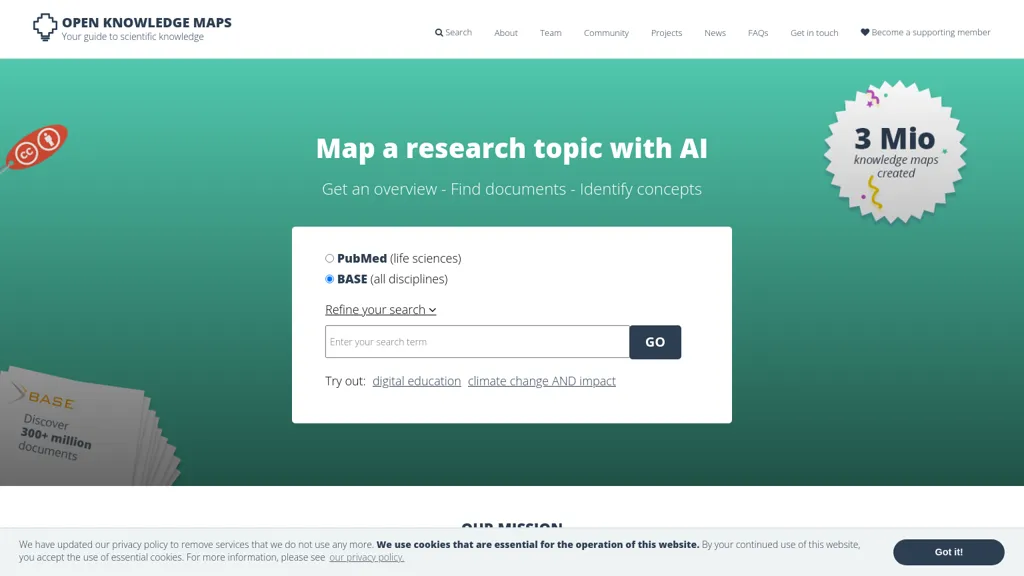
What is openknowledgemaps.org?
Open Knowledge Maps is an AI‑based search engine that visualizes scientific literature across disciplines such as life sciences, engineering, and humanities. It maps research topics by clustering related publications, enabling users to see connections between concepts and identify thematic trends.
The platform supports a wide range of document types—including journal articles, theses, conference papers, datasets, and patents—and emphasizes high metadata quality to improve map accuracy. Researchers, librarians, and educators can refine searches by time range, relevance, or document type and export results for further analysis.
The service is open‑source and hosted on GitHub, allowing organizations to embed its components into custom discovery systems. As a non‑profit organization focused on open science, it promotes equitable access to research findings and supports integration with open‑access repositories.
The interface is compatible with major web browsers and offers multilingual support for international users. Open Knowledge Maps provides a scalable, community‑driven infrastructure that enhances discoverability and collaboration within the scientific community.
openknowledgemaps.org details
- Jurisdiction
- Austria
openknowledgemaps.org tech specs
- Works with
- Anthropic / Claude
openknowledgemaps.org pricing
Freemiumopenknowledgemaps.org offers a free plan with paid upgrades available.
Verify on the official pricing page.
View plansopenknowledgemaps.org's key features
-
AI-powered literature search
-
Visual research topic mapping
-
Document clustering by themes
-
High metadata quality requirement
-
Custom integration for services
-
Open-source platform on GitHub
-
Supports multiple document types
openknowledgemaps.org use cases
-
Map interdisciplinary research landscapes for grant proposals, using clustered visualizations to highlight emerging connections across fields and streamline literature reviews
-
Embed metadata‑enhanced knowledge maps into university repositories to boost discoverability, allowing faculty and students to quickly locate related studies across disciplines
-
Create multilingual research trend dashboards for funding agencies, enabling decision makers to assess global developments and identify priority areas for investment
openknowledgemaps.org user reviews
Based on 1 review, 100% of users recommend openknowledgemaps.org, rated highly for quality results.
Liked for
Would you recommend openknowledgemaps.org?
Who is openknowledgemaps.org for?
-
Academic researchers
-
Data scientists
-
Knowledge graph engineers
-
Information visualizers
-
Research analysts
openknowledgemaps.org FAQ
Is openknowledgemaps.org free?
Partly. openknowledgemaps.org has a free plan with usage limits, and paid plans unlock the full feature set.
What are the best alternatives to openknowledgemaps.org?
The closest alternatives to openknowledgemaps.org are Consensus, ConceptMap AI, Connected Papers, MindMap AI and Topical Map AI. You can compare them side by side in the alternatives section further down this page.
What does openknowledgemaps.org do with my data?
Its privacy policy states that personal data is not sold or shared for marketing purposes. Data may be shared with third-party service providers that help run the product.
Which AI models does openknowledgemaps.org use?
openknowledgemaps.org is built on Anthropic / Claude. Which models you can reach may depend on your plan.
Compliance, privacy and billing terms are as stated in each product's own published documentation and have not been independently verified by TopAI.tools.


