
What is Connected Papers?
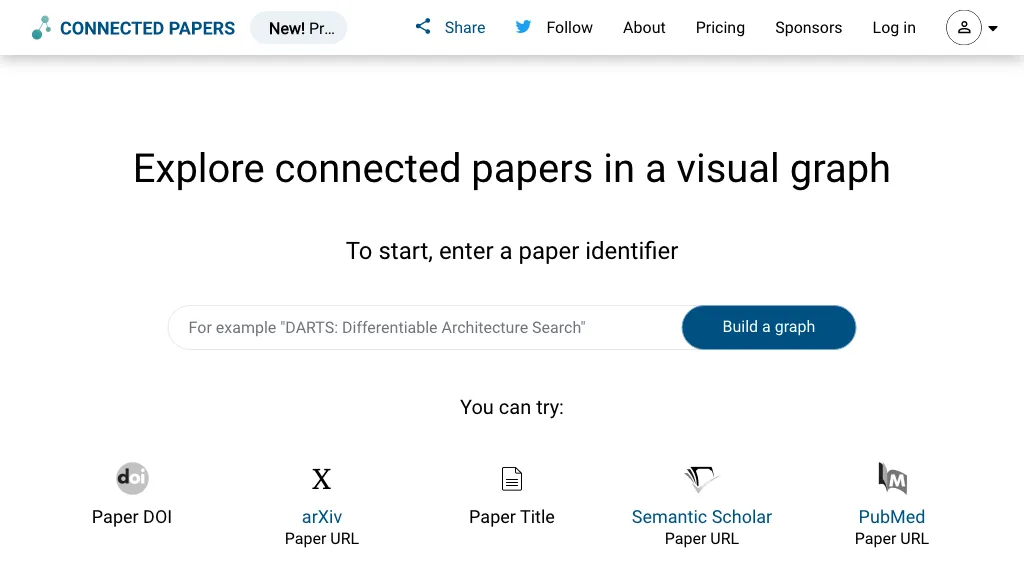
Connected Papers maps academic literature into a visual graph, allowing researchers to enter a paper and instantly view related works and citation pathways. The interface supports building multiple graphs, letting users explore trends, influential papers, and emerging research directions.
By highlighting ancestor and derivative works, the tool helps scholars construct comprehensive bibliographies and identify key literature for theses or reviews. It draws from the Semantic Scholar database, covering machine learning, biology, philosophy, and other scientific fields.
Connected Papers details
- Jurisdiction
- State of Israel
- Built for
- Individuals
Connected Papers tech specs
- Payment Processors
- PayPal
Connected Papers pricing
FreemiumConnected Papers offers a free plan with paid upgrades available.
- Auto-renewal
- Yes
Verify on the official pricing page.
View plansConnected Papers's key features
-
Visual graph of papers
-
Build paper similarity graph
-
Discover related recent papers
-
Identify prior works
-
Identify derivative works
-
Generate bibliography gaps
-
Semantic Scholar database coverage
Connected Papers use cases
-
Build a comprehensive, up-to-date bibliography for a grant proposal by entering a seminal paper, then instantly following citation pathways and related works to capture key studies, recent breakthroughs, and relevant gaps
-
Spot research gaps and emerging trends by exploring the literature discovery graph: start with a core article, trace citation networks to uncover under‑studied sub‑fields, and identify promising directions for a thesis or startup idea
-
Create an engaging conference poster that visualizes the evolution of a research topic: use Connected Papers’ citation pathway explorer to illustrate how key findings and theories interconnect across time, highlighting pivotal works and recent contributions
Connected Papers user reviews
Based on 24 reviews, 75% of users recommend Connected Papers, rated highly for value for money.
Liked for
Disliked for
Would you recommend Connected Papers?
Who is Connected Papers for?
-
Academic researchers
-
Research writers
-
Data analysts
-
Knowledge managers
-
Subject matter scholars
Connected Papers FAQ
Is Connected Papers free?
Partly. Connected Papers has a free plan with usage limits, and paid plans unlock the full feature set.
Is Connected Papers safe to use?
Connected Papers carries the TopAI.tools verified mark, which we award after a manual review of pricing transparency, published terms, public following and working functionality. It has a substantial audience that is independently measured month to month.
Is Connected Papers good?
Connected Papers has a 75% recommendation rate from 24 reviewers on TopAI.tools. Reviewers rate it highest on value for money and quality of results.
What are the best alternatives to Connected Papers?
The closest alternatives to Connected Papers are Semanticscholar, Qonqur, Papers, Scisummary and Explainpaper. You can compare them side by side in the alternatives section further down this page.
What does Connected Papers do with my data?
Connected Papers states that customer content is not used to train its models. Its privacy policy states that personal data is not sold or shared for marketing purposes. Data may be shared with third-party service providers that help run the product.
Does Connected Papers auto-renew or offer refunds?
Connected Papers subscriptions renew automatically until you cancel.
Compliance, privacy and billing terms are as stated in each product's own published documentation and have not been independently verified by TopAI.tools.


