
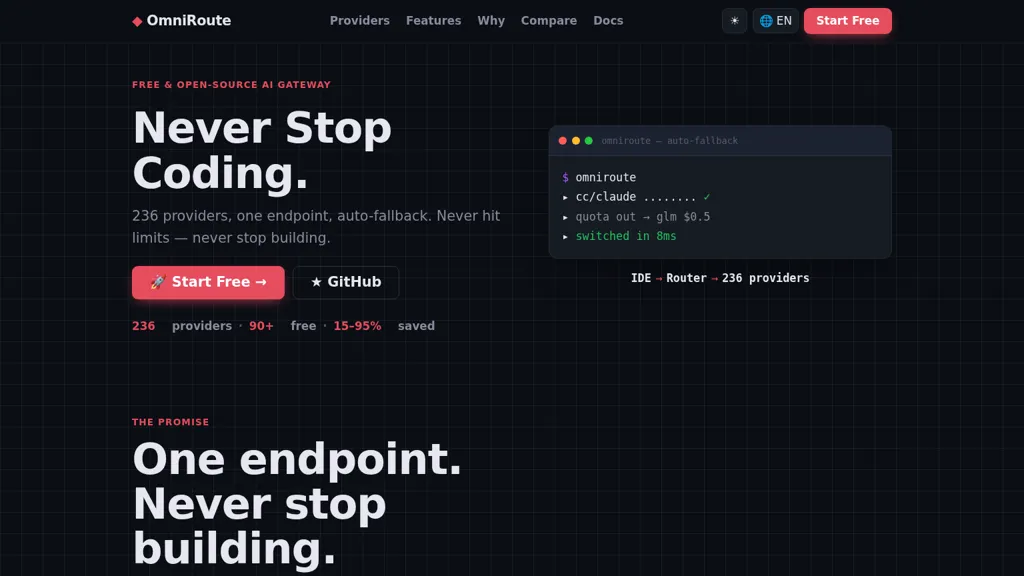
What is OmniRoute?
OmniRoute is an open-source AI gateway that routes requests to 236 LLM providers through a single /v1 endpoint, compatible with OpenAI, Claude, Gemini and local models.It implements auto-fallback and 17 routing strategies with tiered fallback and 9-factor scoring to maintain availability and reduce downtime.
Built-in RTK+Caveman stacked compression reduces tokens by 15–95% and includes persistent memory (FTS5 + Qdrant), circuit breakers, connection cooldowns and model lockouts for layered resilience.The gateway exposes MCP and A2A protocols, a 95-tool MCP server and cloud agent integrations for agent-native workflows and coding assistants.
Self-hostable with a local dashboard, per-provider proxying and TLS fingerprint stealth, OmniRoute stores encrypted local credentials and supports regional access.Provider catalog and free-tier tracking cover 90+ free providers with pool-deduped quota accounting to maximize available free tokens.
OmniRoute pricing
FreemiumOmniRoute offers a free plan with paid upgrades available.
Verify on the official pricing page.
View plansOmniRoute's key features
-
Single-endpoint multi-provider AI gateway with auto-fallback across 236 providers (/v1 compatibility)
-
RTK + Caveman stacked token-compression pipeline (composable engines)
-
17 routing strategies with tiered fallback and 9-factor auto-scoring for cost/quota-aware routing
-
Three-layer resilience model: provider circuit breaker, connection cooldown, and model lockout
-
Built-in MCP server and A2A JSON-RPC agent protocol exposing the gateway as 95 tools across 30 scopes (cloud agents supported)
OmniRoute use cases
-
Create a resilient, cost-optimized AI inference layer by routing requests to 236 LLM providers through a single /v1 endpoint, using tiered fallback routing and provider quota tracking to ensure uptime and control spend while leveraging stacked token compression to reduce token costs
-
Build a privacy-first, self-hosted AI gateway for customer-facing chatbots and virtual assistants that uses persistent LLM memory for personalized conversations, agent-native integrations for complex workflows, and self-hosted analytics to keep data on-premises
-
Implement fault-tolerant multi-LLM automation pipelines for internal agents and RPA workflows, leveraging auto-fallback, resilience controls and MCP/A2A support for reliability, persistent memory for context continuity, and stacked token compression plus quota monitoring to optimize latency and API usage
OmniRoute user reviews
Based on 1 review, 100% of users recommend OmniRoute, rated highly for quality results.
Liked for
Would you recommend OmniRoute?
Who is OmniRoute for?
-
Developers
-
Devops engineers
-
System architects
-
Tech leads
-
Machine learning engineers
OmniRoute FAQ
Is OmniRoute free?
Partly. OmniRoute has a free plan with usage limits, and paid plans unlock the full feature set.
What are the best alternatives to OmniRoute?
The closest alternatives to OmniRoute are FreeLLMAPI, LLMAPI.ai, Otari AI, Openrouter.ai and portkey.ai. You can compare them side by side in the alternatives section further down this page.
Does OmniRoute have an API?
Yes. OmniRoute offers an API, so you can call it from your own applications instead of using the interface directly.


