
What is LiveKit?
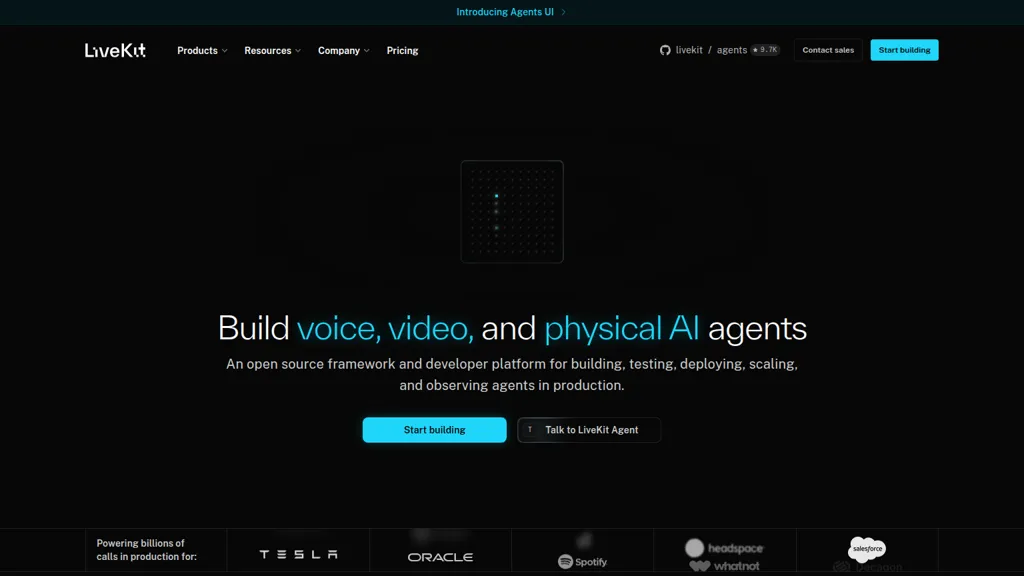
LiveKit, an open-source framework and cloud platform for building and hosting real-time voice, video, and physical AI agents. Provides a media server, WebRTC support, and SDKs for browser, mobile, and server environments, plus a cloud dashboard for session management and monitoring.
Supports low-latency streaming, multi-party calls, TTS and speech-to-text integrations, and telephony connectors for unified web and phone workflows. Enables granular agent code control and integration with external model providers and speech APIs for conversational AI, contact center automation, and robotics use cases.
Offers scalable hosting and deployment tools, metrics and connection tests, and programmatic APIs for production rollouts. Includes open-source components, managed cloud options, developer documentation, and community support to accelerate prototyping and production implementations.
LiveKit details
- Jurisdiction
- California, United States
- Built for
- Businesses and teams
- Stated compliance
- SOC 2, GDPR, HIPAA
Compliance as stated in LiveKit's own published documentation.
LiveKit tech specs
- Works with
- OpenAI / GPT OpenAI / Whisper Anthropic / Claude Google / Gemini DeepSeek xAI / Grok ElevenLabs Kimi
- Integrations
- Twilio
LiveKit pricing
SubscriptionPricing details aren't listed here — check the official pricing page below.
- Auto-renewal
- Yes
Verify on the official pricing page.
View plansLiveKit's key features
-
Open-source framework and cloud platform for real-time voice, video, and physical AI agents
-
Media server with WebRTC support for low-latency voice and video streaming
-
SDKs (including Python) for TTS, speech detection, and agent development
-
Telephony integration and unified export interface for web and phone calls
-
Cloud dashboard and hosting for deploying, managing, and scaling agents
LiveKit use cases
-
Build a low-latency live video conferencing and collaboration app using LiveKit's open-source WebRTC SDKs and media server, adding screen sharing, recording, scalable hosting and programmatic APIs for custom workflows and integrations
-
Deploy a conversational voice contact center that uses LiveKit's telephony connectors, STT and TTS to power AI-driven agents for inbound/outbound calls, real-time monitoring and seamless handoff to human operators while scaling on-demand
-
Create remote robotic teleoperation and voice-enabled physical AI agents by streaming high-frame-rate video with LiveKit, using STT for voice commands, TTS for agent responses, and the platform's low-latency hosting and APIs to coordinate sensors and actuators
LiveKit user reviews
Would you recommend LiveKit?
Who is LiveKit for?
-
Real-time communication developers
-
Voice video chat creators
-
Physical agent developers
-
Webrtc infrastructure operators
-
Voice technology integrators
LiveKit FAQ
Is LiveKit free?
No. LiveKit is a paid product and requires a paid plan to use.
Is LiveKit safe to use?
LiveKit states SOC 2, GDPR and HIPAA compliance in its own published documentation. It has a substantial audience that is independently measured month to month.
What are the best alternatives to LiveKit?
The closest alternatives to LiveKit are Video SDK, Voice.ai, Deepgram Voice AI, 008 and Voiceflow. You can compare them side by side in the alternatives section further down this page.
What does LiveKit do with my data?
LiveKit states that customer content is not used to train its models. Its privacy policy states that personal data is not sold or shared for marketing purposes. Data may be shared with third-party service providers that help run the product.
Does LiveKit auto-renew or offer refunds?
LiveKit subscriptions renew automatically until you cancel.
Which AI models does LiveKit use?
LiveKit is built on OpenAI / GPT, OpenAI / Whisper, Anthropic / Claude, Google / Gemini, DeepSeek, xAI / Grok, ElevenLabs and Kimi. Which models you can reach may depend on your plan.
What does LiveKit integrate with?
LiveKit connects with Twilio.
Compliance, privacy and billing terms are as stated in each product's own published documentation and have not been independently verified by TopAI.tools.


