
Top 29 WhatTheDiff Alternatives in 2026
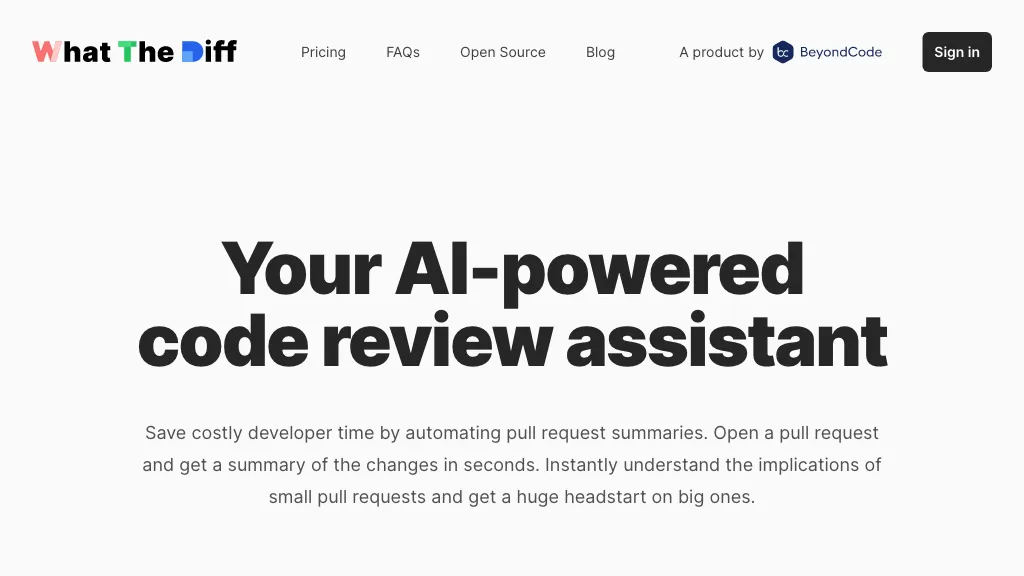
No user reviews yet FreemiumAI‑powered assistant that auto‑generates pull request descriptions, summarizes changes, and creates changelogs for GitHub and GitLab. It sends notifications, supports inline refactoring, offers granular settings, provides a public changelog, and exposes a JSON API—without storing code.
We've ranked 29 WhatTheDiff alternatives, including 20 with a free plan. Rankings are based on feature coverage and user feedbacks.
Top-rated alternatives include Gitmore, GitLoop, and Coderabbit.
29 WhatTheDiff Alternatives & Competitors, Ranked by User Reviews
Click Compare on any tool to compare it side-by-side with WhatTheDiff.
 #1
Gitmore
#1
Gitmore
Gitmore connects GitHub, GitLab, or Bitbucket via OAuth/webhooks to monitor commits, PRs, merges and issues, providing AI-generated daily/weekly email or Slack reports, blocker detection, a real-time PR dashboard, and context-aware repository chat — metadata-only.
 #2
GitLoop
#2
GitLoop
GitLoop is an AI codebase assistant for GitHub and GitLab that automatically indexes repositories, offers natural‑language search, generates documentation and unit tests, reviews pull requests, provides chatbot onboarding, and surfaces complexity hotspots to improve code quality and speed reviews.
 #3
Coderabbit
#3
Coderabbit
CodeRabbit automates pull‑request reviews with AI, detecting bugs instantly and suggesting fixes. It integrates with Git, IDEs, and CLI, delivers diff summaries, diagrams, and a chat interface, all while preserving privacy with encryption and zero‑data retention.
 #4
CodeReviewBot.AI
#4
CodeReviewBot.AI
AI Code Review Bot automatically scans GitHub pull requests for bugs, security flaws, and performance issues across multiple languages. It adds detailed, actionable comments directly to PR threads, enabling consistent, rapid code quality checks without manual effort.
 #5
Chatprd
#5
Chatprd
ChatPRD automates creation of requirement documents, user stories, and technical specs from simple prompts, analyzing research, code, and issues to spot gaps. It offers real‑time coaching, collaborative dashboards, and secure export to Linear, Notion, Confluence, Google Docs, Slack, and GitHub.
 #6
Refact AI
#6
Refact AI
Refact.ai is an autonomous AI agent for IDEs (VS Code, JetBrains, Neovim) that analyzes entire projects, generates code, completes, debugs, and runs end‑to‑end tasks. It supports multiple LLMs, on‑prem or cloud hosting, and builds a knowledge base from interactions.
- Catch deals before they expire
- Unlock tools matched to you
- Show off your AI stacks
Already a member? Sign in
 #7
Aider.chat
#7
Aider.chat
Aider is an AI-powered pair programming tool that helps developers collaborate with LLMs for editing, refactoring, and debugging code within Git repositories. It supports multiple languages and integrates with IDEs and editors for real-time updates.
 #8
Giteai
#8
Giteai
GiteAI automatically generates commit messages by analyzing code changes, supports customizable templates such as Conventional Commits, provides searchable logs, project metrics, and security alerts for vulnerabilities, freeing developers from manual documentation.
 #9
Releasesnotes
#9
Releasesnotes
ReleasesNotes automatically converts GitHub and GitLab commits into structured release notes. Users filter by date, author, or keyword; the AI compiles new features, bug fixes, and enhancements into a unified document, cutting manual writing and speeding release cycles.
 #10
Innerai.com
#10
Innerai.com
All‑in‑one platform integrating GPT‑4o, Claude, Gemini, and others for unified text, image, video, and document AI. Offers summarizing, translation, prompt templates, workflow tools, quiz creation, SCORM export, web search, subtitles, dubbing. SOC II‑compliant with field‑level encryption and data isolation.
 #11
Genspark.ai
#11
Genspark.ai
Genspark unifies inbox, workflows, and collaboration into one AI workspace, offering a 1‑million‑token context window, voice‑to‑text, auto‑meeting notes, and Chrome extensions for instant summarization and task automation across WhatsApp, Slack, and Teams.
 #12
Programming Helper
#12
Programming Helper
AI Studio converts natural‑language prompts into working code across C++, Python, JavaScript, SQL, CSS, HTML, and regex. It translates snippets, adds typing hints, estimates complexity, offers git/command lookup, and provides plain‑English explanations, supporting collaboration and quick prototyping.
 #13
Ask AI
#13
Ask AI
Chat & Ask AI combines web search, image generation, link analysis, document chat, and YouTube summarization in one interface. It offers up‑to‑date answers, multilingual support, file uploads, and a prompt library, powered by GPT‑5.2, Gemini, Claude, and Stable Diffusion XL.
 #14
Git Digest
#14
Git Digest
Git Digest automates code change summaries, delivering daily or weekly updates to enhance team collaboration. It offers visual analytics for tracking trends, supports multi-user accounts, and features an AI chatbot for efficient customer support.
 #15
Ellipsis
#15
Ellipsis
Ellipsis.dev automatically reviews every GitHub commit and pull request, detecting bugs, anti‑patterns, and style issues. It generates summaries, async fixes, and test‑ready changes, and offers weekly change logs in a SOC 2‑compliant VPC environment.
 #16
Kodus
#16
Kodus
Open‑source AI code‑review platform that plugs into GitHub, GitLab, Bitbucket, and Azure DevOps at the pull‑request level. Model‑agnostic, it runs custom rule sets, tracks technical debt, and delivers real‑time metrics without storing source code.
 #17
Claude Code
#17
Claude Code
Claude Code is an AI-powered coding assistant that operates within the terminal, automating tasks like editing files, fixing bugs, executing tests, and managing git workflows. It enhances developer productivity through natural language commands and real-time support.
 #18
AI Perfect Assistant
#18
AI Perfect Assistant
AI Perfect Assistant adds ChatGPT, Gemini, Claude, and 60+ LLMs to Office 365 apps, delivering real‑time grammar, style checks, drafting, summarization, translation, and formula generation to streamline writing, analysis, and teamwork across Word, Excel, PowerPoint, Outlook, Teams, and OneNote.
 #19
Codeant.ai
#19
Codeant.ai
CodeAnt AI automates pull‑request review, static analysis, and governance, reducing review cycles by up to 80%. It scans codebases for SAST, SCA, secrets, IaC, and SBOM compliance, enforces test coverage and linting, delivering velocity and defect metrics IDEs, Git, CI/CD.
 #20
Voilà
#20
Voilà
Voilà AI Assistant is a cross‑platform browser extension, desktop, and mobile app that uses GPT‑5 to summarize, rewrite, translate, and auto‑reply to emails, chats, PDFs, spreadsheets, and YouTube transcripts, while correcting spelling, grammar, tone and generating images from text.
 #21
AI-Flow
#21
AI-Flow
AI-Flow is a no‑code platform enabling creators to build and run AI workflows via drag‑and‑drop, integrating models from OpenAI, StabilityAI, Anthropic, and Replicate for batch image, video, and content summarization.
 #22
Kamara
#22
Kamara
Kamara AI integrates into GitHub, delivering contextual code analysis, automated reviews, bug detection, performance and security checks, and auto‑generates pull requests, tests, and documentation updates that match project style while preserving institutional knowledge.
 #23
CodeMate
#23
CodeMate
CodeMate AI is a VS Code plugin that translates natural‑language prompts into code, providing pull‑request reviews, bug and security analysis, refactoring, debugging, optimization, and documentation generation. It supports GitHub, Bitbucket, GitLab, Azure DevOps, and runs locally for secure, scalable operation.
 #24
Documentation.AI
#24
Documentation.AI
Documentation.AI is an AI-powered platform for creating and maintaining technical documentation, featuring an integrated AI agent that drafts updates and identifies stale content. It provides in-doc AI search, interactive API tools, and structured content optimized for LLMs and search engines.
 #25
AI Power
#25
AI Power
Unifies multiple AI APIs into a single interface, offers chatbots, AI forms, image generation, voice input, PDF chat, web search, memory, and automates content creation for bloggers and social media scheduling.
 #26
pre.dev
#26
pre.dev
pre.dev automates end‑to‑end software development. It accepts ideas or repositories, generates architecture, writes and verifies code, then pushes to a feature branch. Integrations with GitHub, Slack, Jira via OAuth run agents in secure, multi‑stack sandboxes.
 #27
Git Assistant
#27
Git Assistant
Git Assistant merges GitHub and ChatGPT so developers can generate, refine, and test code directly in the repository, auto‑creating pull requests, offering real‑time feedback, and maintaining an audit trail to streamline collaboration and reduce context switching.
 #28
gptcli
#28
gptcli
GPT CLI brings ChatGPT to the terminal, auto‑generating Git commit messages from diffs and translating natural‑language requests into shell commands. Plugins for translation, weather, Notion, etc. can be added via npm, fitting into dev and admin workflows.
 #29
DocuWriter.ai
#29
DocuWriter.ai
DocuWriter.ai automatically generates technical documentation from source code, delivering Swagger‑compatible API docs, Postman collections, and UML diagrams. It produces test suites, adds code comments, refactors code, converts languages, and syncs updates via n8n in searchable knowledge spaces.
Frequently Asked Questions
Why look for WhatTheDiff alternatives?
Common reasons users switch from WhatTheDiff:
- Feature gaps: teams needing specific capabilities like Generate Descriptions may find a more focused alternative better suited to their workflow.
- Flexibility: exploring alternatives helps find tools that better match your team size, integrations, and budget.
What is the best alternative to WhatTheDiff?
Based on 1 user review, Gitmore (100% positive) ranks as the top WhatTheDiff alternative. Gitmore connects GitHub, GitLab, or Bitbucket via OAuth/webhooks to monitor commits, PRs, merges and issues, providing AI-generated daily/weekly email It is available on a Free trial plan.
How do the top WhatTheDiff alternatives compare?
| Tool | Pricing | Starting Price | User Rating |
|---|---|---|---|
| WhatTheDiff this tool | Freemium | $19/mo | — |
| Gitmore | Free trial | — | 100% (1) |
| GitLoop | Subscription | — | — |
| Coderabbit | Free trial | — | 70% (20) |
| CodeReviewBot.AI | Freemium | $15/mo | — |
| Chatprd | Freemium | $5 | — |
Are there free WhatTheDiff alternatives?
Yes, 20 free alternatives found in our list: Gitmore, Coderabbit, CodeReviewBot.AI. and 17 more — use the pricing filter above to see them all.
What should I look for in a WhatTheDiff alternative?
- Core capabilities: confirm the tool supports Generate Descriptions, Summarize Notifications, Generate Changelogs.
- Pricing transparency: look for clear free plan, trial period, or tiered pricing — avoid tools that hide costs.
- User reviews: check both the satisfaction percentage and the number of reviews; a high score from few users is less reliable.
- Integrations: verify it connects with your existing stack before committing.
- Support and updates: active development and responsive support are strong signals of a maintained product.
Which WhatTheDiff alternative has the highest user rating?
Gitmore has the highest satisfaction score among WhatTheDiff alternatives, with 100% positive from 1 user review. It is available on a Free trial plan.
What are WhatTheDiff alternatives used for?
- Generate Descriptions
- Summarize Notifications
- Generate Changelogs
- translate texts
- Send Notifications