
What is Coderabbit?
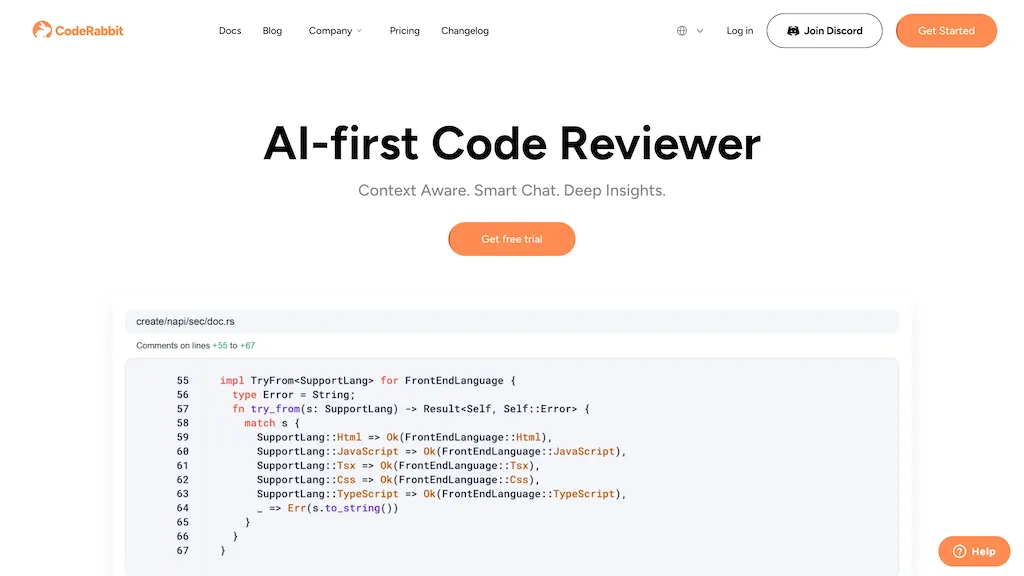
CodeRabbit automates pull‑request reviews with AI, providing instant bug detection and suggested fixes that can be applied with a single click.
It integrates directly into Git, IDEs, and the command line, offering context‑aware analysis across entire codebases and external resources such as Jira and web queries.
The tool supplies concise diff summaries, architectural diagrams, and a chat interface for developers to give feedback and generate issues or documentation.
Custom workflow rules and coding guidelines are defined in a YAML file, enabling teams to tailor reviews to their standards.
Automated reports, pre‑merge checks, unit test generation, and docstring creation streamline the release pipeline.
Security is enforced through end‑to‑end encryption, zero‑data‑retention policy, and SOC 2 Type II certification, ensuring code privacy during analysis.
Coderabbit details
- Company
- CodeRabbit, Inc.
- Built for
- Businesses and teams
- Data residency
- United States
- Stated compliance
- SOC 2, GDPR, HIPAA
Compliance as stated in Coderabbit's own published documentation.
Coderabbit tech specs
- Works with
- Anthropic / Claude
- Cloud
- AWS Google Cloud
- Integrations
- Slack Jira GitHub GitLab
Coderabbit pricing
Free trial- Free trial
- 14 days
Verify on the official pricing page.
Start free trialCoderabbit's key features
-
One-click AI fixes and commits
-
TLDR summaries with diagrams
-
Noise-filtered bug detection
-
Customizable workflow in YAML
-
40+ linters and security scanners
-
Pre-merge natural‑language checks
-
End-to-end encrypted data protection
Coderabbit use cases
-
Automate nightly pull‑request reviews for a large microservices repo, instantly highlighting regressions, generating unit tests, and summarizing diffs in a single click—no manual code inspection required.
-
Integrate CodeRabbit into your IDE workflow to provide real‑time, context‑aware code feedback on every commit, with encrypted diff diagrams and a chat‑style discussion for quick remediation.
-
Use CodeRabbit to audit your CI/CD yaml pipelines, detect security misconfigurations, and suggest corrections—while keeping all analysis data on local machines with zero‑data retention.
Coderabbit user reviews
Based on 21 reviews, 71% of users recommend Coderabbit, rated highly for ease of use.
Liked for
Disliked for
Would you recommend Coderabbit?
Main competitors of Coderabbit
Here are some of the major competitors comparisons vs. Coderabbit.

Who is Coderabbit for?
-
Software developers
-
Code reviewers
-
Technical architects
-
System administrators
-
Product managers
Coderabbit FAQ
Is Coderabbit free?
Not permanently. Coderabbit gives you a free trial of 14 days, after which a paid plan is required. Plans include Pro at $12/mobilled annually or $15/mo per contributing developer.
Is Coderabbit safe to use?
Coderabbit states SOC 2, GDPR and HIPAA compliance in its own published documentation. Coderabbit is operated by CodeRabbit, Inc.. Coderabbit carries the TopAI.tools verified mark, which we award after a manual review of pricing transparency, published terms, public following and working functionality.
Is Coderabbit good?
Coderabbit has a 71% recommendation rate from 21 reviewers on TopAI.tools. Reviewers rate it highest on ease of use and value for money.
What are the best alternatives to Coderabbit?
The closest alternatives to Coderabbit are CodeReviewBot.AI, Bito.ai, Kodus, Korbit and Ellipsis. You can compare them side by side in the alternatives section further down this page.
What does Coderabbit do with my data?
Its privacy policy states that personal data is not sold or shared for marketing purposes. Data may be shared with third-party service providers that help run the product. Customer data is held in United States.
Who made Coderabbit?
Coderabbit is built and operated by CodeRabbit, Inc..
Which AI models does Coderabbit use?
Coderabbit is built on Anthropic / Claude. Which models you can reach may depend on your plan.
What does Coderabbit integrate with?
Coderabbit connects with Slack, Jira, GitHub and GitLab.
Compliance, privacy and billing terms are as stated in each product's own published documentation and have not been independently verified by TopAI.tools.


