
Top 23 Ocular AI Alternatives in 2026
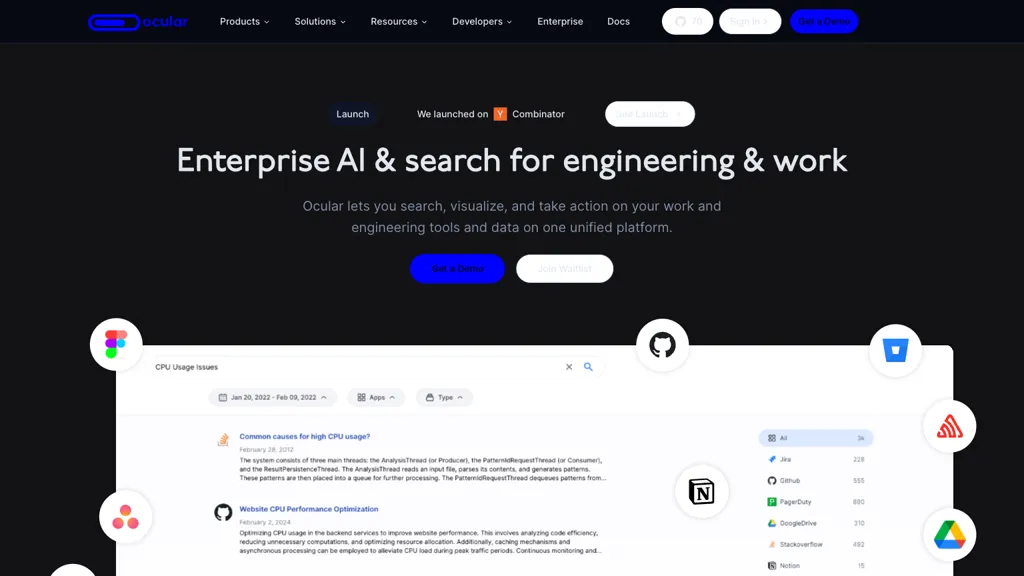
No user reviews yet FreemiumOcular AI unifies multimodal data from cloud, local, and external sources into a single catalog for search, versioning, and AI‑assisted labeling with human‑in‑the‑loop. It supports RLHF, GPU training pipelines, RESTful search API, and role‑based compliance controls.
We've ranked 23 Ocular AI alternatives, including 17 with a free plan. Rankings are based on feature coverage and user feedbacks.
Top-rated alternatives include Atlas Cloud, voxel51.com, and Appen.
23 Ocular AI Alternatives & Competitors, Ranked by User Reviews
Click Compare on any tool to compare it side-by-side with Ocular AI.
 #1
Atlas Cloud
#1
Atlas Cloud
Atlas Cloud AI is a full-modal AI platform offering unified API access for generating text-to-image, text-to-video, image-to-video, and audio content through a single integration. It provides developers with a model catalog, reference-based editing, and production-ready outputs including 4K resolution, synchronized audio, and strong character consistency for enterprise workflows.
 #2
voxel51.com
#2
voxel51.com
FiftyOne is a visual AI platform that centralizes data curation, annotation, and model evaluation across images, video, point clouds, and metadata. It offers interactive slicing, automatic labeling with confidence scoring, role‑based access, versioning, and open‑source integration.
 #3
Appen
#3
Appen
Appen delivers human‑validated datasets across six domains—alignment, agentic AI, speech/audio, multimodal, physical, and model integrity—using automation and a global workforce of 1 million+ contributors. SOC 2/ISO 27001 certified, it supports large‑scale AI training and independent evaluation.
 #4
AIML API
#4
AIML API
AIMLAPI.com offers a unified API endpoint for over 400 AI models spanning chat, image, video, audio, voice, text, 3D, and OCR. It supports sandbox testing, granular access control, batch requests, and an OpenClaw runtime for secure, human‑in‑the‑loop workflows.
 #5
BasicAI Cloud
#5
BasicAI Cloud
BasicAI is an end‑to‑end data annotation platform for image, video, audio, LiDAR, and text, offering AI‑powered labeling, collaborative workflows, real‑time QA, and private deployment, used by ML engineers in autonomous driving, robotics, and logistics.
 #6
Scale
#6
Scale
Scale AI delivers a full‑stack generative‑AI platform that integrates enterprise data, supports fine‑tuning, RLHF, and model safety evaluation, and enables secure AI agent deployment with compliance‑certified cloud infrastructure for regulated and government use.
- Catch deals before they expire
- Unlock tools matched to you
- Show off your AI stacks
Already a member? Sign in
 #7
Tredence.com
#7
Tredence.com
AI and data analytics platform delivering end‑to‑end solutions across multiple sectors. It accelerates experimentation to production, supports data engineering, MLOps, LLMOps, and digital engineering, integrating Databricks, Snowflake, and Google Cloud to shorten insight‑to‑action time and boost efficiency.
 #8
AIChat.fm
#8
AIChat.fm
Multimodal AI workspace integrating ChatGPT, Claude, Gemini, Grok and Husky to create and edit text, images, audio, and video, compare multiple models, build custom agents with memory, index web/Telegram for enhanced search, and support team workflows.
 #9
Luma AI
#9
Luma AI
Luma AI unifies image, video, audio, and text workflows. Using the UNI‑1 and Ray3.14 models, it generates high‑resolution, motion‑accurate video from prompts or visual input, streamlining concept drafting, asset creation, and refinement in one interface.
 #10
Iris.ai
#10
Iris.ai
Iris.ai unifies enterprise data into secure AI agents, enabling retrieval‑augmented generation workflows. It ingests millions of documents, supplies evaluated answers, and offers real‑time dashboards for governance, cost‑efficient LLM deployment across regulated industries.
 #11
People for AI
#11
People for AI
People for AI offers dedicated in‑house labeling teams for diverse machine‑learning datasets, ensuring consistent quality, data security, and GDPR‑aligned handling. They support all annotation tools, from small proofs of concept to large production volumes, with continuous monitoring and re‑annotation.
 #12
HumanLayer
#12
HumanLayer
HumanLayer is an open-source IDE and orchestration layer for AI coding agents, managing parallel Claude Code sessions, multiclaude workflows, worktrees and remote workers, with context-engineering tools, session replay, workflow templates and GitHub-integrated code-review automation.
 #13
Isahit
#13
Isahit
isahit provides human-centered data labeling and processing for computer vision, NLP, and speech, offering collaborative workspaces, secure API, customizable annotator training, quality control, and AI-assisted workflows (active learning, RLHF, RAG) to prepare data for model training.
 #14
deepsense.ai
#14
deepsense.ai
DeepSense.ai provides end‑to‑end AI solutions for enterprises, integrating large language models, retrieval‑augmented generation, MLOps, advanced computer‑vision, edge inference, and predictive analytics to deliver scalable, real‑time AI agents, co‑pilots, and maintenance optimization.
 #15
Sup AI
#15
Sup AI
Sup AI is a multi-model orchestration platform that intelligently routes queries to the best frontier models for task-specific results. It ensures verifiable accuracy by scoring outputs in real-time, automatically retrying low-confidence responses and linking claims to citable sources.
 #16
EmpirioLabs AI
#16
EmpirioLabs AI
EmpirioLabs AI is a platform for hosting, deploying, and scaling open-source and proprietary AI models via API or web playground. It supports multimodal, long-context models with optimized endpoints, creative templates, and high-throughput rate limits for production workloads.
 #17
Plurai AI
#17
Plurai AI
Simulation-driven platform that evaluates and monitors AI agents across modalities with realistic multi-turn scenarios, CI/CD-integrated automated tests, configurable safety/policy guardrails, and analytics for failures, hallucinations, and performance to ensure production readiness.
 #18
Alle-AI
#18
Alle-AI
Alle‑AI aggregates and compares outputs from multiple generative AI models, delivering unified results while reducing bias and hallucinations through consistency checks and fact‑checking. It supports text, image, audio, video generation, offers an API, workbench, and an educational licensing program.
 #19
AI Tutor
#19
AI Tutor
AI Tutor consolidates 200+ models into a single interface, enabling instant switching across text, image, audio, and video. It offers coding support, document analysis, app building, research tools, chatbot creation, and Beam for side‑by‑side model comparison.
 #20
UBIAI
#20
UBIAI
UBIAI fine‑tunes LLMs with classifiers, retrievers, and reasoning. It automates PDF/DOCX labeling, synthetic data, and quality filtering; offers 15‑minute prompt‑level tuning or 2‑4 hour weight training; exports to GGUF, safetensors, or Hugging Face for API or custom deployment.
 #21
Modelfusion
#21
Modelfusion
ModelFusion integrates multiple generative AI tools, allowing users to interact with various AI models for document analysis and image generation. Its multichat functionality enhances productivity and creativity, making it ideal for businesses and researchers.
 #22
Grably
#22
Grably
Grably provides multimodal datasets—language, vision, audio, code, and scientific—totaling over 100 PB across 500 M participants. It supports multilingual, low‑resource modeling, video reasoning, speech alignment, code generation, and scientific text for research and production use.
 #23
LightLayer
#23
LightLayer
LightLayer provides scalable, richly annotated egocentric datasets—synchronized RGB, audio, IMU, and depth—via distributed capture coordination, automated collection workflows, and streamlined annotation pipelines to produce delivery-ready data for embodied AI and robotic perception training.
Frequently Asked Questions
Why look for Ocular AI alternatives?
Common reasons users switch from Ocular AI:
- Feature gaps: teams needing specific capabilities like Analyze Data may find a more focused alternative better suited to their workflow.
- Flexibility: exploring alternatives helps find tools that better match your team size, integrations, and budget.
What is the best alternative to Ocular AI?
Based on 2 user reviews, Atlas Cloud (100% positive) ranks as the top Ocular AI alternative. Atlas Cloud AI is a full-modal AI platform offering unified API access for generating text-to-image, text-to-video, image-to-video, and audio content It is available on a Freemium plan.
How do the top Ocular AI alternatives compare?
| Tool | Pricing | Starting Price | User Rating |
|---|---|---|---|
| Ocular AI this tool | Freemium | — | — |
| Atlas Cloud | Freemium | — | 100% (2) |
| voxel51.com | Free | — | — |
| Appen | Freemium | — | 69.2% (26) |
| AIML API | Freemium | — | 28.6% (7) |
| BasicAI Cloud | Paid | — | — |
Are there free Ocular AI alternatives?
Yes, 17 free alternatives found in our list: Atlas Cloud, voxel51.com, Appen. and 14 more — use the pricing filter above to see them all.
What should I look for in a Ocular AI alternative?
- Core capabilities: confirm the tool supports Analyze Data, Organize Datasets, Automate Labelings.
- Pricing transparency: look for clear free plan, trial period, or tiered pricing — avoid tools that hide costs.
- User reviews: check both the satisfaction percentage and the number of reviews; a high score from few users is less reliable.
- Integrations: verify it connects with your existing stack before committing.
- Support and updates: active development and responsive support are strong signals of a maintained product.
Which Ocular AI alternative has the highest user rating?
Atlas Cloud has the highest satisfaction score among Ocular AI alternatives, with 100% positive from 2 user reviews. It is available on a Freemium plan.
What are Ocular AI alternatives used for?
- Analyze Data
- Organize Datasets
- Automate Labelings
- Build Models
- Extract Insights