
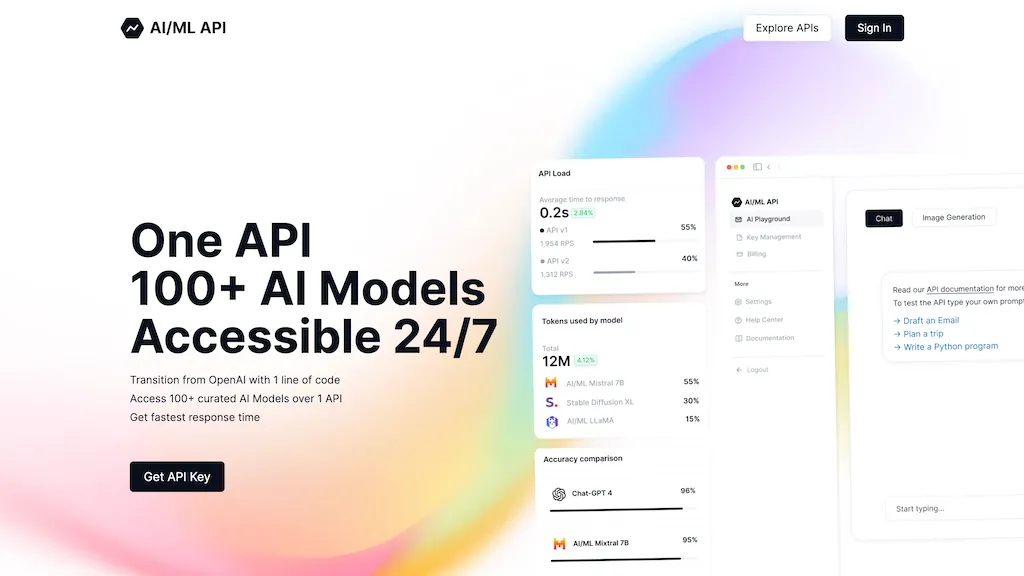
What is AIML API?
AIMLAPI.com is a unified API platform that grants developers access to more than 400 AI models across chat, image, video, audio, voice, text, 3D, and OCR categories. The service provides a single endpoint for all models, allowing quick switch between modalities without multiple integration points.
Each model can be tested in a sandbox environment before production use, and the API key system supports granular access control. The platform emphasizes data security with 99 % uptime and offers a human‑in‑the‑loop feature through its OpenClaw local runtime for sensitive workflows.
Integration is simplified by using standard RESTful requests and Python SDK examples, reducing the learning curve for new users. The API supports batch requests and high‑throughput scenarios, making it suitable for both small projects and enterprise‑scale applications.
AIML API details
- Company
- AIMLAPI OÜ
- Jurisdiction
- Estonia
- Built for
- Developers
AIML API tech specs
- Works with
- OpenAI / GPT Anthropic / Claude Google / Gemini xAI / Grok Qwen Black Forest Labs / Flux ByteDance / Seedance MiniMax
- Integrations
- Slack
AIML API pricing
FreemiumVerify on the official pricing page.
View plansAIML API's key features
-
Single API for 400+ models
-
Local execution with human supervision
-
Fast inference on serverless infrastructure
-
Multimodal model support
-
Easy endpoint integration
-
Sandbox AI playground
AIML API use cases
-
Create an AI‑powered customer support system that ingests text, voice, and image queries through a single endpoint, processes them in batch, and routes flagged tickets to human agents via OpenClaw for secure review
-
Automate social media content moderation by sending images, videos, audio, and text to the unified API in sandbox mode, then batch‑process the results and forward any violations to a human‑in‑the‑loop workflow
-
Build a multilingual educational platform that converts text prompts into videos, 3D models, and captions, batching requests for high throughput and using the Python SDK to translate outputs for global audiences
AIML API user reviews
Based on 7 reviews, 29% of users recommend AIML API, rated highly for ease of use.
Liked for
Disliked for
Would you recommend AIML API?
Who is AIML API for?
-
Artificial intelligence developers
-
Machine learning engineers
-
Data scientists
-
Software developers
-
Business analysts
AIML API FAQ
Is AIML API free?
Partly. AIML API has a free plan with usage limits, and paid plans unlock the full feature set. Plans include Z-image turbo at $0.007, Sora 2 at $0.13, Qwen3 vl plus at $0.26 and Veo 3.1 at $0.52.
Is AIML API safe to use?
AIML API is operated by AIMLAPI OÜ, registered in Estonia. It has a substantial audience that is independently measured month to month.
What are the best alternatives to AIML API?
The closest alternatives to AIML API are Openrouter.ai, APIMart, Use.ai, AiHubMix and AnyAPI.ai. You can compare them side by side in the alternatives section further down this page.
Does AIML API have an API?
Yes. AIML API offers an API, so you can call it from your own applications instead of using the interface directly.
Who made AIML API?
AIML API is built and operated by AIMLAPI OÜ, a company registered in Estonia.
Which AI models does AIML API use?
AIML API is built on OpenAI / GPT, Anthropic / Claude, Google / Gemini, xAI / Grok, Qwen, Black Forest Labs / Flux, ByteDance / Seedance and MiniMax. Which models you can reach may depend on your plan.
What does AIML API integrate with?
AIML API connects with Slack.


