
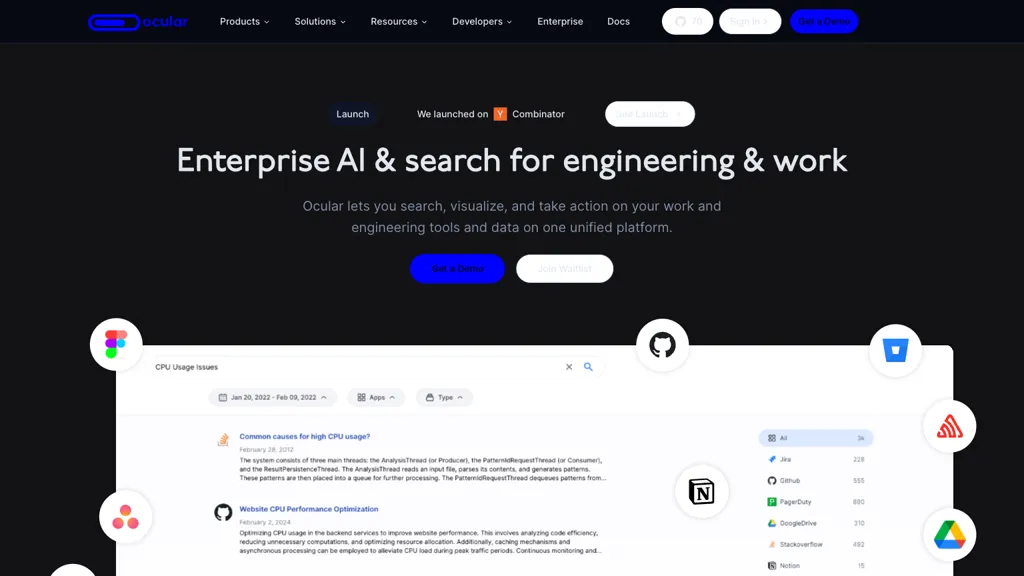
What is Ocular AI?
Ocular AI provides a unified multimodal lakehouse that consolidates data from cloud, local storage, and external sources, enabling teams to search, curate, and version datasets in a single catalog. The platform supports large‑scale labeling through AI agents and human‑in‑the‑loop workflows, allowing precise annotation of videos, images, and audio with minimal manual effort.
Ocular Bolt extends the data layer to include reinforcement‑learning‑with‑human‑feedback (RLHF) and expert alignment for model training and evaluation, facilitating domain‑specific quality control. Integrated GPU clusters and scalable training pipelines let users build, test, and compare custom AI models directly on their enterprise data.
A RESTful search API enables developers to embed multimodal retrieval capabilities into applications with natural language queries. The system includes role‑based access control, data lineage, and compliance features to maintain security and privacy across the data lifecycle.
Ocular AI details
- Jurisdiction
- Sweden
- Data residency
- United States
Ocular AI pricing
FreemiumOcular AI offers a free plan with paid upgrades available.
- Auto-renewal
- Yes
Verify on the official pricing page.
View plansOcular AI's key features
-
Centralized multimodal lakehouse
-
Ingest and curate multimodal data
-
AI agent + human labeling
-
GPU cluster training pipelines
-
Interactive model evaluation playground
-
REST API multimodal search
-
Versioned dataset project management
Ocular AI use cases
-
Consolidate product design assets, user feedback videos, and sensor data into Ocular AI’s multimodal catalog, enabling cross‑functional teams to search, version, and label data with human‑in‑the‑loop for accelerated feature development.
-
Deploy Ocular AI’s RLHF training pipeline to fine‑tune a conversational AI model on a curated, GPU‑accelerated dataset, while maintaining role‑based compliance controls over sensitive content.
-
Expose the enterprise multimodal search API to internal data scientists, allowing real‑time retrieval of labeled video, audio, and text snippets for downstream analytics, with built‑in data lineage for auditability.
Ocular AI user reviews
Would you recommend Ocular AI?
Who is Ocular AI for?
-
Enterprise architects
-
Data scientists
-
Software developers
-
System administrators
-
Business strategists
Ocular AI FAQ
Is Ocular AI free?
Partly. Ocular AI has a free plan with usage limits, and paid plans unlock the full feature set.
What are the best alternatives to Ocular AI?
The closest alternatives to Ocular AI are Atlas Cloud, Appen, Luma AI, voxel51.com and Isahit. You can compare them side by side in the alternatives section further down this page.
What does Ocular AI do with my data?
Its privacy policy states that personal data is not sold or shared for marketing purposes. Data may be shared with third-party service providers that help run the product. Customer data is held in United States.
Does Ocular AI auto-renew or offer refunds?
Ocular AI subscriptions renew automatically until you cancel.
Does Ocular AI have an API?
Yes. Ocular AI offers an API, so you can call it from your own applications instead of using the interface directly.
Compliance, privacy and billing terms are as stated in each product's own published documentation and have not been independently verified by TopAI.tools.


