
What is understand-anything.com?
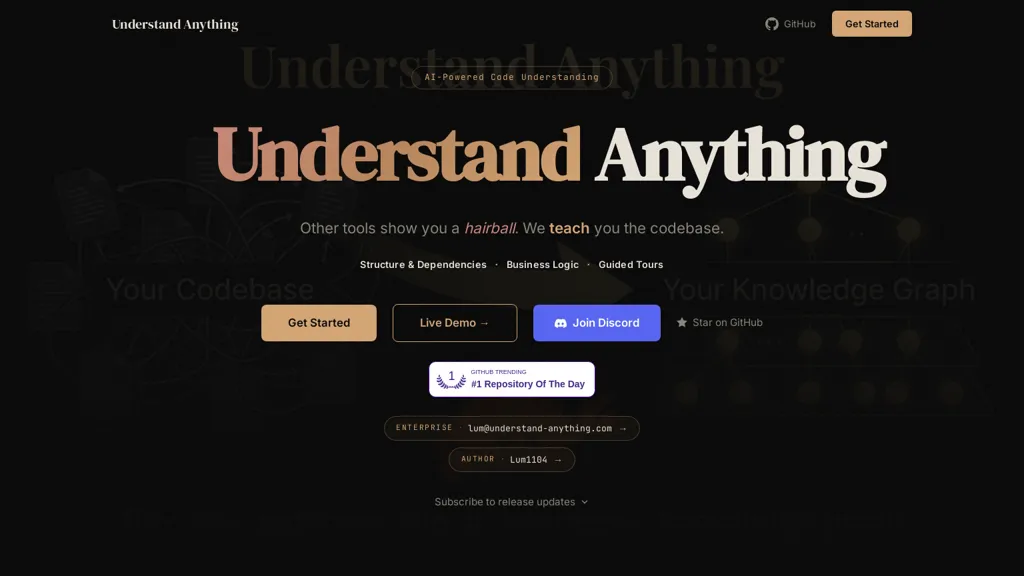
Understand Anything maps codebases into interactive knowledge graphs that expose files, functions, edges, and business domains. It supports 26+ file types, including Dockerfiles, Terraform, SQL, and Markdown, to produce a unified view of structure and dependencies. Features include hierarchical drill-down, smart layout, community clustering, fuzzy semantic search, and smart filters by type, complexity, and layer. The dependency path finder reveals shortest paths between components while AI-generated guided tours provide step-by-step walkthroughs for authentication flows, payment pipelines, and user lifecycles to speed onboarding and knowledge transfer. Export options (PNG, SVG, filtered JSON) and integrations with CLI, GitHub, plugin marketplaces, and AI coding models enable documentation and tooling workflows. Typical users include engineers, architecture reviewers, dev leads, and product teams seeking faster code comprehension, impact analysis, and onboarding.
understand-anything.com details
- Company
- Infinite Universe, Inc.
- Jurisdiction
- United States (Delaware)
- Data residency
- United States
understand-anything.com tech specs
- Works with
- Anthropic / Claude Google / Gemini
- Integrations
- GitHub
understand-anything.com pricing
Freemiumunderstand-anything.com offers a free plan with paid upgrades available.
- Auto-renewal
- Yes
Verify on the official pricing page.
View plansunderstand-anything.com's key features
-
Interactive knowledge graphs mapping codebases into files, functions, edges, and business domains
-
Unified multi-format ingestion (Dockerfiles, Terraform, SQL, Markdown, etc.) producing a unified view of structure and dependencies
-
Hierarchical drill-down with smart layout and community clustering for visual exploration
-
Fuzzy semantic search with smart filters by type, complexity, and layer
-
Dependency path finder revealing shortest paths between components
understand-anything.com use cases
-
Accelerate new-hire onboarding by generating AI-guided code tours from the codebase knowledge graph that highlight critical files, functions and business domains, provide hierarchical drill-downs and semantic search so engineers quickly grasp architecture without reading sprawling docs
-
Run fast architecture impact analysis and change-risk assessments using interactive dependency graphs and dependency path finding to visualize upstream/downstream effects across 26+ file types, identify affected modules, and produce focused test lists and rollout plans
-
Improve debugging, feature handoffs and cross-team collaboration by using semantic code search, code structure visualization and interactive dependency paths to locate implementations, trace call chains, reveal hidden couplings and create shareable walkthroughs for complex issues
understand-anything.com user reviews
Would you recommend understand-anything.com?
Who is understand-anything.com for?
-
Software engineers
-
Product managers
-
Code reviewers
-
Coding educators
-
Open source contributors
understand-anything.com FAQ
Is understand-anything.com free?
Partly. understand-anything.com has a free plan with usage limits, and paid plans unlock the full feature set.
Is understand-anything.com safe to use?
understand-anything.com is operated by Infinite Universe, Inc., registered in United States (Delaware). It has a substantial audience that is independently measured month to month.
What are the best alternatives to understand-anything.com?
The closest alternatives to understand-anything.com are You.com, OpenCode.ai, Blackbox AI, Command Code AI and Augment Code. You can compare them side by side in the alternatives section further down this page.
What does understand-anything.com do with my data?
understand-anything.com states that customer content is not used to train its models. Its privacy policy states that personal data is not sold or shared for marketing purposes. Data may be shared with third-party service providers that help run the product. Customer data is held in United States.
Does understand-anything.com auto-renew or offer refunds?
understand-anything.com subscriptions renew automatically until you cancel.
Who made understand-anything.com?
understand-anything.com is built and operated by Infinite Universe, Inc., a company registered in United States (Delaware).
Which AI models does understand-anything.com use?
understand-anything.com is built on Anthropic / Claude and Google / Gemini. Which models you can reach may depend on your plan.
What does understand-anything.com integrate with?
understand-anything.com connects with GitHub.
Compliance, privacy and billing terms are as stated in each product's own published documentation and have not been independently verified by TopAI.tools.


