
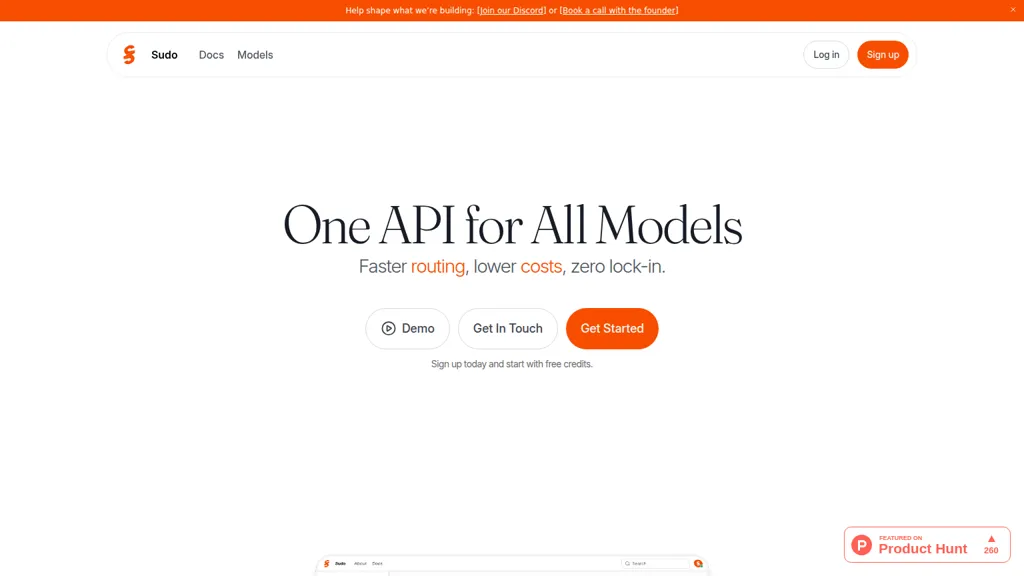
What is Sudo AI?
Sudo is a multi-model API platform that provides a single endpoint for accessing GPT-4, Claude, and open-source LLMs. It supports text, image, and audio generation and offers SDKs for Python and TypeScript to accelerate developer integration. Built-in model routing manages latency and throughput across providers to reduce vendor lock-in and simplify model selection.
The platform centralizes billing options (subscription, usage, or hybrid) and request routing to consolidate model orchestration and operational overhead. Developers create an API key, install the SDK, and route requests through Sudo to manage models, telemetry, and deployments from one interface.
Sudo AI pricing
FreeThis tool is free to use, with no credit card required.
Verify on the official pricing page.
Get started freeSudo AI's key features
-
Unified API endpoint to access multiple LLMs (GPT-4, Claude, open-source)
-
OpenAI-compatible API and SDKs for Python and TypeScript (pip/npm install sudo-ai)
-
Platform-managed request routing, billing, and AI-native in-context ads
-
Support for text, image, and audio generation (multimodal)
-
Real-time performance optimization with improved latency and throughput
Sudo AI use cases
-
Build a production-ready multilingual customer support assistant using Sudo's unified LLM endpoint and SDKs to route queries to GPT-4, Claude, or fast open-source models based on latency and cost, delivering text, image, and audio responses with centralized billing and a single integration
-
Develop an automated content creation pipeline that orchestrates GPT-4 for copy, an image model for visuals, and an audio model for narration via Sudo's model orchestration API and latency-aware routing, producing SEO-friendly articles, illustrations, and podcast snippets with Python/TypeScript SDKs
-
Implement a cost-efficient A/B testing platform for LLM outputs that dynamically routes traffic between premium and open-source models, compares multimodal variations (text, image, audio), and consolidates performance and billing metrics through Sudo's single endpoint
Sudo AI user reviews
Would you recommend Sudo AI?
Who is Sudo AI for?
-
Software developers
-
Technology managers
-
Data analysts
-
Product builders
-
Cloud architects
Sudo AI FAQ
Is Sudo AI free?
Yes. Sudo AI is free to use and does not require a credit card.
What are the best alternatives to Sudo AI?
The closest alternatives to Sudo AI are AIML API, APIMart, AiHubMix, AI API and GPTunneL. You can compare them side by side in the alternatives section further down this page.
Does Sudo AI have an API?
Yes. Sudo AI offers an API, so you can call it from your own applications instead of using the interface directly.


