
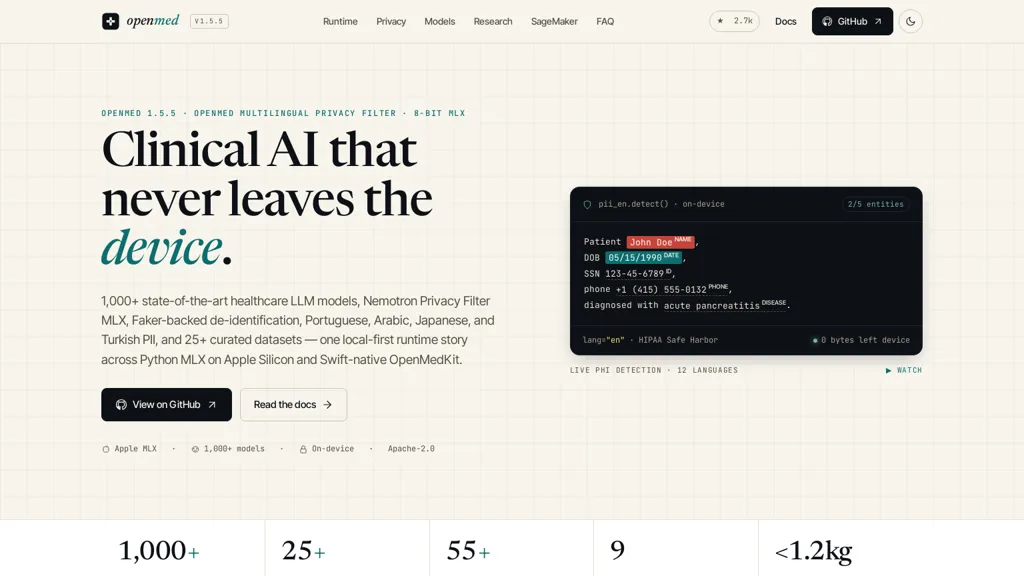
What is Openmed?
Openmed is an on-device clinical AI platform for local-first PHI/PII detection, de-identification, and named-entity recognition in clinical text.It provides a model library of 1,000+ healthcare NER and LLM variants, 55+ PII entity types, multilingual support across 12 languages, and over 25 curated biomedical datasets including MIMIC-III and PubMed.
The runtime supports MLX acceleration on Apple Silicon and native Swift integration via OpenMedKit, plus composable Python APIs and batch processing for clinical workflows.Privacy controls include the nemotron privacy filter, deterministic faker-backed surrogate replacement, configurable redaction methods (mask, redact, hash, date-shift), and air-gapped operation with no external API calls.
Domain-aware validators and keyword boosting reduce false positives for locale-specific identifiers (SSN, NIR, Steuer‑ID, CPF/CNPJ) while smart entity merging reassembles fragmented tokens for accurate extraction.
Intended users include clinicians, healthcare researchers, and developers who need HIPAA Safe Harbor detection, local de-identification, and production-ready NER pipelines on macOS, iOS, and server environments.
Openmed details
- Stated compliance
- HIPAA
Compliance as stated in Openmed's own published documentation.
Openmed tech specs
- AI infrastructure
- Hugging Face
- Cloud
- AWS Azure
- Integrations
- GitHub
Openmed's key features
-
On-device clinical AI for local-first PHI/PII detection, de-identification, and named-entity recognition in clinical text
-
Model library of healthcare NER and LLM variants with curated biomedical datasets
-
Multilingual NER and PII detection across multiple languages
-
Runtime integrations: MLX acceleration on Apple Silicon, native Swift integration via OpenMedKit, composable Python APIs, and batch processing for clinical workflows
-
Privacy and de-identification controls: nemotron privacy filter, deterministic faker-backed surrogate replacement, configurable redaction methods (mask/redact/hash/date-shift), air-gapped operation, domain-aware validators, and smart entity merging
Openmed use cases
-
Create HIPAA-compliant de-identified datasets from EHR notes using openmed's on-device PHI detection and clinical de-identification pipeline, leveraging deterministic surrogate replacement and locale-aware identifier validation to preserve analytic utility while running air-gapped on macOS/iOS/servers
-
Integrate multilingual medical NER and real-time PHI/PII redaction into telehealth or mobile health apps with openmed's on-device ML acceleration and 1,000+ model variants to automatically redact sensitive data offline, reduce latency, and maintain patient privacy
-
Build a reproducible clinical ML data curation and QA workflow with openmed by extracting structured entities from free-text clinical notes, applying configurable privacy controls and HIPAA Safe Harbor detection, and producing compliant training cohorts for research without exposing PHI to the cloud
Openmed user reviews
Based on 2 reviews, 100% of users recommend Openmed, rated highly for quality results.
Liked for
Would you recommend Openmed?
Who is Openmed for?
-
Clinical developers
-
Data scientists
-
Machine learning engineers
-
Privacy officers
-
Hospital it administrators
Openmed FAQ
Is Openmed safe to use?
Openmed states HIPAA compliance in its own published documentation.
What are the best alternatives to Openmed?
The closest alternatives to Openmed are NativeBI, Segmed, iDox.ai, md.ai and Hathr AI. You can compare them side by side in the alternatives section further down this page.
What does Openmed do with my data?
Its privacy policy states that personal data is not sold or shared for marketing purposes.
Does Openmed have an API?
Yes. Openmed offers an API, so you can call it from your own applications instead of using the interface directly.
What does Openmed integrate with?
Openmed connects with GitHub.
Compliance, privacy and billing terms are as stated in each product's own published documentation and have not been independently verified by TopAI.tools.


