
What is Openlit?
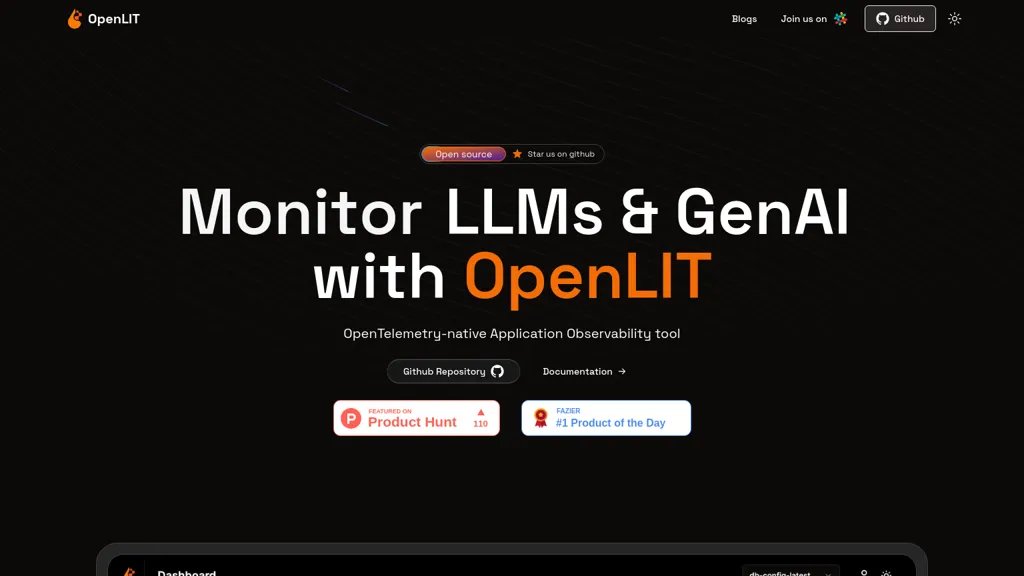
OpenLIT is an open‑source platform built on OpenTelemetry that enables end‑to‑end observability for large language model applications.
It supplies distributed tracing for real‑time monitoring of request flows, bottlenecks, and full lifecycle events across multiple deployments.
The platform includes AI model evaluation tools that run online or offline tests through a UI or SDK for prompt and model performance comparison.
Prompt Hub lets teams centrally version, deploy, and iterate on prompts, with integrated experiment tracking to accelerate development cycles.
Fleet Hub aggregates telemetry from all LLM workloads, allowing custom SQL queries, dashboard widgets, and cross‑environment comparison in a single view.
A zero‑code Kubernetes Operator automatically instruments applications, requiring only a configuration file for integration with existing observability stacks.
OpenLIT supports major LLM providers and frameworks—including OpenAI, Anthropic, Cohere, LangChain, and LlamaIndex—plus vector database integrations like Pinecone and ChromaDB.
The open‑source nature allows self‑hosting, full data privacy, and community contributions that keep the tool aligned with production requirements.
Openlit details
- Built for
- Individuals
Openlit tech specs
- Works with
- OpenAI / GPT Anthropic / Claude Meta Mistral Cohere DeepSeek xAI / Grok Amazon Bedrock ElevenLabs
- AI infrastructure
- Hugging Face Together AI Groq
- Cloud
- Azure
- Integrations
- GitHub
Openlit pricing
SubscriptionVerify on the official pricing page.
View plansOpenlit's key features
-
Distributed tracing of LLM apps
-
Model evaluation via UI and SDK
-
Prompt management with version control
-
Real-time monitoring dashboards with SQL queries
-
Multi-deployment management across environments
-
Zero-code Kubernetes observability operator
Openlit use cases
-
Deploy an end‑to‑end LLM observability stack with OpenLIT’s zero‑code Kubernetes operator, automatically collecting distributed tracing, model evaluation metrics, and fleet telemetry across all your services
-
Easily version, roll back, and audit LLM prompts with OpenLIT’s prompt versioning, ensuring consistent behavior and compliance in production
-
Leverage OpenLIT’s real‑time telemetry aggregation dashboard to monitor latency, error rates, and resource usage for each model, enabling proactive scaling and rapid debugging
Openlit user reviews
Would you recommend Openlit?
Who is Openlit for?
-
System administrators
-
Data visualizers
-
Infrastructure architects
-
Observability engineers
-
Monitoring engineers
Openlit FAQ
How much does Openlit cost?
Openlit is a paid product with no free plan. Plans include Token supporter at $10/mo and Context window hero at $50/mo.
What are the best alternatives to Openlit?
The closest alternatives to Openlit are MLflow, LangWatch, Klu.ai, honeyhive.ai and Keywords AI. You can compare them side by side in the alternatives section further down this page.
What does Openlit do with my data?
Its privacy policy states that personal data is not sold or shared for marketing purposes. Data may be shared with third-party service providers that help run the product.
Which AI models does Openlit use?
Openlit is built on OpenAI / GPT, Anthropic / Claude, Meta, Mistral, Cohere, DeepSeek, xAI / Grok, Amazon Bedrock and ElevenLabs. Which models you can reach may depend on your plan.
What does Openlit integrate with?
Openlit connects with GitHub.
Compliance, privacy and billing terms are as stated in each product's own published documentation and have not been independently verified by TopAI.tools.


