
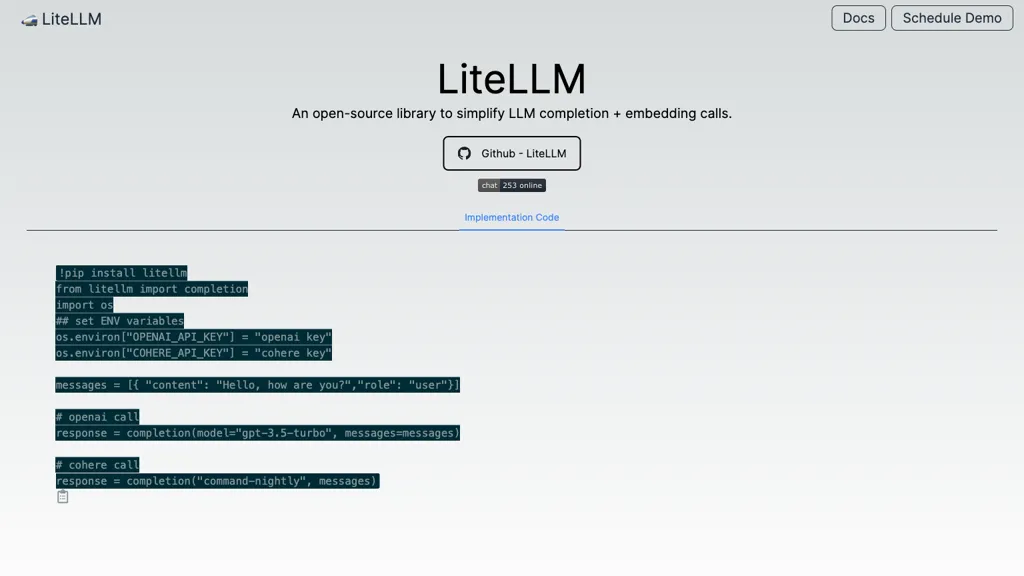
What is liteLLM?
LiteLLM is an open‑source gateway that standardizes access to over 100 large language models, including OpenAI, Azure, Bedrock, Gemini, and GCP.
It routes requests through an OpenAI‑compatible API, enabling seamless fallback to alternate providers when a model is unavailable.
Built-in cost tracking logs spend per key, user, team, or organization, and supports tag‑based attribution for budgeting and rate limiting.
The platform offers guardrails, prompt management, and pass‑through endpoints, while automatically logging usage to S3, GCS, or other storage backends.
Users can deploy LiteLLM on‑prem or in the cloud, with Docker images and a lightweight Python SDK for integration into existing infrastructure.
Logging and observability are supported via OpenTelemetry, Prometheus, and third‑party services such as Langfuse, Arize Phoenix, and Langsmith.
Enterprise deployments add JWT authentication, SSO, audit logs, custom SLAs, and virtual key management for secure, scalable LLM usage.
LiteLLM provides rate limits, RPM/TPM controls, and load balancing to manage traffic and maintain consistent performance.
liteLLM details
- Company
- Berrie AI Incorporated
- Built for
- Businesses and teams
- Stated compliance
- SOC 2, ISO 27001
Compliance as stated in liteLLM's own published documentation.
liteLLM tech specs
- Works with
- OpenAI / GPT Anthropic / Claude Google / Gemini Meta Mistral
- Cloud
- AWS Google Cloud Azure Cloudflare
- Integrations
- Slack Jira GitHub GitLab
liteLLM pricing
FreemiumVerify on the official pricing page.
View plansliteLLM's key features
-
OpenAI-compatible API gateway
-
Spend tracking with budgets
-
Rate limiting and guardrails
-
Multi-provider fallback support
-
Logging to S3, GCS, Prometheus
-
Virtual keys and JWT auth
-
Self-hosted or cloud deployment
liteLLM use cases
-
Build an internal chatbot that automatically switches between GPT‑4 and open‑source models based on cost thresholds and compliance tags, ensuring seamless user experience without manual model selection.
-
Integrate LiteLLM into your data pipeline to centrally log and analyze LLM usage, generating real‑time cost dashboards and trigger alerts when budgets are exceeded, all while maintaining privacy through on‑prem deployment.
-
Create a multi‑tenant SaaS application that routes user prompts through different LLM providers according to region and latency, applying guardrails to filter harmful content and providing end‑to‑end observability via built‑in monitoring hooks.
liteLLM user reviews
Would you recommend liteLLM?
Who is liteLLM for?
-
Software developers
-
Data scientists
-
Product designers
-
E-commerce sellers
-
Content creators
liteLLM FAQ
Is liteLLM free?
Partly. liteLLM has a free plan with usage limits, and paid plans unlock the full feature set.
Is liteLLM safe to use?
liteLLM states SOC 2 and ISO 27001 compliance in its own published documentation. liteLLM is operated by Berrie AI Incorporated. It has a substantial audience that is independently measured month to month.
What are the best alternatives to liteLLM?
The closest alternatives to liteLLM are FreeLLMAPI, OurToken.ai, portkey.ai, OmniRoute and Openrouter.ai. You can compare them side by side in the alternatives section further down this page.
What does liteLLM do with my data?
Its privacy policy states that personal data is not sold or shared for marketing purposes.
Does liteLLM have an API?
Yes. liteLLM offers an API, so you can call it from your own applications instead of using the interface directly.
Who made liteLLM?
liteLLM is built and operated by Berrie AI Incorporated.
Which AI models does liteLLM use?
liteLLM is built on OpenAI / GPT, Anthropic / Claude, Google / Gemini, Meta and Mistral. Which models you can reach may depend on your plan.
What does liteLLM integrate with?
liteLLM connects with Slack, Jira, GitHub and GitLab.
Compliance, privacy and billing terms are as stated in each product's own published documentation and have not been independently verified by TopAI.tools.


