
What is Lmql?
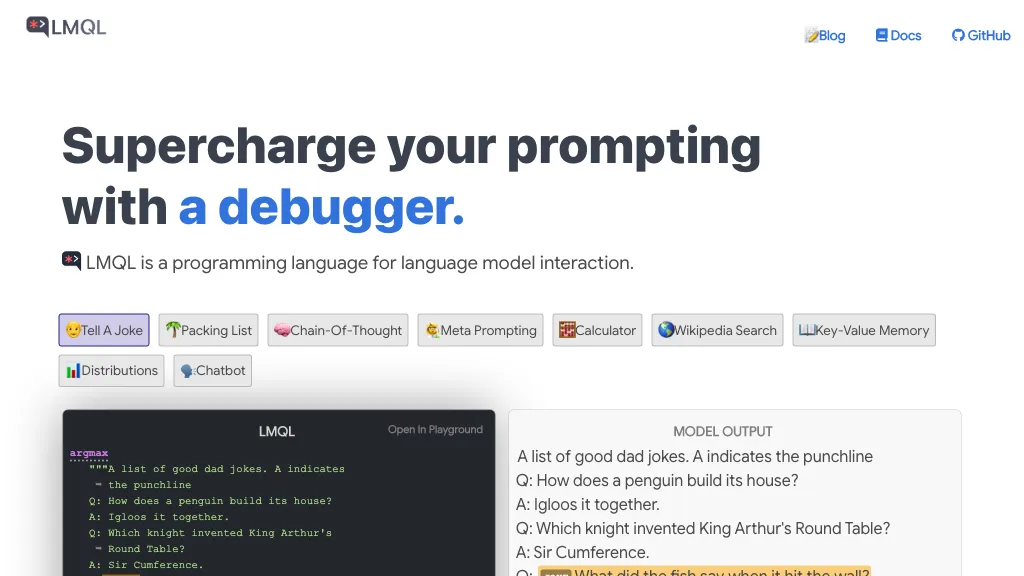
LMQL is a programming language designed for interacting with large language models (LLMs). It supports modular prompting through types, templates, constraints, and an optimizing runtime that enforces hard constraints on model output. Nested queries enable procedural programming patterns, allowing developers to reuse prompt components and embed local instructions within a larger prompt.
LMQL code can be written in Python, making it easy to integrate into existing workflows and to leverage Python’s control flow and string interpolation. The language is backend‑agnostic, providing a single‑line switch between llama.cpp, OpenAI, and Hugging Face Transformers.
Built‑in features such as meta prompting, tool augmentation, and chatbot scaffolding simplify the construction of multi‑part prompts. LMQL offers runtime support for measuring distributions, applying regular expression constraints, and generating typed outputs that guarantee format consistency.
Lmql pricing Freemium
Lmql offers a free plan with paid upgrades available.
Verify on the official pricing page.
View plansLmql user reviews
Based on 1 review, 100.0% of users recommend Lmql, rated highly for quality results.
Liked for
Would you recommend Lmql?
Lmql's key features
-
Modular LLM prompting with types
-
Constrained variable generation
-
Nested query reuse
-
Cross-backend portability
-
Python control flow integration
-
Runtime optimization engine
Lmql use cases
-
Generate a type‑safe, multi‑backend chatbot script that automatically switches between OpenAI and local llama.cpp, ensuring runtime compliance with content policies via LMQL’s constraint checks.
-
Build a dynamic FAQ generator for an e‑commerce site, using nested LMQL queries to pull product info and enforce a strict JSON schema, enabling rapid content updates without manual coding.
-
Create a multilingual summarizer that limits output length, enforces paragraph structure with LMQL, and automatically translates the results via Hugging Face models for global marketing teams.
Who is it for?
-
Software developers
-
Technical architects
-
Data analysts
-
System administrators
-
Research scientists