
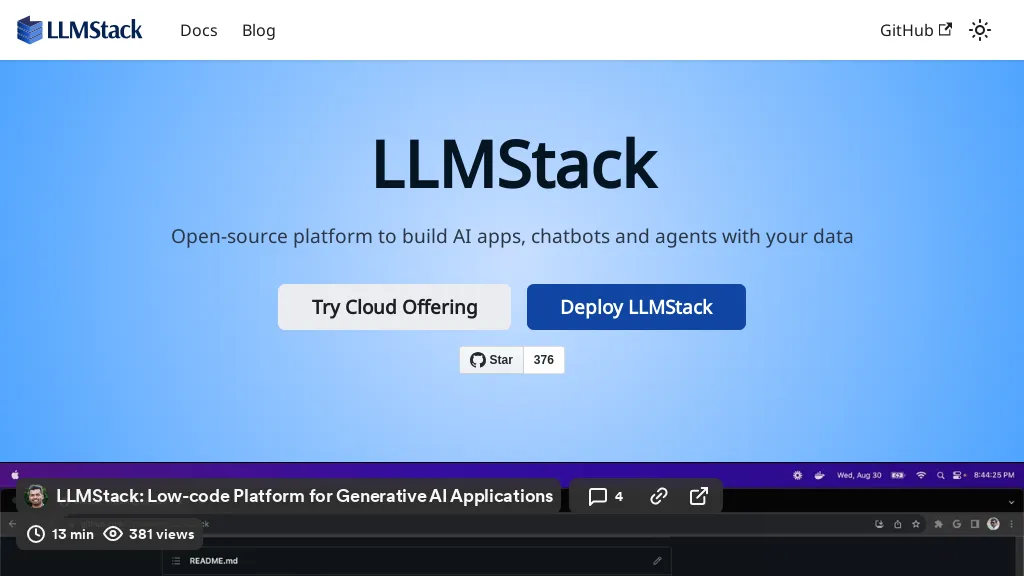
What is LLMStack?
LLMStack is an open‑source platform that lets developers and data scientists create AI agents, workflows, and applications without coding.
The tool supports all major model providers—OpenAI, Cohere, Stability AI, Hugging Face, and others—making model chaining straightforward.
Users can import data from Web URLs, PDFs, audio files, PPTs, Google Drive, Notion, and more to feed generative AI models.
The React‑based UI enables real‑time collaboration, with viewer and collaborator roles that allow teams to build and share apps publicly or with restricted audiences.
LLMStack pricing
FreemiumLLMStack offers a free plan with paid upgrades available.
Verify on the official pricing page.
View plansLLMStack's key features
-
No-code AI app builder
-
Model chaining across providers
-
Import data from diverse sources
-
Collaborative building with role permissions
-
Open-source platform for AI agents
-
Cloud deployment of LLMStack
-
Integrates with major model providers
LLMStack use cases
-
Build a zero-code, collaborative AI‑driven knowledge base for your enterprise using LLMStack, importing PDFs and web content, and granting granular permissions to team members, all within a React UI
-
Create an automated customer support workflow with LLMStack, chaining LLMs for intent classification, response generation, and sentiment analysis, while importing data from your ticketing system and allowing real‑time collaboration on response templates
-
Deploy a data ingestion and analytics pipeline with LLMStack, pulling data from cloud services and audio files, feeding it through chained models for summarization and insights, and sharing results with stakeholders via a permissioned UI
LLMStack user reviews
Based on 4 reviews, 75% of users recommend LLMStack, rated highly for quality results.
Liked for
Disliked for
Would you recommend LLMStack?
Main competitors of LLMStack
Here are some of the major competitors comparisons vs. LLMStack.


Who is LLMStack for?
-
Llm developers
-
Data architects
-
Software engineers
-
Platform integrators
-
Technical architects
LLMStack FAQ
Is LLMStack free?
Partly. LLMStack has a free plan with usage limits, and paid plans unlock the full feature set.
What are the best alternatives to LLMStack?
The closest alternatives to LLMStack are AI-Flow, n8n.io, Gooey.AI, Use.ai and OpenCode.ai. You can compare them side by side in the alternatives section further down this page.


