
What is Fileverity?
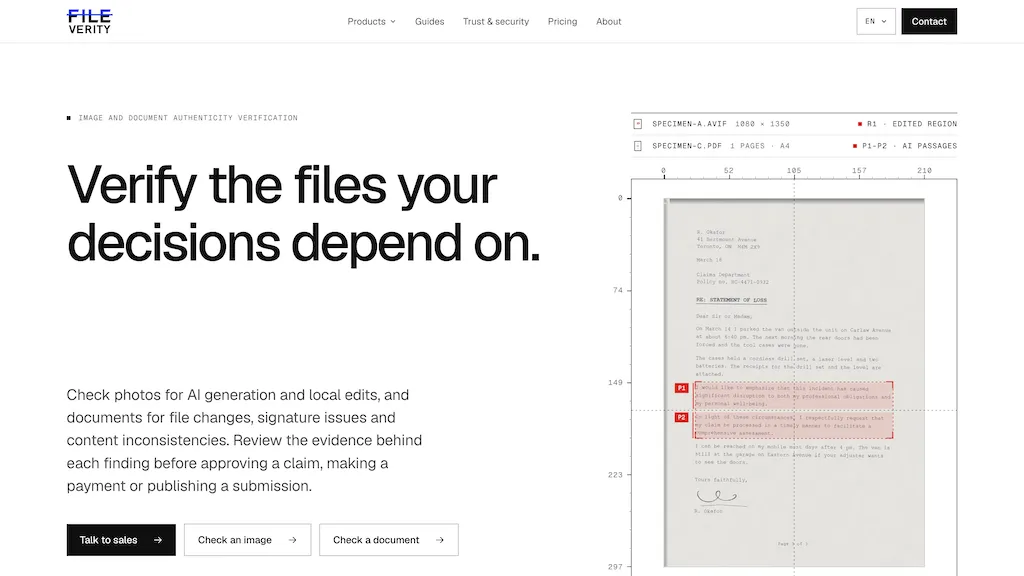
Fileverity verifies image and document authenticity by detecting AI-generated images, local edits, and AI-written passages. Reads provenance and machine-readable labels such as Content Credentials (C2PA), metadata and software traces to corroborate findings.
Locates edited regions and flagged passages and reports the evidence basis and strength rather than relying on a single score. Produces sealed, timestamped reports tied to the file by a SHA-256 fingerprint and an RFC 3161 timestamp, with JSON and PDF outputs for verification.
Deletes files after analysis and maintains continuously updated detection models to address new generators. Offers web checks, API and batch processing, and on-premises offline deployment for integration with existing systems.
Reports include findings, locations, and recommended next steps to support verifiable documentation of file integrity.
Fileverity pricing
FreemiumVerify on the official pricing page.
View plansFileverity's key features
-
Detects AI-generated images, local edits, and AI-written passages
-
Reads provenance and machine-readable labels (C2PA), metadata, and software traces to corroborate findings
-
Locates edited regions and flagged passages and reports evidence basis and strength instead of a single score
-
Produces sealed, timestamped reports tied to files using SHA-256 fingerprints and RFC 3161 timestamps with JSON and PDF outputs
-
Supports web checks, API and batch processing, and on-premises offline deployment; deletes files after analysis and maintains continuously updated detection models
Fileverity use cases
-
Verify the authenticity of images and documents used in news reporting and fact-checking with Fileverity—detect AI-generated content and AI-written passages, read C2PA provenance and metadata, locate edited regions, and produce sealed SHA-256/RFC3161 timestamped JSON and PDF reports to support publication and legal chain-of-custody
-
Authenticate digital evidence for legal cases and internal investigations by scanning files on-premises with Fileverity to uncover local edits, software traces and provenance metadata, then generate sealed timestamped reports with embedded evidence and recommended next steps for court-ready documentation
-
Protect businesses and platforms from fraud and compliance risks by using Fileverity to detect manipulated invoices, forged credentials and AI-generated submissions, perform on-premises forensic scanning of sensitive files, and produce PDF/JSON reports that inform remediation and regulatory reporting
Fileverity user reviews
Based on 1 review, 100% of users recommend Fileverity, rated highly for quality results.
Liked for
Would you recommend Fileverity?
Who is Fileverity for?
-
Journalists and fact-checkers
-
Digital forensic analysts
-
Law enforcement investigators
-
Legal teams and litigators
-
Platform trust & safety and content moderation teams
-
Media organizations and newsrooms
-
Compliance, risk management, and audit teams
-
Corporate security and incident response teams
-
Archivists and records managers
-
Election officials and government agencies
-
Academic researchers studying misinformation and ai-generated media
-
Verification teams at ngos and human rights organizations
Fileverity FAQ
Is Fileverity free?
Partly. Fileverity has a free plan with usage limits, and paid plans unlock the full feature set. Plans include Image pro - 1 report at $2.99, Doc pro - 1 report at $8.99, Image pro - 10 reports at $23.90 and Doc pro - 10 reports at $69.90.
What are the best alternatives to Fileverity?
The closest alternatives to Fileverity are WasItAI, Copyleaks, wedetect.ai, AI Image Detector and Mydetectai. You can compare them side by side in the alternatives section further down this page.
Does Fileverity have an API?
Yes. Fileverity offers an API, so you can call it from your own applications instead of using the interface directly.


