
What is ApexAPI?
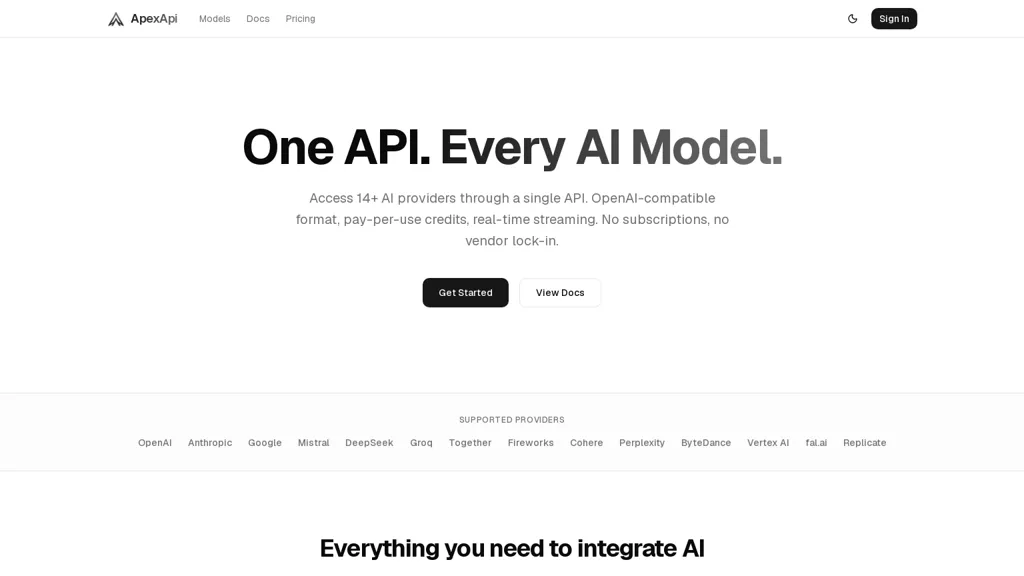
ApexAPI provides a unified AI API gateway exposing 14+ providers through a single OpenAI-compatible endpoint.Developers use one API key and a consistent request format to access models from OpenAI, Anthropic, Google (Vertex AI), Mistral, Cohere, Replicate, Groq, Perplexity and others.
Supports chat completions, text and image model endpoints, and real-time token streaming via Server-Sent Events (SSE).Switch providers by changing the model name, manage multiple provider accounts from one interface, and integrate with existing OpenAI SDKs as a drop-in replacement.
Suitable for developer prototypes, multi-model experimentation, and production deployments that require model portability and unified monitoring.
ApexAPI details
- Company
- Nitrotech Inc.
- Jurisdiction
- Delaware
- Built for
- Individuals
- Data residency
- United States
ApexAPI tech specs
- Works with
- OpenAI / GPT Anthropic / Claude Google / Veo Google / Imagen Mistral Stability AI DeepSeek xAI / Grok Black Forest Labs / Flux Kling ByteDance / Seedance ByteDance / Seedream MiniMax / Hailuo Ideogram Recraft ElevenLabs MiniMax
- Payment Processors
- Stripe
ApexAPI pricing
Paid- Refund window
- 1 days
Verify on the official pricing page.
View plansApexAPI's key features
-
Unified OpenAI-compatible API gateway for multiple model providers
-
Single API key and consistent request format to access all providers
-
Support for chat completions, text and image model endpoints, and real-time token streaming via Server-Sent Events (SSE)
-
Provider switching by model-name and management of multiple provider accounts from one interface
-
Drop-in compatibility with existing OpenAI SDKs and documentation including API reference, model catalog, authentication, rate limits, and streaming examples
ApexAPI use cases
-
Build a multi-model experimentation platform with apexapi's unified AI gateway and single-key access, enabling teams to switch providers, compare chat/text/image models, and port models without changing integration code
-
Integrate real-time token streaming and SSE into chatbots and collaborative apps using apexapi's drop-in SDK replacement to deliver low-latency, token-by-token responses and seamless provider failover
-
Consolidate multi-provider account management, billing, and model selection for production pipelines by routing text, chat, and image requests through apexapi's single endpoint to simplify deployment, scaling, and provider fallback
ApexAPI user reviews
Would you recommend ApexAPI?
Who is ApexAPI for?
-
Software developers
-
Machine learning engineers
-
Data scientists
-
Technical product managers
-
Engineering leads
ApexAPI FAQ
How much does ApexAPI cost?
ApexAPI is a paid product with no free plan. Plans include Starter at $10, Developer at $25, Pro at $50 and Scale at $100.
Is ApexAPI safe to use?
ApexAPI is operated by Nitrotech Inc., registered in Delaware.
What are the best alternatives to ApexAPI?
The closest alternatives to ApexAPI are AnyAPI.ai, Openrouter.ai, OminiGate.ai, AiHubMix and NewAPI. You can compare them side by side in the alternatives section further down this page.
What does ApexAPI do with my data?
ApexAPI states that customer content is not used to train its models. Its privacy policy states that personal data is not sold or shared for marketing purposes. Data may be shared with third-party service providers that help run the product. Customer data is held in United States.
Does ApexAPI auto-renew or offer refunds?
ApexAPI states a 1-day refund window.
Does ApexAPI have an API?
Yes. ApexAPI offers an API, so you can call it from your own applications instead of using the interface directly.
Who made ApexAPI?
ApexAPI is built and operated by Nitrotech Inc., a company registered in Delaware.
Which AI models does ApexAPI use?
ApexAPI is built on OpenAI / GPT, Anthropic / Claude, Google / Veo, Google / Imagen, Mistral, Stability AI, DeepSeek, xAI / Grok, Black Forest Labs / Flux, Kling, ByteDance / Seedance, ByteDance / Seedream, MiniMax / Hailuo, Ideogram, Recraft, ElevenLabs and MiniMax. Which models you can reach may depend on your plan.
Compliance, privacy and billing terms are as stated in each product's own published documentation and have not been independently verified by TopAI.tools.


