What Is AI Compliance? And How to Implement It ?
Imagine you've just built the coolest app imaginable. You're days away from launch, ready to take the tech world by storm.
Then comes the speed bump: AI compliance.
It's tempting to think of rules and regulations as heavy paperwork designed to slow down innovation. But without them, the digital world turns into the Wild West—where user privacy gets compromised, bias runs unchecked, and your brilliant creation could face massive fines or get pulled from app stores overnight.
Compliance isn't about killing your creativity; it's the guardrail that keeps your rocket ship on course. Let's break down the exact laws, policies, and frameworks you need to know so you can launch safely, build trust, and win the game.
Why Do We Even Need Policies?
Think about it like this. Would you ever get on a roller coaster if you knew there were zero safety inspections, no seatbelts, and the engineers just built it based on "vibes". No way.
The same goes for technology, especially Artificial Intelligence (AI). When we use tech, we are handing over our most private information: our names, our locations, our health issues, our credit cards, and our private chats.
Policies exist to:
Protect Your Secrets: They make sure creepy companies can't just scrape your face from a photo and use it in an ad without asking.
Prevent Disasters: They ensure that the servers holding your bank accounts are practically un-hackable.
Hold Bullies Accountable: If a massive tech company messes up and leaks your data, these policies ensure they pay massive fines (we're talking millions of dollars).
In my experience, a company that brags about its security compliance is a company that actually respects you.
The Flip Side: Do These Rules Kill Innovation?
Now, I have some strong opinions on this. Yes, policies can be a massive pain in the neck, and yes, they absolutely slow down innovation.
Imagine you have a brilliant idea for a new AI feature. In the old days, you could code it over the weekend and push it to millions of users on Monday. Today? If you want to launch that same feature legally, you have to:
Hire a lawyer.
Run an audit.
Check if it violates privacy laws in 15 different countries.
Change how the AI stores data.
It is exhausting. Startups with very little money often struggle to keep up with these rules, while giant tech monopolies (who have armies of lawyers) easily pay the fees and dominate the market. Sometimes, these strict policies accidentally build a wall that keeps the little guys out.
But here is my hot take: Slow and safe is better than fast and catastrophic.
If a strict policy slows a company down for six months so they can prove their AI isn't dangerous, then I say that's a win for humanity.
Let’s break down exactly what these rules are. I’ve organized them into a master sheet for you.
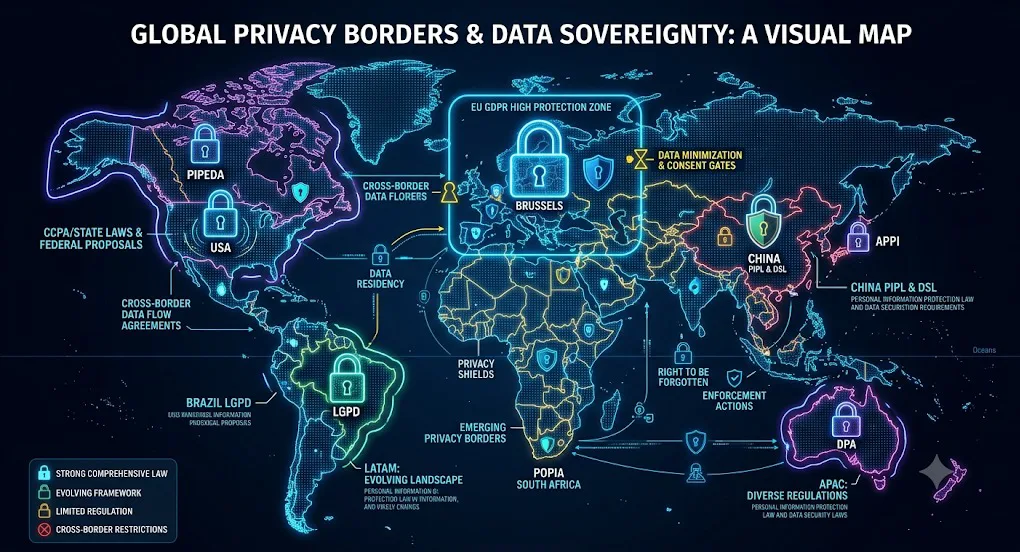
1. The Global Privacy Patchwork (Where Your Data Lives)
Different countries have entirely different ideas about how your data should be treated. These laws govern how companies must legally handle personal data and what rights you have as a user.
Europe and the UK:
GDPR (General Data Protection Regulation) & UK GDPR: This is the big boss of privacy laws. Europe believes in a strict "Opt-In" framework. That means a company cannot use your data unless you explicitly say, "Yes, you can." Furthermore, they are obsessed with Data Localization asking the question, does the data process and store inside EU boundaries? If you want to move European data to America, you have to jump through flaming hoops.
North America: The “Opt-Out”
In the US, the rules are more fragmented. Instead of one big national law, it's a state-by-state patchwork. The US generally uses an "Opt-Out" framework. They can use your data until you explicitly tell them to stop (usually via a mandatory "Do Not Sell My Info" button).
CCPA (California Consumer Privacy Act) & CPRA (California Privacy Rights Act): California’s massive privacy laws that give users the right to know what is collected and to demand its deletion.
TDPSA (Texas Data Privacy and Security Act): Texas's own flavor of data protection.
VCDPA (Virginia Consumer Data Protection Act): Virginia joining the privacy fight.
ICDPA (Indiana Consumer Data Protection Act): Indiana setting its own state boundaries.
The B2B Vetting Filter for the US: You need to look for GPC Support (Global Privacy Control). Does the application support automated browser opt-out signals so you don't have to click "opt-out" on every single website?
Canada:
PIPEDA (Personal Information Protection and Electronic Documents Act) & Law 25 (Quebec): Canada does not play around. They enforce hard opt-in rules for all sensitive data classes. Their main metric? Consent Logging. The system must explicitly keep a permanent record proving that you, the individual user, clicked accept.
Australia: The Right to be Forgotten
Privacy Act 1988: Australia governs data through 13 strict Australian Privacy Principles (APPs). My favorite part about their approach is the focus on the Right to Destroy. They want direct mechanics built into apps that allow for the complete wiping of candidate or user data. If you want out, you are completely erased.
Asia-Pacific (APAC) & Beyond: The Sovereign Clouds
When you move into APAC and South America, governments want to keep their citizens' data within their own physical borders.
PIPL (Personal Information Protection Law - China): Strict domestic storage mandates. If you collect data in China, it generally stays on a physical server in China.
DPDP Act (Digital Personal Data Protection - India): India's comprehensive framework for digital rights.
APPI (Act on the Protection of Personal Information - Japan): Japan's localized data protection rules.
The Key Metric Here: Availability of a Sovereign Cloud. Does the tech company have localized cloud nodes inside these specific countries to keep the governments happy?
2. Core Operational Security
Okay, so we have the laws that dictate how we handle data. But how do we prove our computers and servers are actually safe from hackers?
That’s where independent external audits come in. These frameworks check if your infrastructure and technical architecture are safely built and responsibly governed.
Here are the standards you absolutely must know:
SOC 2 Type II: This is huge in North America. An auditor literally watches a company for 6 to 12 months to track their operational controls. It's not a one-day pop quiz; it's a continuous, months-long test. B2B Vetting Filter: You must have Type II. Type I is just a point-in-time check, which isn't good enough. Banking and Finance SOC 2 Compliant AI tools are non-negotiable prerequisites for the industry now.
ISO/IEC 27001: This is the globally accepted standard for evaluating a firm's overarching Information Security Management System (ISMS). If a mid-market or enterprise company is "ISO Vetted," it means their data safety practices are universally respected.
ISO/IEC 42001: This is a newer, massive deal. It is an auditable certification specifically for an Artificial Intelligence Management System (AIMS). It ensures you have systematic risk, transparency, and bias tracing across the entire lifecycle of your AI.
NIST AI RMF (Risk Management Framework 1.0): Used heavily in the US and globally, this is a voluntary framework built on four pillars: Govern, Map, Measure, and Manage. It provides a Risk Operating Model used to systematically document safety, bias, and explainability trade-offs in AI.
In my experience, if a software vendor cannot produce a SOC 2 Type II or an ISO 27001 certificate, you should run the other way. It means they are building a house without checking if the foundation is made of concrete or mud.
3. Industry-Specific Compliance
Now, let's get into the weeds. Sometimes, general privacy and security aren't enough. Certain industries deal with data that is so incredibly sensitive, they need their own specialized, hardcore compliance layers.
I call these the "Niche Overrides." If you want to build an app in these fields, you have to abide by a whole new set of brutal rules.
The Healthcare Policies
Health data is the most sensitive data on earth. If someone hacks your gaming account, that's annoying. If someone hacks your medical records, that's life-ruining.
HIPAA (Health Insurance Portability and Accountability Act): The famous US healthcare law. It requires the software vendor to sign a Business Associate Agreement (BAA), which basically says, "If we mess up and leak your health data, we accept full legal responsibility". HIPAA Compliant Healthcare AI Tools is a must for the Health-Care sector.
GDPR Article 9 (EU & UK): Remember how strict the EU is? They classify health info as "Special Category Data." It requires hyper-strict data boundaries and explicit tracking laws that make HIPAA look like a warmup.
PHIPA (Personal Health Information Protection Act - Ontario, Canada): The direct Canadian provincial equivalent to HIPAA, defining strict medical data privacy boundaries.
Privacy Act (Health - Australia): Treats all health platforms as "APP Entities," making them subject to massive, crushing fines for patient data exposure.
The Finance & Payments Policies
PCI DSS (Payment Card Industry Data Security Standard - v4.0): If your app touches a credit card, you answer to PCI DSS globally. It requires hard network firewalls and tokenization rules.
DORA (Digital Operational Resilience Act - EU): This is a mandatory framework ensuring third-party tech vendors have insanely high operational resilience against outages.
The Student Protectors
FERPA (Family Educational Rights and Privacy Act): A US law that protects the privacy of student education records.
COPPA (Children's Online Privacy Protection Act): A US law specifically designed to protect the privacy of children under 13 online.
4. The EU AI Act
If anyone ever tells you that AI is entirely unregulated and companies can do whatever they want, tell them to look up the European Union Artificial Intelligence Act (EU AI Act).
This is one of the most comprehensive piece of tech legislation written in our lifetime.
The penalties are terrifying for companies: up to €35 million or 7% of their global turnover
The EU AI Act is smart because it doesn't treat all AI the same. It uses a Risk Tier System.
The more dangerous the AI, the harder the rules.
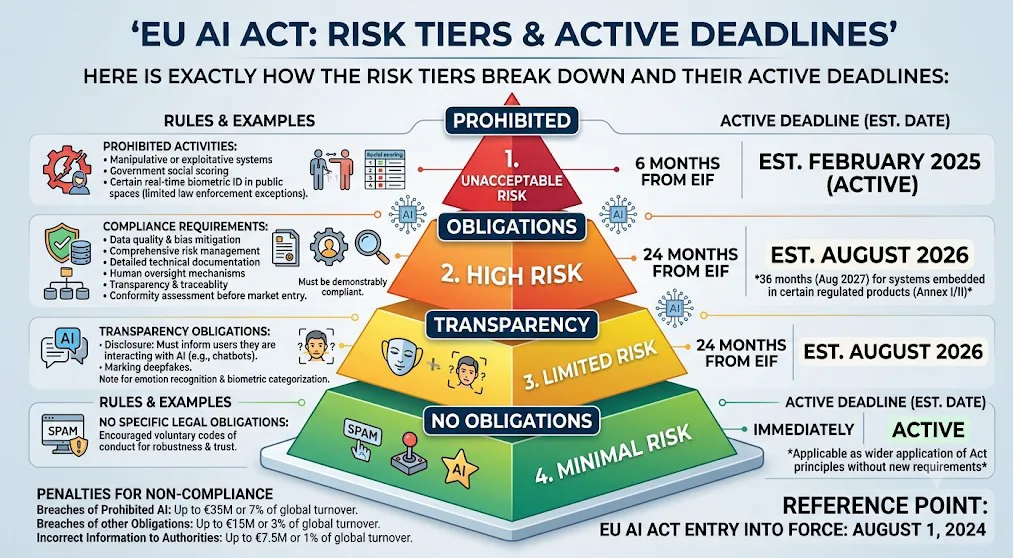
Here is exactly how the risk tiers break down and their active deadlines:
Tier 1: Unacceptable Risk
What it is: AI used for subliminal manipulation, social scoring, or untargeted biometric facial scraping.
The Deadline: Banned (As of Feb 2025).
The B2B Rule: Immediate Exclusion. These tools are completely illegal in the EU. Period.
Tier 2: Limited / Minimal Risk
What it is: Basic generative text apps, image generators, conversational bots, and customer triage systems.
The Deadline: Active (As of August 2026).
The B2B Rule: Transparency Disclosures. You must explicitly alert users that they are talking to a machine. You must also legally watermark AI-generated content.
Tier 3: General Purpose AI (GPAI)
What it is: Foundation models. These are the massive underlying language or image engines (like the core tech behind the biggest chatbots in the world).
The Deadline: Active (As of August 2026).
The B2B Rule: IP & Summary Audit. The creators must supply deep training metadata summaries and absolutely respect EU copyright laws. They can't just steal the entire internet without consequence anymore.
Tier 4: High-Risk AI Systems
What it is: AI used in critical areas: hiring and CV screening, biometrics, banking credit scores, medical devices, or critical infrastructure (like water and power grids).
The Deadline: Enforceable (By Dec 2027).
The B2B Rule: Conformity & Logs. This requires massive amounts of paperwork. Extensive data bias logging, mandatory human-in-the-loop overrides and formal EU registry indexing.
If you are deploying an AI model in a European hospital, you need dual compliance: GDPR for the patient data, and the EU AI Act to prove the model isn't biased. It is a massive undertaking.
5. The Golden Rule of AI: Data Training Governance
We're almost at the end, but I need you to focus on this last part. If you take away anything from this article, let it be this.
When you go out into the business world, you will be asked to evaluate AI tools for your company. You will look at a directory of AI apps. There is one critical flag you must look for above all else: Data Training Governance.
This determines whether an AI app is a safe, business-grade tool, or a massive liability that will get you sued.
Here are the two flags you need to watch for:
Zero-Data-Retention (ZDR):
What it means: The AI vendor explicitly signs terms stating that your inputs (your chats, your documents) are instantly processed and then permanently deleted. They are never used to train their AI models.
Why it matters: This is a Mandatory B2B Green Flag. It is absolutely essential for corporate legal privilege and enterprise safety. If you are uploading top-secret company financial plans to an AI to get a summary, you need a ZDR guarantee that the AI won't spit out your secrets to a competitor tomorrow.
Data Training Opt-In:
What it means: The app defaults to taking your chat conversations, your uploaded photos, or your documents, and uses them to train their public, global models.
Why it matters: This is a Hard Red Flag. It instantly disqualifies the app for standard corporate workflow deployment. If a tool defaults to this, do not use it for anything important.
Final Thoughts: Why This Is Your Problem Now
I know reading through acronyms like GDPR, HIPAA, and SOC 2 Type II isn't thrilling. But here is my final piece of advice, drawn from watching startups rise and crash: The innovators of tomorrow are not just the best coders; they are the people who understand the rules of the board game.
Sources
Policy Name
Official Source / Regulatory Body
General Data Protection Regulation (GDPR)
UK GDPR
California Consumer Privacy Act (CCPA)
California Office of the Attorney General
California Privacy Rights Act (CPRA)
California Privacy Protection Agency (CPPA)
Texas Data Privacy and Security Act (TDPSA)
Virginia Consumer Data Protection Act (VCDPA)
Indiana Consumer Data Protection Act (ICDPA)
Personal Information Protection and Electronic Documents Act (PIPEDA)
Law 25 (Quebec)
LégisQuébec (Publications Québec)
Privacy Act 1988 (Australia)
Federal Register of Legislation (Australia)
Digital Personal Data Protection (DPDP) Act (India)
Ministry of Electronics and Information Technology (MeitY)
Act on the Protection of Personal Information (APPI) (Japan)
Personal Information Protection Commission (PPC)
Personal Information Protection Law (PIPL) (China)
National People's Congress of China
SOC 2 Type II
American Institute of CPAs (AICPA)
ISO/IEC 27001
International Organization for Standardization (ISO)
ISO/IEC 42001
International Organization for Standardization (ISO)
NIST AI Risk Management Framework (AI RMF)
National Institute of Standards and Technology (NIST)
Health Insurance Portability and Accountability Act (HIPAA)
U.S. Department of Health and Human Services (HHS)
Personal Health Information Protection Act (PHIPA) (Ontario)
Payment Card Industry Data Security Standard (PCI DSS)
PCI Security Standards Council
Digital Operational Resilience Act (DORA)
European Union Artificial Intelligence Act (EU AI Act)
Family Educational Rights and Privacy Act (FERPA)
Children's Online Privacy Protection Act (COPPA)