
Top 12 Asymmetric Data Alternatives in 2026
No user reviews yet PaidAsymmetric Data clusters keyword lists into distinct content topics by analyzing SERP overlap. Upload keywords to receive a spreadsheet grouping terms by shared ranking URLs, with rank, traffic estimates, and opportunity metrics, facilitating targeted content strategy across languages and regions.
We've ranked 12 Asymmetric Data alternatives, including 4 with a free plan. Rankings are based on feature coverage and user feedbacks.
Top-rated alternatives include HyperSuggest, Keyword Insights, and Serpwe.
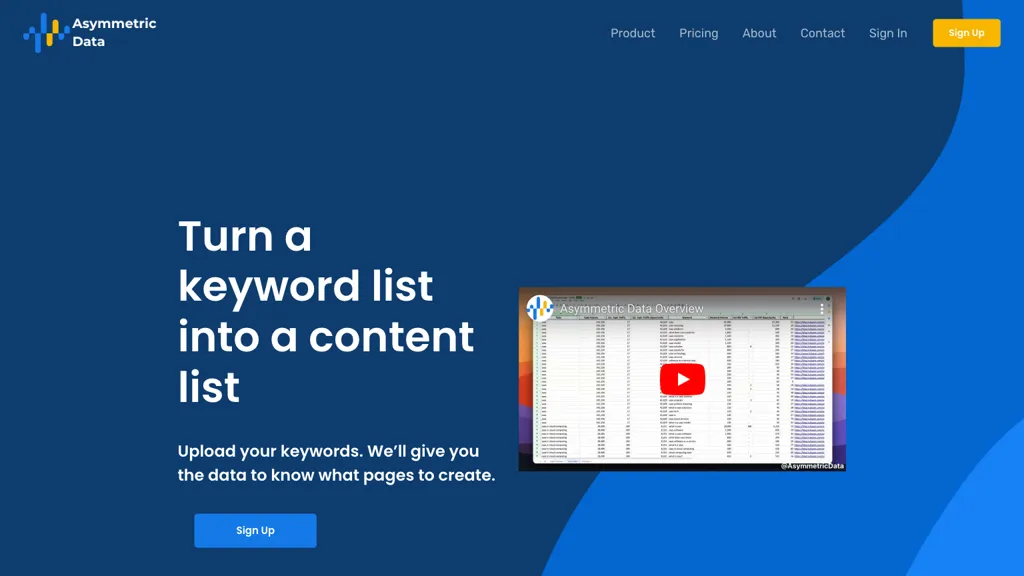
12 Asymmetric Data Alternatives & Competitors, Ranked by User Reviews
Click Compare on any tool to compare it side-by-side with Asymmetric Data.
 #1
HyperSuggest
#1
HyperSuggest
Seospark.io clusters keywords by SERP overlap to build precise topic clusters, offers search volume, competition, low‑competition filters, and generates content briefings. It tracks daily rankings, supports large keyword lists, and enables team collaboration across languages and regions.
 #2
Keyword Insights
#2
Keyword Insights
Keyword Insights consolidates keyword research from Google, Reddit, Quora, and YouTube. It clusters terms, provides volume, difficulty, CPC, SERP similarity, intent, content‑gap analysis, AI‑generated briefs, and on‑page writing support.
 #3
Serpwe
#3
Serpwe
Serpwe discovers keywords through Google and Bing autocomplete, clusters them into topical groups with real‑time SERP data and NLP, creates content briefs, converts them into SEO‑optimized text, and supports CMS publishing while integrating with SEO tools for tracking.
 #4
Neuraltext
#4
Neuraltext
NeuralText aids creators and marketers in generating, researching, and optimizing content. It clusters keywords, analyzes SERPs, offers AI writing tools, and connects to Google Search Console for performance insights, supporting multiple languages.
 #5
KWHero
#5
KWHero
AI‑driven SEO platform that evaluates topical coverage and semantic relevance, offers keyword research, topic clusters, and content briefs, tracks authority metrics across 62 markets, and supports 85+ languages for scalable site architecture.
 #6
Topical Map AI
#6
Topical Map AI
Topical Map AI automates social media and SEO keyword research, generating over 1,000 targeted keywords in seconds. It offers map creation, metrics viewing, and filtering capabilities across 20+ languages, streamlining content strategy for bloggers and marketers.
- Catch deals before they expire
- Unlock tools matched to you
- Show off your AI stacks
Already a member? Sign in
 #7
SEO Content AI
#7
SEO Content AI
SEO Content AI automates keyword‑optimized long‑form content creation, supports multiple languages, builds content clusters, and suggests internal links. It imports keywords for hands‑off research, adds local business URLs for localized SEO, and includes grammar and plagiarism checks.
 #8
Swiftbrief
#8
Swiftbrief
Swiftbrief automates SEO content planning by crawling SERPs, clustering keywords into seed, root, and branch groups, and producing data‑rich briefs. It supplies structured outlines, linking suggestions, media tags, AI‑generated copy, and performance tracking to optimize pages for conversions.
 #9
Contentmaps AI
#9
Contentmaps AI
Contentmaps AI creates topical clusters and authority maps by combining domain analysis, keyword clustering, SERP modeling, and Reddit sentiment. It spotlights content gaps, produces structured briefs, visualizes link opportunities, and streamlines research for teams.
 #10
SEOpital
#10
SEOpital
SEOpital uses AI to cluster keywords, analyze SERPs, and pinpoint ranking factors. It generates optimized articles, enriches existing content, tracks positions via Search Console, flags cannibalization, supports multiple languages, and suggests titles, images, and links.
 #11
KeywordSpy
#11
KeywordSpy
KeywordSpy analyzes Google’s ranking signals (Neural Matching, RankBrain, BERT, etc.) to provide real‑time keyword, title, meta, and HTML recommendations. It offers AI‑driven content outlines, plagiarism checks, rewrite tools, and project tracking for on‑page optimization.
 #12
Keyword Catcher
#12
Keyword Catcher
Keyword Catcher analyzes Google SERPs automatically, providing keyword research, rank tracking, and AI‑generated content outlines. It delivers search volume, competition, page metrics, and long‑tail suggestions, storing reports for ongoing strategy development.
Frequently Asked Questions
Why look for Asymmetric Data alternatives?
Common reasons users switch from Asymmetric Data:
- Cost: Asymmetric Data is a Paid tool — users often look for more affordable or free options.
- Feature gaps: teams needing specific capabilities like Analyze Keywords may find a more focused alternative better suited to their workflow.
- Flexibility: exploring alternatives helps find tools that better match your team size, integrations, and budget.
What is the best alternative to Asymmetric Data?
HyperSuggest ranks as the top Asymmetric Data alternative. Seospark.io clusters keywords by SERP overlap to build precise topic clusters, offers search volume, competition, low‑competition filters, and generat It is available on a Subscription plan starting from $69/mo.
How do the top Asymmetric Data alternatives compare?
| Tool | Pricing | Starting Price | User Rating |
|---|---|---|---|
| Asymmetric Data this tool | Paid | — | — |
| HyperSuggest | Subscription | $69/mo | — |
| Keyword Insights | Subscription | $58/mo | — |
| Serpwe | Paid | — | — |
| Neuraltext | Subscription | $19/mo | — |
| KWHero | Paid | $39/mo | — |
Are there free Asymmetric Data alternatives?
Yes, 4 free alternatives found in our list: Topical Map AI, SEO Content AI, Swiftbrief. and 1 more — use the pricing filter above to see them all.
What should I look for in a Asymmetric Data alternative?
- Core capabilities: confirm the tool supports Analyze Keywords, Generate Spreadsheets, Organize Text.
- Pricing transparency: look for clear free plan, trial period, or tiered pricing — avoid tools that hide costs.
- User reviews: check both the satisfaction percentage and the number of reviews; a high score from few users is less reliable.
- Integrations: verify it connects with your existing stack before committing.
- Support and updates: active development and responsive support are strong signals of a maintained product.
Which Asymmetric Data alternative has the highest user rating?
Topical Map AI has the highest satisfaction score among Asymmetric Data alternatives, with 50% positive from 2 user reviews. It is available on a Freemium plan.
What are Asymmetric Data alternatives used for?
- Analyze Keywords
- Generate Spreadsheets
- Organize Text
- Extract Metrics
- Automate Clusterings