
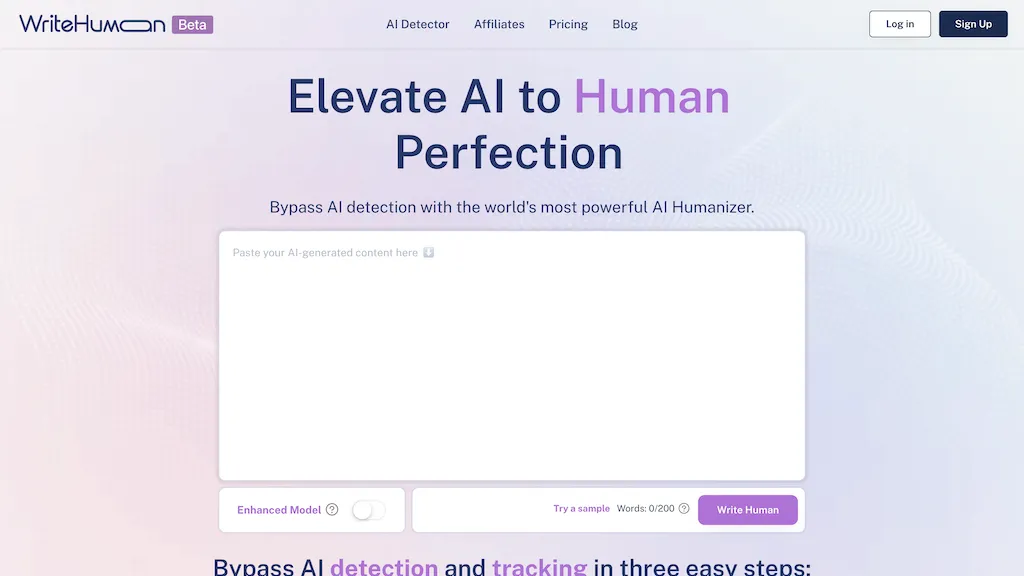
What is WriteHuman?
WriteHuman AI Humanizer Tool transforms AI‑generated text from engines such as ChatGPT, Claude, Gemini, and Deepseek into natural prose by refining sentence structure, rhythm, and tone while preserving the author’s unique voice. The platform includes a built‑in Content Scanner that evaluates readability and naturalness, and an AI Detector that checks output against popular detection services like GPTZero, Copyleaks, and Originality.
Users can generate multiple output variations per request and manage word limits per request with an integrated Word Counter. The tool is accessible through a web interface and a RESTful API, enabling batch processing for high‑volume workflows. WriteHuman serves writers, marketers, freelancers, content creators, agencies, and business professionals who need AI‑generated content that passes originality checks and reads like human‑authored text.
WriteHuman details
- Jurisdiction
- Commonwealth of Virginia
- Built for
- Individuals
WriteHuman tech specs
- Works with
- OpenAI / GPT Anthropic / Claude Google / Gemini DeepSeek xAI / Grok
- Payment Processors
- Stripe
WriteHuman pricing
FreemiumVerify on the official pricing page.
View plansWriteHuman's key features
-
Humanize AI-generated text
-
Detect AI-generated text
-
Detect AI-generated images
-
Detect AI-generated videos
-
Count words and characters
-
Programmatic API access
-
Built‑in content naturalness scanner
WriteHuman use cases
-
Transform AI‑generated marketing emails into brand‑consistent, human‑tone copy while meeting strict word‑count limits and ensuring AI detection scores are below industry thresholds
-
Batch‑humanize technical documentation drafts, automatically scanning for readability issues and providing multiple polished versions ready for publication or training manuals
-
Integrate WriteHuman into a localization workflow: fetch translated text via API, adjust tone and rhythm, and deliver web‑ready, AI‑undetectable content across multiple languages
WriteHuman user reviews
Based on 11 reviews, 73% of users recommend WriteHuman, rated highly for quality results.
Liked for
Disliked for
Would you recommend WriteHuman?
Who is WriteHuman for?
-
Content creators
-
Product designers
-
E-commerce sellers
-
Student learners
-
Academic researchers
WriteHuman FAQ
Is WriteHuman free?
Partly. WriteHuman has a free plan with usage limits, and paid plans unlock the full feature set. Plans include Priority support at $12/mo billed annually, Basic at $12/mo $144 billed yearly, Pro at $18/mo $216 billed yearly and Ultra at $36/mo $432 billed yearly.
Is WriteHuman safe to use?
WriteHuman carries the TopAI.tools verified mark, which we award after a manual review of pricing transparency, published terms, public following and working functionality. It has a substantial audience that is independently measured month to month.
Is WriteHuman good?
WriteHuman has a 73% recommendation rate from 11 reviewers on TopAI.tools. Reviewers rate it highest on quality of results and ease of use.
What are the best alternatives to WriteHuman?
The closest alternatives to WriteHuman are AI Humanize, GPTHumanizer, Super Humanizer AI, HumanizeAI and HumanizeAIText. You can compare them side by side in the alternatives section further down this page.
What does WriteHuman do with my data?
WriteHuman states that customer content may be used to train its models. Its privacy policy states that personal data is not sold or shared for marketing purposes. Data may be shared with third-party service providers that help run the product.
Does WriteHuman have an API?
Yes. WriteHuman offers an API, so you can call it from your own applications instead of using the interface directly.
Which AI models does WriteHuman use?
WriteHuman is built on OpenAI / GPT, Anthropic / Claude, Google / Gemini, DeepSeek and xAI / Grok. Which models you can reach may depend on your plan.
Compliance, privacy and billing terms are as stated in each product's own published documentation and have not been independently verified by TopAI.tools.


