
What is Undetectable WTF?
Undetectable AI transforms AI-generated content into human-like text designed to bypass GPTZero, Turnitin, ZeroGPT and other AI detection systems.
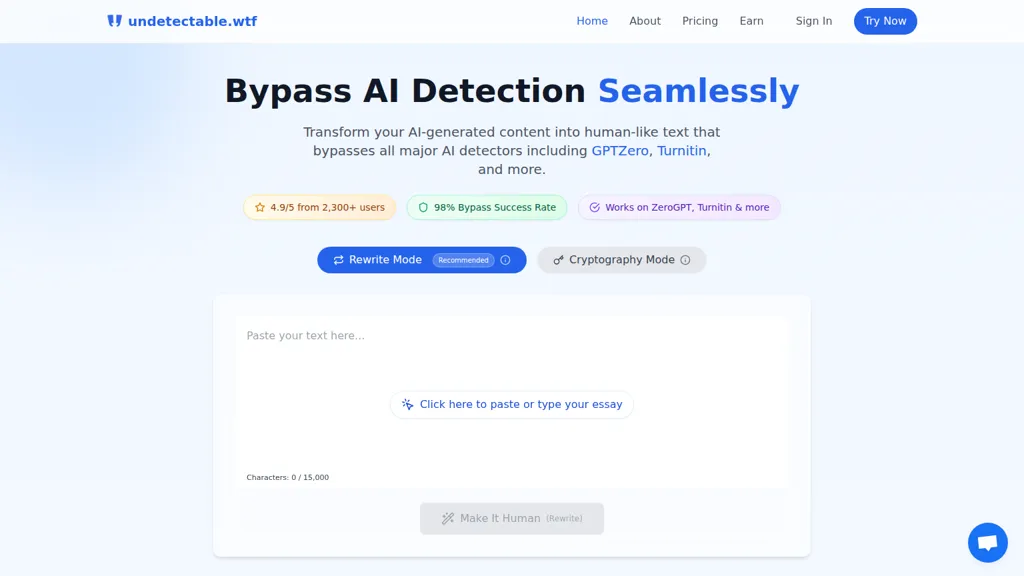
Rewrite mode rephrases sentences for natural-sounding prose and reduced detector signals.
Cryptography mode preserves visual appearance for human readers while altering underlying patterns to make content unreadable to AI detectors.
Supports up to 15,000 characters per submission with paste-or-type input and fast processing.
Designed for students, content writers, researchers, and editors using an AI humanizer to prepare essays, articles, and web content.
Includes a short tutorial and tools to compare detector results and refine outputs.
Undetectable WTF pricing
Free trialVerify on the official pricing page.
Start free trialUndetectable WTF's key features
-
Transforms AI-generated content to bypass major AI detectors (e.g., GPTZero, Turnitin, ZeroGPT)
-
Rewrite Mode: rephrases text to sound natural and less detectable
-
Cryptography Mode: keeps text visually identical for humans while making it unreadable to detectors
-
Processes inputs up to 15,000 characters per submission
-
Web-based interface allowing users to paste or type essays and run a 'Make It Human' processing action
Undetectable WTF use cases
-
Polish AI-generated articles into publication-ready, human-sounding copy using Rewrite mode to refine voice, fix flow and factual slips, then run the detector-comparison tool to address false positives and prepare a transparent AI-use disclosure for editors or publishers
-
Protect sensitive client or research content by applying Cryptography mode to obfuscate personal data and proprietary phrases before sharing drafts, enabling safe collaboration and later local decryption for authorized team members
-
Teach writers and researchers how small edits affect detectability by using the built-in tutorial and detector-aware rewriting to generate multiple versions, compare detector scores, and iteratively improve readability while maintaining ethical AI-disclosure practices
Undetectable WTF user reviews
Would you recommend Undetectable WTF?
Who is Undetectable WTF for?
-
Technical writers
-
Academic researchers
-
Data analysts
-
Cryptographers
-
Software developers
Undetectable WTF FAQ
Is Undetectable WTF free?
Not permanently. Undetectable WTF gives you a free trial, after which a paid plan is required. Plans include Free trial at $0/3 days, Standard at $12.99/mo and Pro at $24.99/mo.
What are the best alternatives to Undetectable WTF?
The closest alternatives to Undetectable WTF are AI Humanize, HumanizeAI, BypassGPT, StealthWriter and BypassGPT AI. You can compare them side by side in the alternatives section further down this page.


