
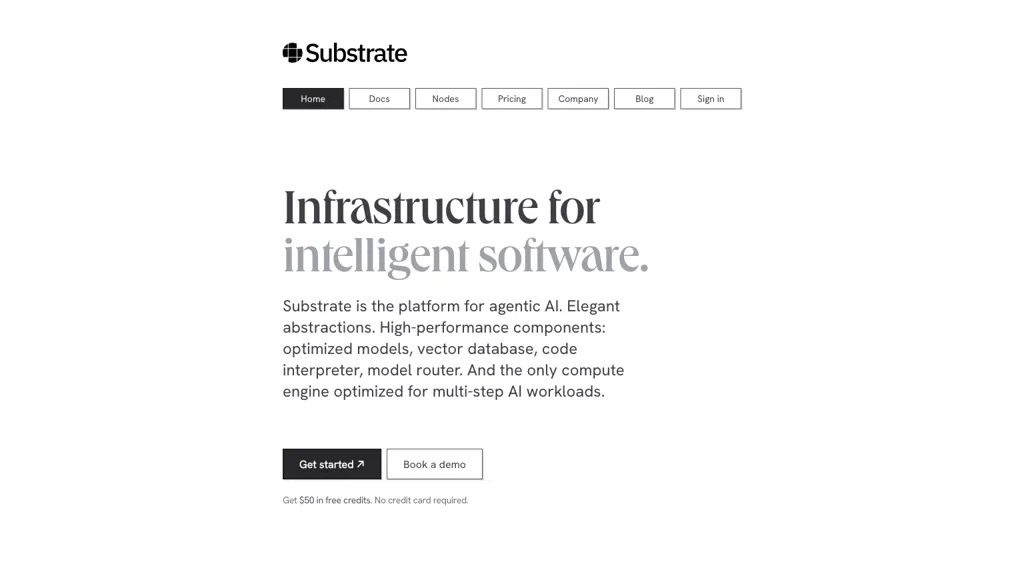
What is Substrate?
Substrate is a platform for building and running compound AI systems that orchestrates multiple models and data sources. It provides modular building blocks called nodes, which can be connected to create directed acyclic graph workflows that represent multi‑step AI tasks.
The engine automatically analyzes the graph to merge compatible nodes, reducing round‑trips and increasing parallelism. Integrated components include an optimized vector database for similarity search, a code interpreter for executing Python or TypeScript snippets, and a model router that selects the appropriate LLM for each step.
Developers can construct workflows in Python or TypeScript using a lightweight SDK, with futures to handle asynchronous execution. Substrate supports rapid prototyping and deployment of agentic AI applications, enabling teams to assemble complex inference pipelines without managing underlying compute infrastructure.
Substrate details
- Company
- Zo Computer Company
- Jurisdiction
- New York
Substrate tech specs
- Cloud
- Vercel
- Payment Processors
- Stripe
- Integrations
- Discord WordPress Webflow
Substrate pricing
FreemiumVerify on the official pricing page.
View plansSubstrate's key features
-
Compute engine for multi-step AI
-
DAG-based automatic workload tuning
-
Modular node workflow abstractions
-
Optimized models, vector DB, interpreter
-
Future-based execution model
-
Python & TypeScript SDK
-
Parallel execution, fewer roundtrips
Substrate use cases
-
Build a data‑driven analytics pipeline that ingests raw logs, runs feature extraction, performs vector similarity search, and streams summarized insights to stakeholders—all orchestrated in Substrate’s DAG, with auto‑parallelism and no heavy infra overhead
-
Create a real‑time customer support chatbot that merges intent detection, vector‑based FAQ retrieval, code execution for dynamic queries, and a model router that selects the best LLM for each intent—all wired through Substrate’s lightweight SDK
-
Prototype an AI recommendation engine by chaining a vector search DB, a collaborative filtering node, and a code interpreter that generates personalized tips, using Substrate’s DAG orchestration to iterate designs quickly
Substrate user reviews
Would you recommend Substrate?
Who is Substrate for?
-
Software developers
-
Data architects
-
System administrators
-
Cloud engineers
-
Database managers


