
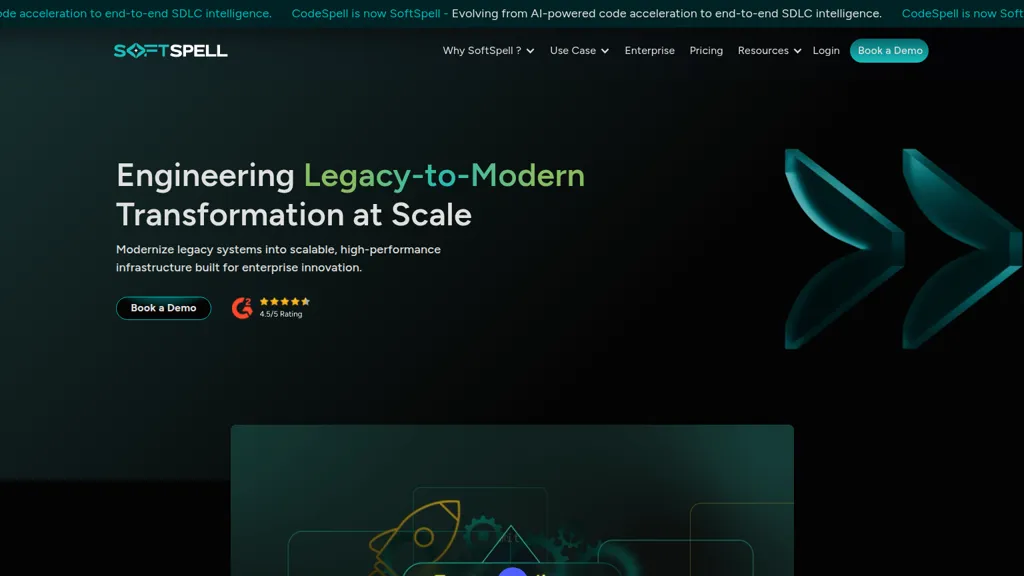
What is SoftSpell?
SoftSpell is an end-to-end SDLC intelligence platform offering ReqSpell, CodeSpell, and TestSpell modules to streamline requirements, code generation, and test automation.It delivers AI-assisted code acceleration and automated test generation to reduce development cycle time and improve test coverage.
Integrations include IDEs (VS Code, IntelliJ, Eclipse), design tools (Figma), and language/runtime support for Java,.NET, PHP, and Node.js.Features include requirement tracing, code-quality checks, and analytics for traceability and auditability across design-to-deploy workflows.
Integrates with existing CI/CD pipelines and developer toolchains to minimize context switching and preserve workflow continuity.Suited for developers, QA engineers, product managers, and engineering leaders focused on improving developer productivity, QA efficiency, and release cadence.
SoftSpell details
- Built for
- Businesses and teams
SoftSpell tech specs
- Cloud
- Azure
- Integrations
- Slack GitLab
SoftSpell pricing
Free trial- Free trial
- 7 days
Verify on the official pricing page.
Start free trialSoftSpell's key features
-
AI-powered code acceleration
-
End-to-end SDLC intelligence (design-to-deploy)
-
Modules for requirements, code, and testing (ReqSpell, CodeSpell, TestSpell)
-
Integrations with IDEs and design tools (Eclipse, VS Code, IntelliJ, Figma)
-
Multi-language/platform support (Java, .NET, PHP, Node.js)
SoftSpell use cases
-
Create production-ready code and corresponding automated tests from user stories and design artifacts using CodeSpell and TestSpell, while ReqSpell ensures requirement traceability and automated delivery through your IDE and CI/CD pipelines
-
Develop a continuous quality gate that enforces coding standards and security checks using SoftSpell's code-quality analytics, surfacing actionable suggestions directly in developers' IDEs and blocking unsafe merges in CI/CD
-
Create audit-ready SDLC reports that trace requirements to code and tests, visualize test coverage and code-quality trends, and integrate with runtime and design tools to support compliance and release decision-making
SoftSpell user reviews
Based on 1 review, 100% of users recommend SoftSpell, rated highly for feature coverage.
Liked for
Would you recommend SoftSpell?
Who is SoftSpell for?
-
Software developers
-
Software architects
-
Project managers
-
Product managers
-
Quality assurance engineers
SoftSpell FAQ
Is SoftSpell free?
Not permanently. SoftSpell gives you a free trial of 7 days, after which a paid plan is required. Plans include Starter at $12/mo/user (billed annually), Starter at $15/mo/user, Growth at $20/mo/user (billed annually) and Growth at $24/mo/user.
What are the best alternatives to SoftSpell?
The closest alternatives to SoftSpell are skcript.com, Snapshot Reviews, Programming Helper, Durable AI and Teste.ai. You can compare them side by side in the alternatives section further down this page.
What does SoftSpell do with my data?
SoftSpell states that customer content is not used to train its models. Its privacy policy states that personal data is not sold or shared for marketing purposes. Data may be shared with third-party service providers that help run the product.
What does SoftSpell integrate with?
SoftSpell connects with Slack and GitLab.
Compliance, privacy and billing terms are as stated in each product's own published documentation and have not been independently verified by TopAI.tools.


