
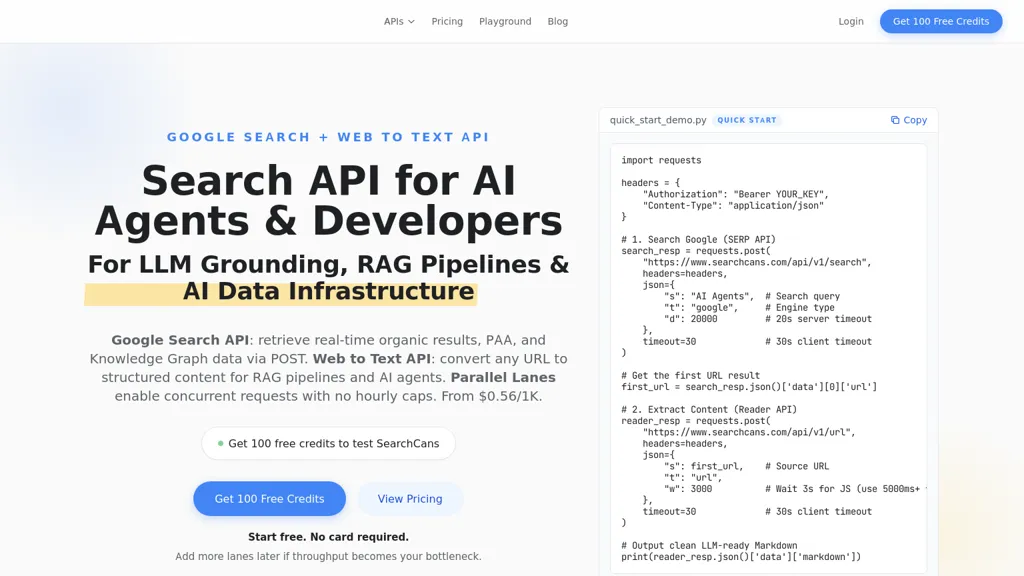
What is SearchCans?
Searchcans provides Google Search API and a Web Text (Reader) API for real-time SERP data and structured web content extraction.The Search API returns organic results, people-also-ask (PAA) entries, and knowledge-graph data as structured JSON via POST requests with bearer-token authentication.
The Reader API converts URLs into cleaned, LLM-ready markdown or JSON for retrieval-augmented generation (RAG) pipelines and AI agents.Parallel lanes, hourly rate limits, and lane stacking enable concurrent requests and scalable throughput for production workloads.
APIs integrate with LangChain and LlamaIndex and remove the need for custom HTML parsing or manual content cleaning.Standard JSON payloads, configurable timeouts, and clear error codes support developer workflows and automated search-driven applications.
Use cases include LLM grounding, search-driven agents, content indexing, automated research, and data enrichment across Google and Bing search sources.
SearchCans details
- Jurisdiction
- State of Washington, United States
- Built for
- Developers
- Data residency
- United States
- Stated compliance
- CCPA
Compliance as stated in SearchCans's own published documentation.
SearchCans pricing
Free trialVerify on the official pricing page.
Start free trialSearchCans's key features
-
Real-time Google Search API returning organic results, people-also-ask entries, and knowledge-graph data as structured JSON via POST with bearer-token authentication
-
Web Text (Reader) API that converts URLs into cleaned, LLM-ready Markdown or JSON for retrieval-augmented generation and AI agents
-
Concurrency and throughput controls via parallel lanes, lane stacking, and hourly rate limits for scalable concurrent requests
-
Native integrations with LangChain and LlamaIndex, removing the need for custom HTML parsing and manual content cleaning
-
Standardized developer interface with standard JSON payloads, configurable timeouts, clear error codes, and support for Google and Bing search sources
SearchCans use cases
-
Build a real-time, search-powered RAG chatbot using Searchcans' Google Search and Reader APIs to pull organic results, PAA, and knowledge-graph data and automatically convert URLs into LLM-ready markdown/JSON for accurate, up-to-date responses
-
Create an SEO and competitive intelligence dashboard by indexing SERP JSON and tracking organic rankings, PAA trends, and knowledge-graph signals with Searchcans' real-time SERP API and scalable concurrent requests to monitor thousands of queries
-
Develop search-driven agents and automated content pipelines that extract, clean, and convert web content into RAG-ready markdown for fast content indexing, summarization, and multi-agent orchestration at scale without building custom parsers
SearchCans user reviews
Based on 3 reviews, 100% of users recommend SearchCans, rated highly for value for money.
Liked for
Would you recommend SearchCans?
Who is SearchCans for?
-
Search application developers
-
Rag pipeline builders
-
Nlp researchers
-
Product managers
-
Enterprise integration architects
SearchCans FAQ
Is SearchCans free?
Not permanently. SearchCans gives you a free trial, after which a paid plan is required. Plans include Pay-per-request at $0.56/1k, Standard at $18.00, Starter at $99.00 and Pro at $597.00.
Is SearchCans safe to use?
SearchCans states CCPA compliance in its own published documentation.
What are the best alternatives to SearchCans?
The closest alternatives to SearchCans are Serpex.dev, TalorData, Exa AI, Firecrawl and LangSearch. You can compare them side by side in the alternatives section further down this page.
What does SearchCans do with my data?
Its privacy policy states that personal data is not sold or shared for marketing purposes. Data may be shared with third-party service providers that help run the product. Customer data is held in United States.
Does SearchCans have an API?
Yes. SearchCans offers an API, so you can call it from your own applications instead of using the interface directly.
Compliance, privacy and billing terms are as stated in each product's own published documentation and have not been independently verified by TopAI.tools.


