
What is RunLLM?
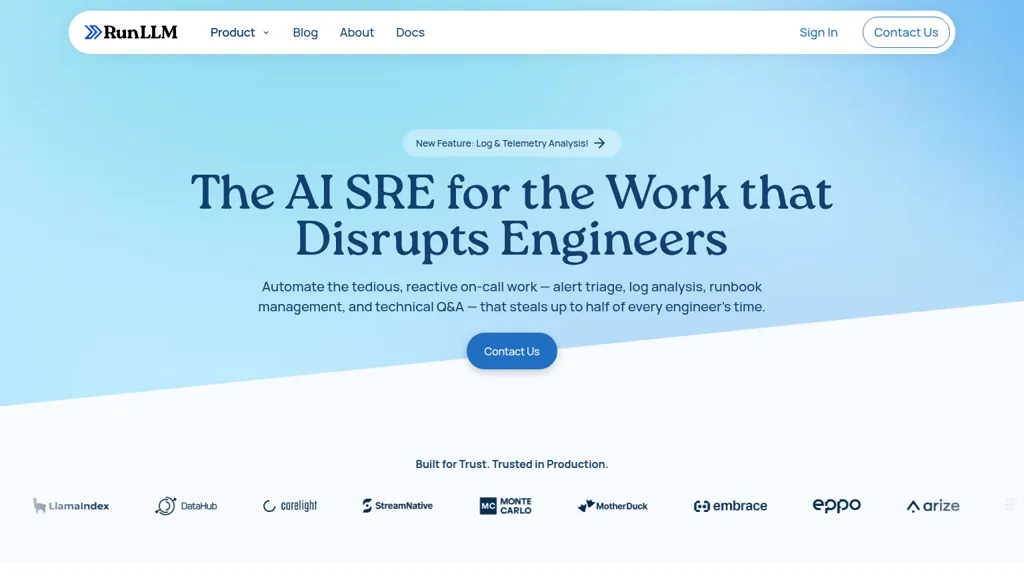
RunLLM automates incident investigations by querying observability tools, correlating telemetry, and delivering causal analyses into team channels. It integrates with Datadog, Splunk, GitHub, and Slack to pull traces, logs, deployments, and error patterns for rapid root-cause identification.
The platform generates reproducible investigation records and live runbooks that capture the steps taken, reducing dependence on individual engineers’ institutional knowledge. On-call engineers receive prioritized findings and remediation or rollback recommendations to accelerate mean time to resolution (MTTR) and standardize response procedures.
Engineering leaders get an auditable history of incidents and diagnostic trends to support onboarding and operational planning. RunLLM refines diagnostic patterns from each incident to improve anomaly detection, alert correlation, and actionable guidance.
RunLLM details
- Company
- RunLLM, Inc. (d/b/a Herald)
- Jurisdiction
- California
- Built for
- Businesses and teams
- Stated compliance
- SOC 2
Compliance as stated in RunLLM's own published documentation.
RunLLM tech specs
- Works with
- Anthropic / Claude
- Integrations
- Slack Jira
RunLLM pricing
FreemiumRunLLM offers a free plan with paid upgrades available.
- Auto-renewal
- Yes
Verify on the official pricing page.
View plansRunLLM's key features
-
Automated investigations triggered by alerts
-
Correlates traces, metrics, logs and deployments for causal analysis
-
Integrations with Datadog, Splunk, GitHub and other data sources
-
Posts detailed diagnostic reports and remediation recommendations to Slack
-
Captures investigation steps and continuously learns to update runbooks
RunLLM use cases
-
Automate end-to-end incident investigations with RunLLM by querying your observability stack (traces, logs, deployments), correlating telemetry into causal failure analyses, and producing reproducible investigation records plus prioritized remediation guidance for on-call teams
-
Create live incident runbooks that update automatically as RunLLM correlates alerts and telemetry, enabling engineers to execute safe remediation steps, track actions in real time, and generate auditable timelines for postmortems and compliance
-
Generate continuous diagnostic trends and alert-correlation dashboards using RunLLM's telemetry correlation engine to reduce noise, surface recurring failure patterns, prioritize engineering work, and provide an auditable trail for SRE reviews and incident prevention
RunLLM user reviews
Based on 1 review, 0% of users recommend RunLLM.
Disliked for
Would you recommend RunLLM?
Who is RunLLM for?
-
Technical architects
-
System administrators
-
Data analysts
-
Software developers
-
Cloud engineers
RunLLM FAQ
Is RunLLM free?
Partly. RunLLM has a free plan with usage limits, and paid plans unlock the full feature set.
Is RunLLM safe to use?
RunLLM states SOC 2 compliance in its own published documentation. RunLLM is operated by RunLLM, Inc. (d/b/a Herald), registered in California.
What are the best alternatives to RunLLM?
The closest alternatives to RunLLM are TraceRoot.AI, autobotAI, Tracecat, Observo and Rootly. You can compare them side by side in the alternatives section further down this page.
What does RunLLM do with my data?
Data may be shared with third-party service providers that help run the product.
Does RunLLM auto-renew or offer refunds?
RunLLM subscriptions renew automatically until you cancel.
Does RunLLM have an API?
Yes. RunLLM offers an API, so you can call it from your own applications instead of using the interface directly.
Who made RunLLM?
RunLLM is built and operated by RunLLM, Inc. (d/b/a Herald), a company registered in California.
Which AI models does RunLLM use?
RunLLM is built on Anthropic / Claude. Which models you can reach may depend on your plan.
What does RunLLM integrate with?
RunLLM connects with Slack and Jira.
Compliance, privacy and billing terms are as stated in each product's own published documentation and have not been independently verified by TopAI.tools.


