
What is Roboflow?
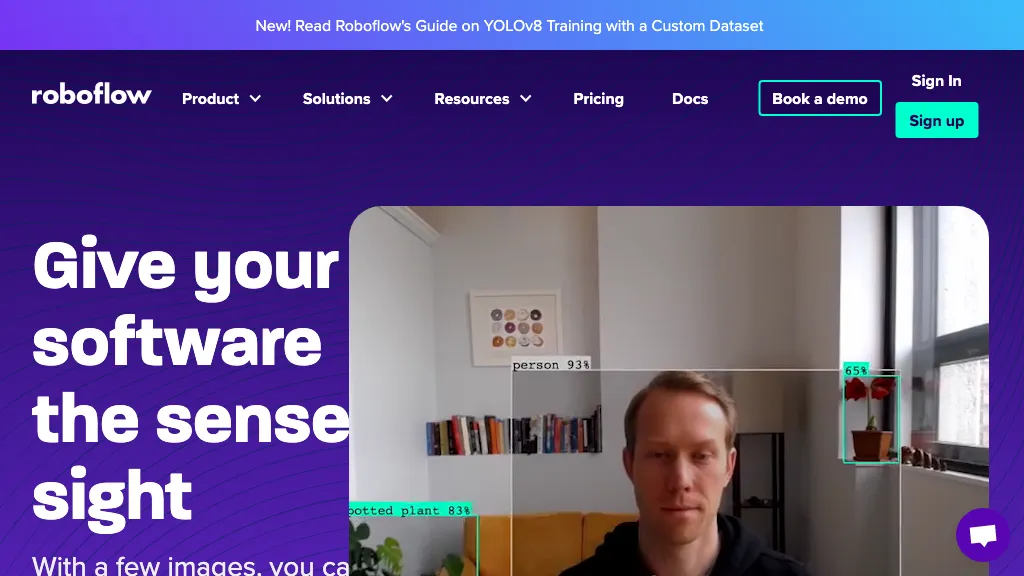
Roboflow is a complete computer‑vision platform that enables developers and enterprises to manage the full model lifecycle—from data annotation and model training to deployment and inference. It offers a low‑code pipeline builder that integrates with popular frameworks such as PyTorch, TensorFlow, and Hugging Face, while providing GPU‑accelerated training infrastructure for large‑scale datasets.
The platform supports model deployment on the cloud, in private VPCs, at the edge, or via API, and includes an open‑source inference server that can be launched with a single pip install. Roboflow supplies a library of ready‑made models (e.g., YOLOv5, YOLOv8, RF‑DETR, SAM) and a collection of open‑source utilities for annotation, tracking, and data transformation.
It connects seamlessly to major cloud providers (AWS, Azure, GCP), storage services (S3, Google Cloud Storage, Supabase), and training frameworks (Colab, Keras, Sagemaker). The platform’s ecosystem includes notebooks, autodistill for high‑quality labeling, and modular trackers for multi‑object tracking.
Roboflow details
- Company
- Roboflow, Inc.
- Jurisdiction
- Delaware
- Built for
- Individuals
- Stated compliance
- SOC 2, HIPAA
Compliance as stated in Roboflow's own published documentation.
Roboflow tech specs
- AI infrastructure
- Hugging Face
- Cloud
- AWS Google Cloud Azure Supabase
- Integrations
- GitHub
Roboflow pricing
FreemiumRoboflow offers a free plan with paid upgrades available.
- Auto-renewal
- Yes
Verify on the official pricing page.
View plansRoboflow's key features
-
Satellite and drone footage analysis
-
Crop yield optimization
-
Automated KYC and investigations
-
Medical care streamlining
-
Production error reduction
-
Pipeline safety automation
-
Security camera threat detection
Roboflow use cases
-
Annotate industrial defect images with minimal coding, train a YOLO model on GPUs, and deploy the model to on‑site edge devices for real‑time quality inspection
-
Create a low‑code pipeline to gather and annotate traffic sign datasets, accelerate training on GPU clusters, and deploy the resulting model to cloud‑based autonomous driving platforms with HIPAA‑level security
-
Develop a multi‑object tracking solution for retail shelf monitoring, annotate product images in the browser, train a fast‑RNN on GPU, and push the model to edge devices for inventory analysis in compliance with SOC2 Type 2
Roboflow user reviews
Based on 10 reviews, 80% of users recommend Roboflow, rated highly for ease of use.
Liked for
Disliked for
Would you recommend Roboflow?
Main competitors of Roboflow
Here are some of the major competitors comparisons vs. Roboflow.


Who is Roboflow for?
-
Machine learning developers
-
Computer vision designers
-
Data analysts
-
E-commerce sellers
-
Product designers
Roboflow FAQ
Is Roboflow free?
Partly. Roboflow has a free plan with usage limits, and paid plans unlock the full feature set.
Is Roboflow safe to use?
Roboflow states SOC 2 and HIPAA compliance in its own published documentation. Roboflow is operated by Roboflow, Inc., registered in Delaware. Roboflow carries the TopAI.tools verified mark, which we award after a manual review of pricing transparency, published terms, public following and working functionality.
Is Roboflow good?
Roboflow has an 80% recommendation rate from 10 reviewers on TopAI.tools. Reviewers rate it highest on ease of use and quality of results.
What are the best alternatives to Roboflow?
The closest alternatives to Roboflow are Ultralytics, BasicAI Cloud, Robovision.ai, SyntheticAIdata and Ocular AI. You can compare them side by side in the alternatives section further down this page.
What does Roboflow do with my data?
Roboflow states that customer content may be used to train its models. Its privacy policy states that personal data is not sold or shared for marketing purposes. Data may be shared with third-party service providers that help run the product.
Does Roboflow auto-renew or offer refunds?
Roboflow subscriptions renew automatically until you cancel.
Does Roboflow have an API?
Yes. Roboflow offers an API, so you can call it from your own applications instead of using the interface directly.
Who made Roboflow?
Roboflow is built and operated by Roboflow, Inc., a company registered in Delaware.
What does Roboflow integrate with?
Roboflow connects with GitHub.
Compliance, privacy and billing terms are as stated in each product's own published documentation and have not been independently verified by TopAI.tools.


