
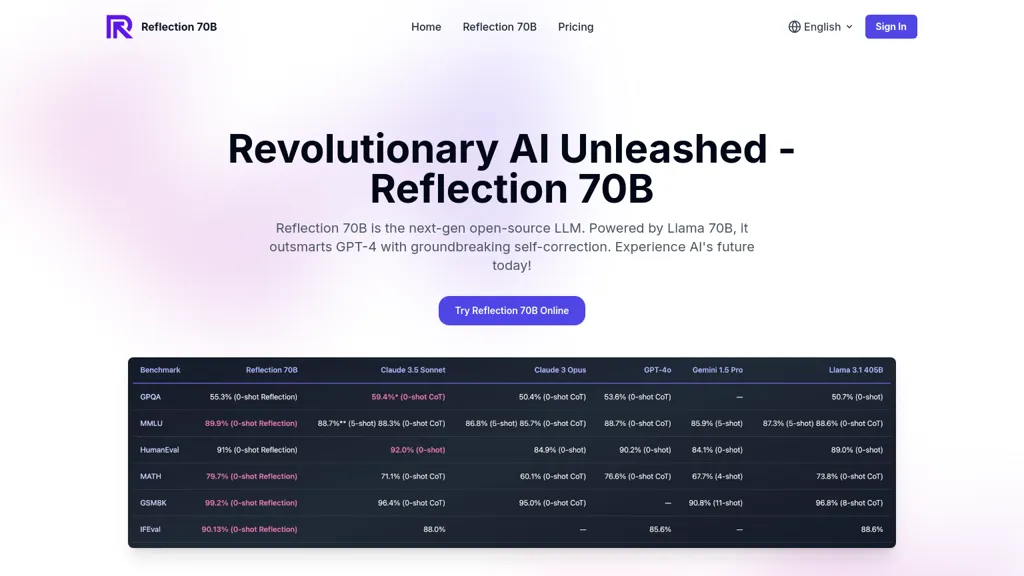
What is Reflection 70B?
Reflection 70B is an open‑source large language model based on Meta’s Llama 3.1 70B Instruct that incorporates a reflection‑tuning mechanism for real‑time self‑correction during text generation. The model performs well on benchmarks such as MMLU, HumanEval, MATH, IFEval, and GSM8K, often surpassing GPT‑4o and Llama 3.
1 405B in accuracy and precision. Reflection 70B’s architecture allows it to break complex tasks into discrete reasoning steps, improving reliability for high‑precision applications like coding assistance, debugging, and advanced problem solving. Developers can integrate the model into existing workflows through compatible APIs, while researchers use it for natural language processing experiments and product managers deploy it for context‑aware dialogue in customer‑facing tools.
Reflection 70B details
- Built for
- Individuals
Reflection 70B tech specs
- Works with
- OpenAI / GPT Meta
Reflection 70B pricing
FreemiumVerify on the official pricing page.
View plansReflection 70B's key features
-
Real-time self-correction
-
Reflection-Tuning training method
-
Seamless Llama 3.1 compatibility
-
Benchmark-topping performance
-
High-precision stepwise reasoning
-
Advanced coding support
-
Structured token-based correction
Reflection 70B use cases
-
Automated code review and refactoring for open‑source projects, leveraging Reflection 70B’s self‑correcting logic to spot bugs and suggest optimal implementations, all via a simple API call from your CI pipeline.
-
Dynamic math tutoring platform that instantly solves complex equations and step‑by‑step proofs, using Reflection 70B’s advanced reasoning to self‑correct mistakes and explain concepts in natural language, all while preserving user privacy on a no‑registration web interface.
-
Enterprise knowledge‑base chatbot that drafts precise, context‑aware responses and self‑checks for factual accuracy, integrating Reflection 70B’s real‑time reflection tuning to continually improve answers without exposing internal data through the API.
Reflection 70B user reviews
Would you recommend Reflection 70B?
Who is Reflection 70B for?
-
Software developers
-
Creative problem-solvers
-
Data privacy advocates
-
Conversational language researchers
-
Human-computer interface designers
Reflection 70B FAQ
Is Reflection 70B free?
Partly. Reflection 70B has a free plan with usage limits, and paid plans unlock the full feature set. Plans include Basic at $7.9/mo, Standard at $12.9/mo and Professional at $16.9/mo.
What are the best alternatives to Reflection 70B?
The closest alternatives to Reflection 70B are Llama.cpp, Oobabooga, BenchLLM, Exllama and Vllm. You can compare them side by side in the alternatives section further down this page.
What does Reflection 70B do with my data?
Its privacy policy states that personal data is sold or shared for marketing purposes.
Which AI models does Reflection 70B use?
Reflection 70B is built on OpenAI / GPT and Meta. Which models you can reach may depend on your plan.
Compliance, privacy and billing terms are as stated in each product's own published documentation and have not been independently verified by TopAI.tools.


