
What is MCP Defender?
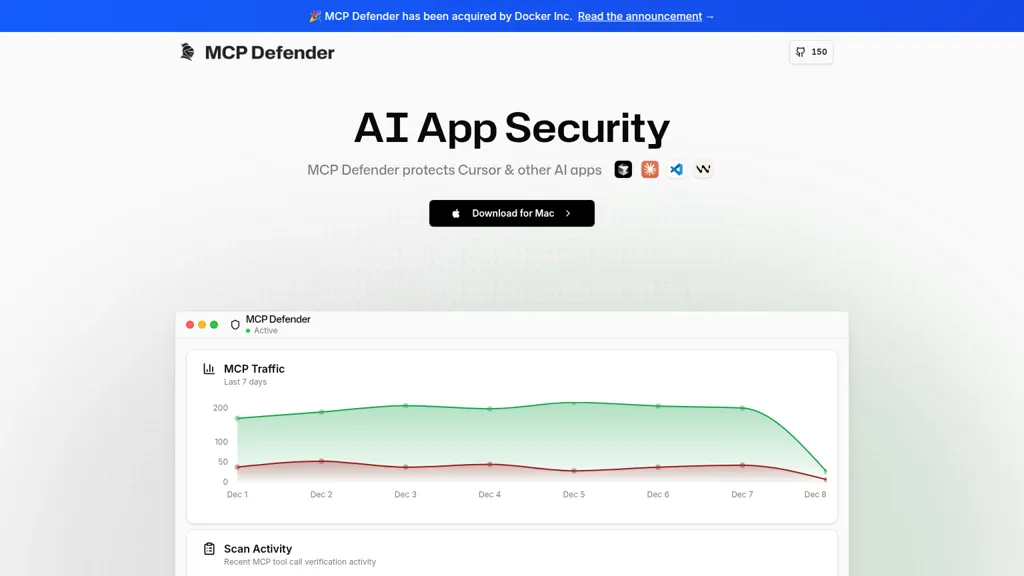
MCP Defender protects AI applications by scanning and filtering MCP tool calls in real time for AI app security.
It acts as a secure proxy that inspects requests and responses to identify and block prompt injection, tool poisoning, credential theft, arbitrary code execution, and remote command injection.
LLM-powered detection plus deterministic signatures provide layered threat detection; users can manage scan signatures and choose their own LLM provider and API keys.
Automatic protection runs in the background without modifying client apps and supports Cursor, Claude, Visual Studio Code and other MCP-integrated tools.
Logs and alerts give developers and security teams visibility into tool call activity and blocked threats for incident response and audit.
Open source and AGPL-3.0 licensed, suitable for teams that require deployable source code and policy control for AI tool security.
MCP Defender details
- Company
- MCP Defender Inc.
- Jurisdiction
- California, United States
MCP Defender tech specs
- Works with
- Anthropic / Claude
- Integrations
- GitHub
MCP Defender pricing
FreemiumMCP Defender offers a free plan with paid upgrades available.
Verify on the official pricing page.
View plansMCP Defender's key features
-
Real-time secure proxy analyzing communications between AI apps and MCP servers
-
LLM-powered malicious-activity detection combined with deterministic signature analysis
-
Configurable scan control with user-manageable signatures
-
Automated enforcement to allow or block MCP tool calls in real-time
-
Pluggable LLM provider support with custom API keys and integrations for Cursor, Claude, Visual Studio Code, and Windsurf
MCP Defender use cases
-
Protect enterprise AI assistants and agent tool integrations by deploying MCP Defender as a secure proxy to scan and filter all MCP tool calls in real time, blocking prompt injection, tool poisoning, and credential theft before they reach backend services
-
Harden customer-facing chatbots and virtual agents with MCP Defender to prevent remote command injection and arbitrary code execution by using LLM-powered detection and deterministic signatures to stop malicious prompts and data exfiltration
-
Secure developer CI/CD and automation pipelines that call external tools by routing tool calls through MCP Defender to monitor for compromised plugins, prevent credential leaks, and enforce policy compliance with open-source, auditable security controls
MCP Defender user reviews
Would you recommend MCP Defender?
Who is MCP Defender for?
-
Cybersecurity engineers
-
Software developers
-
System administrators
-
Data analysts
-
Infrastructure architects
MCP Defender FAQ
Is MCP Defender free?
Partly. MCP Defender has a free plan with usage limits, and paid plans unlock the full feature set.
Is MCP Defender safe to use?
MCP Defender is operated by MCP Defender Inc., registered in California, United States.
What does MCP Defender do with my data?
Its privacy policy states that personal data is sold or shared for marketing purposes. Data may be shared with third-party service providers that help run the product.
Does MCP Defender have an API?
Yes. MCP Defender offers an API, so you can call it from your own applications instead of using the interface directly.
Who made MCP Defender?
MCP Defender is built and operated by MCP Defender Inc., a company registered in California, United States.
Which AI models does MCP Defender use?
MCP Defender is built on Anthropic / Claude. Which models you can reach may depend on your plan.
What does MCP Defender integrate with?
MCP Defender connects with GitHub.
Compliance, privacy and billing terms are as stated in each product's own published documentation and have not been independently verified by TopAI.tools.