
What is How LLMs work?
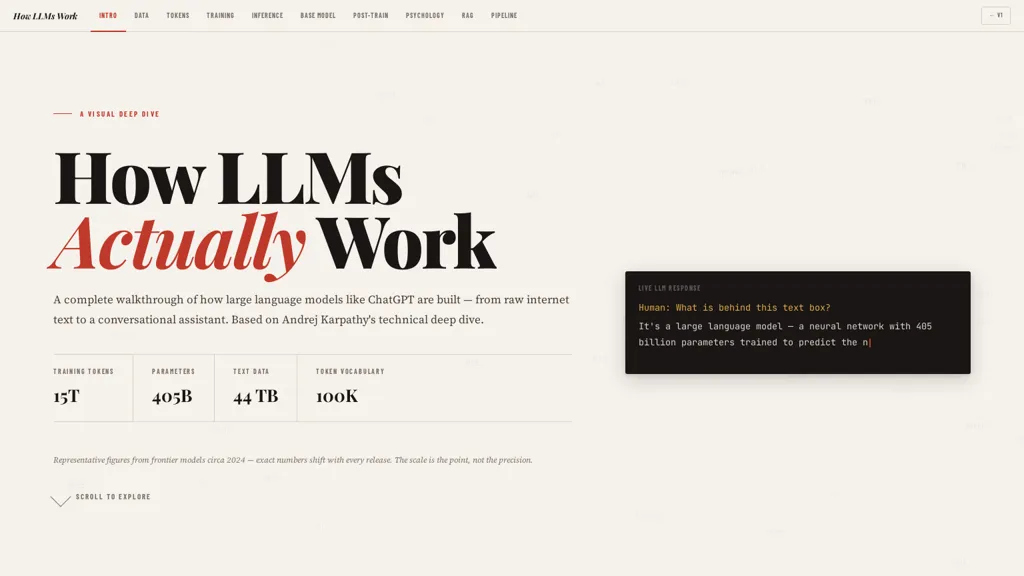
LLMs Work is a visual deep dive into how large language models operate, covering pre-training, tokenization, transformer architecture, attention mechanisms, inference, and retrieval-augmented generation (RAG) pipelines.
The resource documents data preparation steps—web crawling, language filtering, deduplication, and PII removal—and references representative corpora such as FineWeb and Common Crawl.It explains tokenization approaches like byte pair encoding (BPE), tokenizer vocabularies, and how token embeddings feed multi-head attention and transformer blocks.
Training topics include loss measurement, parameter updates across billions of parameters, and practical notes on sampling and autoregressive inference.The content targets ML researchers, engineers, data scientists, and students seeking a technical walkthrough of model internals, dataset curation, and deployment considerations.
Visualizations, stepwise walkthroughs, and live examples support debugging, model evaluation, and understanding generation behavior.
How LLMs work pricing
FreeThis tool is free to use, with no credit card required.
Verify on the official pricing page.
Get started freeHow LLMs work's key features
-
Pre-training and model internals coverage (transformer architecture, attention mechanisms)
-
Tokenization methods and token embedding pipeline (BPE, tokenizer vocabularies)
-
Data preparation pipeline (web crawling, language filtering, deduplication, PII removal)
-
Training and inference procedures (loss measurement, large-scale parameter updates, sampling, autoregressive inference)
-
Retrieval-augmented generation (RAG) and inference pipeline explanations
How LLMs work use cases
-
Inspect and debug model behavior by visualizing tokenization (BPE merges), transformer attention maps, autoregressive inference traces and intermediate layer activations with LLMs Work's live examples and visualizations to pinpoint hallucinations, performance bottlenecks, and optimization targets without building custom tooling
-
Curate and optimize datasets and RAG pipelines for fine-tuning by using LLMs Work to simulate training dynamics, evaluate retrieval strategies, visualize dataset coverage and failure modes, and generate interpretable metrics that accelerate domain adaptation and reduce trial-and-error
-
Onboard engineers, researchers and product teams with interactive visual walkthroughs of LLM internals—pre-training, tokenization, attention mechanics, inference and deployment trade-offs—enabling collaborative debugging, informed architecture decisions, and clearer communication of model limitations to stakeholders
How LLMs work user reviews
Would you recommend How LLMs work?
Who is How LLMs work for?
-
Ml researchers
-
Engineers
-
Data scientists
-
Students
How LLMs work FAQ
Is How LLMs work free?
Yes. How LLMs work is free to use and does not require a credit card.