
What is Hex?
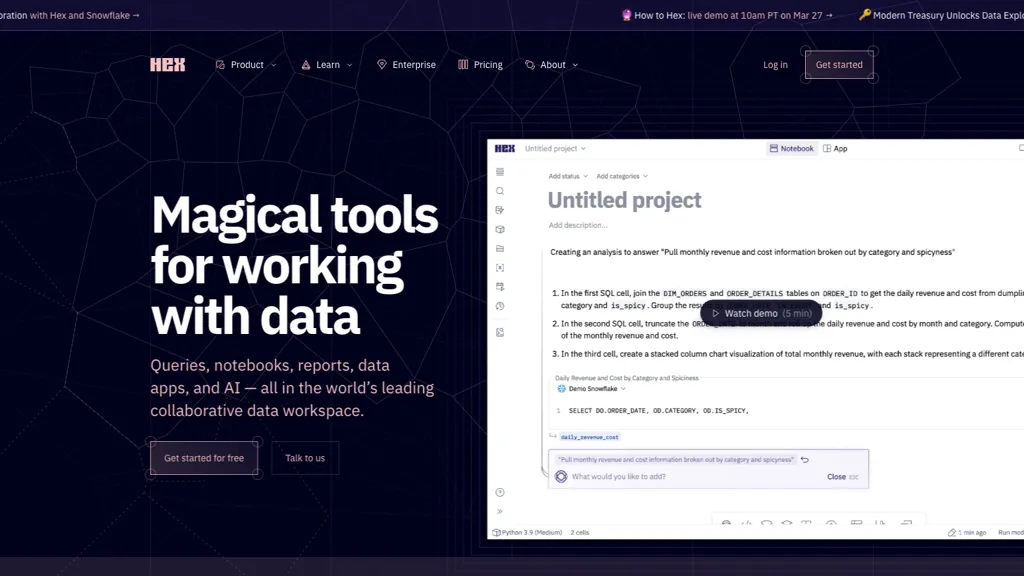
Hex is an AI analytics platform that consolidates notebooks, conversational self‑serve, and data apps into one connected workspace.
It relies on a shared context engine that incorporates semantic models, business rules, and database schema to deliver consistent, trustworthy insights.
Data scientists can write code in notebooks, while business users can pose plain‑language queries through Threads or Slack and receive AI‑generated analysis.
Publish interactive dashboards and embedded analytics with a single click, enabling collaboration across the data team.
Native connectors support major warehouses (Snowflake, BigQuery, Redshift, etc.) and integrations with dbt, GitHub, Airflow, and Prefect.
The platform is designed for analysts, data engineers, and non‑technical stakeholders who need accurate, actionable insights from their data.
Hex details
- Built for
- Individuals
- Stated compliance
- HIPAA
Compliance as stated in Hex's own published documentation.
Hex tech specs
- Works with
- OpenAI / GPT Anthropic / Claude
- Cloud
- AWS
- Integrations
- Slack Microsoft Teams Figma GitHub GitLab
Hex pricing
Freemium- Free trial
- 14 days
Verify on the official pricing page.
View plansHex's key features
-
AI agent auto-generates SQL and charts
-
First-class SQL editor with Jinja, dbt
-
Python and R with AI fixes
-
No-code data exploration and visualizations
-
Graph-based execution for reproducibility
-
Infinite data scale with warehouse compute
-
Hosted, secure compute with Docker images
Hex use cases
-
Enable data analysts to embed interactive dashboards into internal portals, letting non‑technical stakeholders ask Snowflake queries via Slack and instantly see results without writing SQL.
-
Collaboratively build machine‑learning notebooks in Hex, while business users validate model outputs through conversational threads, ensuring data science insights are aligned with strategic goals.
-
Accelerate quarterly financial reporting by merging BigQuery data into a single Hex workspace, allowing finance teams to run self‑serve, semantically‑contextualized queries and export ready‑to‑publish visualizations.
Hex user reviews
Based on 21 reviews, 76% of users recommend Hex, rated highly for quality results.
Liked for
Disliked for
Would you recommend Hex?
Who is Hex for?
-
Data analysts
-
Data scientists
-
Data engineers
-
Business analysts
-
Data team leads
Hex FAQ
Is Hex free?
Partly. Hex has a free plan with usage limits, and paid plans unlock the full feature set. Plans include Large at $0.32, Extra large at $0.65, 2xl at $1.29 and 4xl at $2.58.
Is Hex safe to use?
Hex states HIPAA compliance in its own published documentation. Hex carries the TopAI.tools verified mark, which we award after a manual review of pricing transparency, published terms, public following and working functionality. It has a substantial audience that is independently measured month to month.
Is Hex good?
Hex has a 76% recommendation rate from 21 reviewers on TopAI.tools. Reviewers rate it highest on quality of results and value for money.
What are the best alternatives to Hex?
The closest alternatives to Hex are Seek, DataBrain, basedash.com, Chat2DB and Breadcrumb.ai. You can compare them side by side in the alternatives section further down this page.
What does Hex do with my data?
Hex states that customer content is not used to train its models. Its privacy policy states that personal data is not sold or shared for marketing purposes. Data may be shared with third-party service providers that help run the product.
Does Hex have an API?
Yes. Hex offers an API, so you can call it from your own applications instead of using the interface directly.
Which AI models does Hex use?
Hex is built on OpenAI / GPT and Anthropic / Claude. Which models you can reach may depend on your plan.
What does Hex integrate with?
Hex connects with Slack, Microsoft Teams, Figma, GitHub and GitLab.
Compliance, privacy and billing terms are as stated in each product's own published documentation and have not been independently verified by TopAI.tools.


