
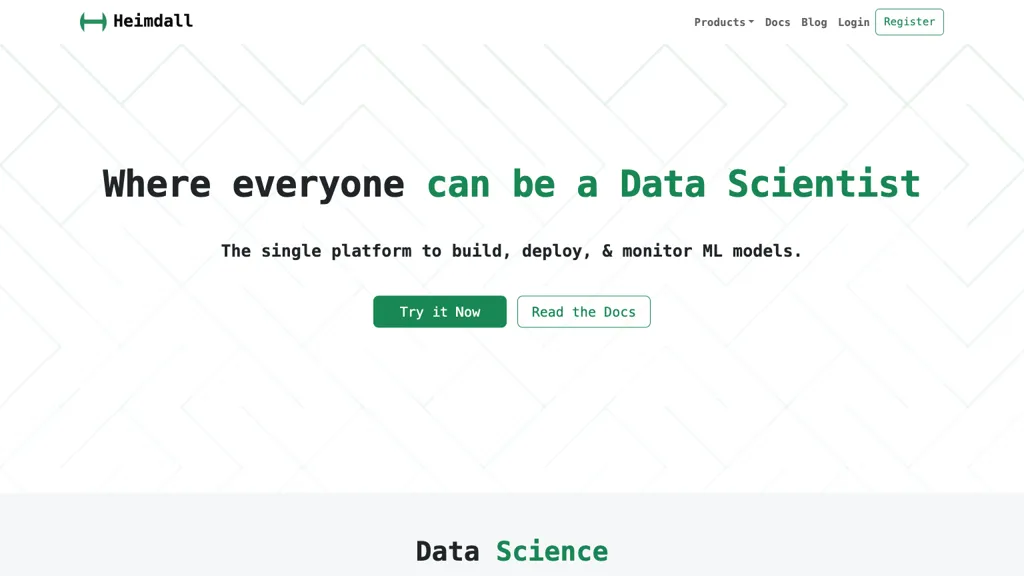
What is Heimdall ML?
Heimdall is a cloud‑based no‑code platform that builds, deploys, and monitors machine learning, forecasting, and data transformation models. It supports import from CSV, Databricks, and major data warehouses such as Redshift, BigQuery, and PostgreSQL, allowing users to connect existing data sources quickly.
With the Forge pipeline, Heimdall automates feature extraction for images and text, generating labeled datasets for classification models without manual preprocessing. The ML Forecast Loop component provides time‑series forecasting and adaptive learning, updating models in real time as new data arrives.
Models can be deployed with a single click and accessed via REST API for integration into business workflows. Heimdall’s interface offers explainable predictions and model monitoring dashboards, giving teams visibility into model performance over time.
Heimdall ML details
- Jurisdiction
- United States of America
- Built for
- Businesses and teams
Heimdall ML pricing
FreemiumHeimdall ML offers a free plan with paid upgrades available.
Verify on the official pricing page.
View plansHeimdall ML's key features
-
No-code machine learning platform
-
Automated model prototyping
-
Real-time performance insights
-
Seamless data integration
-
Explainable AI with feature importance
Heimdall ML use cases
-
Predict inventory demand for retail by feeding CSV sales data into Heimdall’s automated feature extractor, deploying a real‑time time‑series model via REST API and visualizing forecast confidence with an explainable dashboard
-
Detect equipment failures in manufacturing by uploading sensor CSV logs, building a no‑code anomaly detection model, and monitoring live alerts on a cloud‑based dashboard that explains root causes for non‑technical operators
-
Create a credit‑risk scoring system for fintech: import customer CSV data, automatically generate features, train a predictive model, deploy it for real‑time loan decisions, and provide a compliance‑friendly explainable AI panel
Heimdall ML user reviews
Would you recommend Heimdall ML?
Who is Heimdall ML for?
-
Machine learning engineers
-
Software developers
-
Data scientists
-
Cloud engineers
-
Data analysts
Heimdall ML FAQ
Is Heimdall ML free?
Partly. Heimdall ML has a free plan with usage limits, and paid plans unlock the full feature set.
What are the best alternatives to Heimdall ML?
The closest alternatives to Heimdall ML are plat.ai, Analytics Model, H2O AI, Durable AI and Bricks. You can compare them side by side in the alternatives section further down this page.
What does Heimdall ML do with my data?
Its privacy policy states that personal data is not sold or shared for marketing purposes. Data may be shared with third-party service providers that help run the product.
Does Heimdall ML have an API?
Yes. Heimdall ML offers an API, so you can call it from your own applications instead of using the interface directly.
Compliance, privacy and billing terms are as stated in each product's own published documentation and have not been independently verified by TopAI.tools.


