
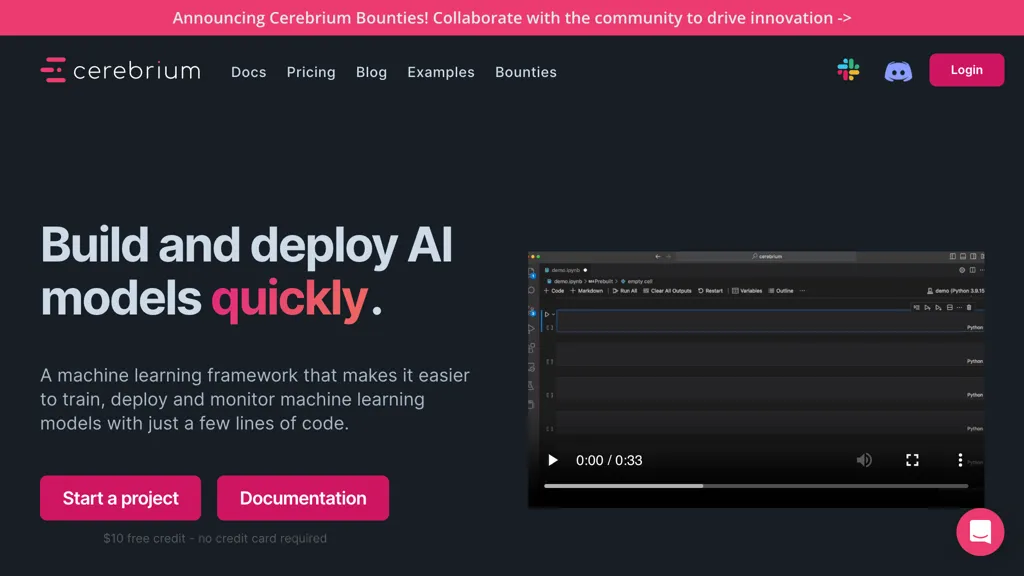
What is Cerebrium?
Cerebrium is a serverless AI infrastructure platform that supports rapid deployment of large language models, vision models, and agent-based applications. It offers zero DevOps management, auto‑scaling from zero to thousands of containers, and per‑second billing for efficient cost control.
The service provides fast cold starts (≤2 seconds), multi‑region deployment, and native WebSocket and streaming endpoints for low‑latency real‑time interactions. Users can select from more than 12 GPU types—including T4, A10, A100, H100, Trainium, and Inferentia—directly from the dashboard, and can customize runtime environments with Dockerfiles or native runtimes.
Integrated OpenTelemetry, batching, concurrency, asynchronous job queues, and distributed storage simplify observability, throughput, and data persistence without external setup. The platform supports CI/CD pipelines, gradual rollouts, and secure secrets management, making it suitable for developers, ML engineers, and enterprises that require reliable, compliant AI deployment at scale.
Cerebrium details
- Company
- Cerebrium Inc.
- Jurisdiction
- United Kingdom
- Built for
- Businesses and teams
- Stated compliance
- SOC 2, GDPR, HIPAA
Compliance as stated in Cerebrium's own published documentation.
Cerebrium tech specs
- Works with
- OpenAI / GPT Meta Stability AI Qwen
- Cloud
- AWS Google Cloud
- Integrations
- Slack Twilio
Cerebrium pricing
Freemium- Auto-renewal
- Yes
Verify on the official pricing page.
View plansCerebrium's key features
-
Serverless AI deployment platform
-
Global multi-region deployment
-
Per-second usage billing
-
Auto-scaling to thousands containers
-
GPU request batching
-
Distributed storage for models
-
Real-time WebSocket and streaming endpoints
Cerebrium use cases
-
Deploy a real‑time image‑captioning microservice for e‑commerce product feeds using Cerebrium's serverless vision models, auto‑scaling GPUs, and low‑latency WebSocket endpoints—no DevOps or infrastructure maintenance required.
-
Launch a multi‑region chatbot for a global SaaS platform, leveraging Cerebrium's zero‑DevOps LLM deployment, per‑second billing, and containerized GPU selection to keep response latency under 50 ms while scaling automatically during peak usage.
-
Implement an event‑driven document‑analysis pipeline that runs language models on user uploads, automatically spinning up GPU containers on demand and billing by the second—streamlining compliance checks without provisioning servers.
Cerebrium user reviews
Based on 4 reviews, 75% of users recommend Cerebrium, rated highly for quality results.
Liked for
Disliked for
Would you recommend Cerebrium?
Who is Cerebrium for?
-
Machine learning engineers
-
Data analysts
-
Software developers
-
System administrators
-
Cloud architects
Cerebrium FAQ
Is Cerebrium free?
Partly. Cerebrium has a free plan with usage limits, and paid plans unlock the full feature set. Plans include Standard at $100/mo.
Is Cerebrium safe to use?
Cerebrium states SOC 2, GDPR and HIPAA compliance in its own published documentation. Cerebrium is operated by Cerebrium Inc., registered in United Kingdom. It has a substantial audience that is independently measured month to month.
What are the best alternatives to Cerebrium?
The closest alternatives to Cerebrium are SiliconFlow, Release.ai, RunPod, Vast.AI and Wafer AI. You can compare them side by side in the alternatives section further down this page.
What does Cerebrium do with my data?
Its privacy policy states that personal data is not sold or shared for marketing purposes.
Does Cerebrium auto-renew or offer refunds?
Cerebrium subscriptions renew automatically until you cancel.
Does Cerebrium have an API?
Yes. Cerebrium offers an API, so you can call it from your own applications instead of using the interface directly.
Who made Cerebrium?
Cerebrium is built and operated by Cerebrium Inc., a company registered in United Kingdom.
Which AI models does Cerebrium use?
Cerebrium is built on OpenAI / GPT, Meta, Stability AI and Qwen. Which models you can reach may depend on your plan.
What does Cerebrium integrate with?
Cerebrium connects with Slack and Twilio.
Compliance, privacy and billing terms are as stated in each product's own published documentation and have not been independently verified by TopAI.tools.


