
What is Cebra?
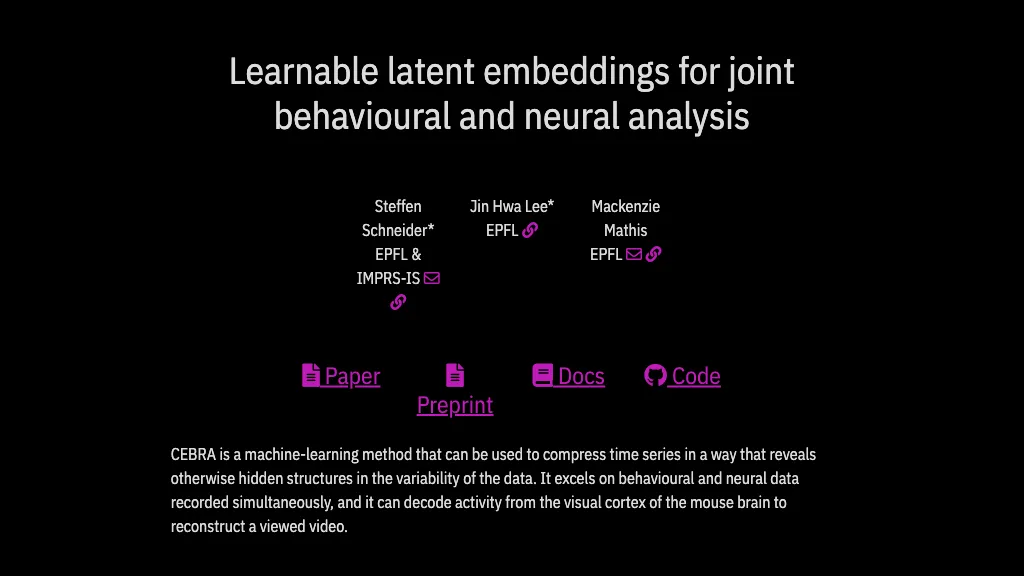
CEBRA is a machine‑learning method that compresses high‑dimensional time series from behavioral and neural recordings into low‑dimensional, interpretable embeddings. It supports both supervised (hypothesis‑driven) and self‑supervised (discovery‑driven) workflows, enabling researchers to integrate auxiliary variables such as video frames or positional data.
The embeddings preserve consistency across sessions and modalities, making it suitable for multi‑session experiments and for comparing 2‑photon imaging with Neuropixels electrophysiology. CEBRA’s latent space can be decoded with k‑Nearest‑Neighbors or other classifiers, allowing reconstruction of visual input from mouse visual cortex or inference of animal position from hippocampal activity with median errors around 5 cm.
The algorithm has been applied to primate motor cortex, mouse visual cortex, and rat hippocampus, demonstrating accurate trajectory and navigation decoding across species. Users can access the open‑source implementation on GitHub and reference the 2023 Nature paper for detailed methodology and validation.
Cebra pricing
FreeThis tool is free to use, with no credit card required.
Verify on the official pricing page.
Get started freeCebra's key features
-
Self-supervised time-series embeddings
-
Joint behavioral and neural analysis
-
Consistent low-dimensional latent space
-
Cross-modality embedding
-
Video reconstruction from visual cortex
-
Attribution maps via contrastive learning
-
Multi-session dataset integration
Cebra use cases
-
Rapidly compress multi‑day mouse behavioral videos and simultaneous electrophysiology recordings into a shared low‑dimensional latent space, enabling cross‑session alignment and unsupervised clustering of neural states without manual feature engineering.
-
Leverage CEBRA’s self‑supervised trajectory inference to predict future behavioral trajectories from calcium imaging data, facilitating real‑time closed‑loop stimulation protocols in freely moving rodents.
-
Integrate multi‑modal data from head‑mounted sensors and LFPs across species to generate unified embeddings, allowing researchers to train cross‑species classifiers that generalize from mouse to primate neural activity.
Cebra user reviews
Based on 1 review, 100% of users recommend Cebra, rated highly for quality results.
Liked for
Would you recommend Cebra?
Who is Cebra for?
-
Neuro scientists
-
Scientific researchers
-
Data analysts
-
Biological scientists
-
Scientific scientists
Cebra FAQ
Is Cebra free?
Yes. Cebra is free to use and does not require a credit card.