
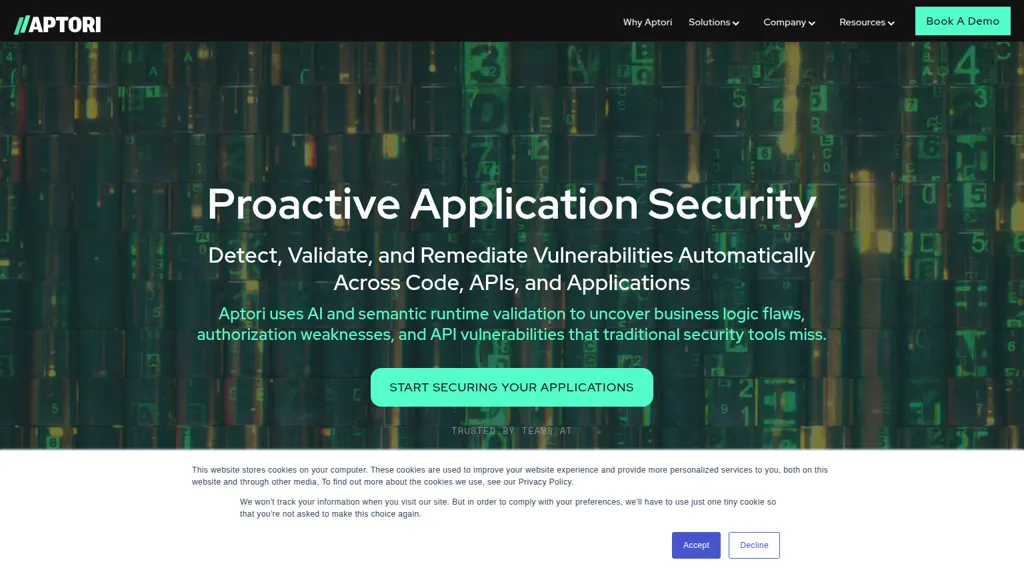
What is Aptori?
Aptori AI Security Engineer provides AI-driven AppSec for automated vulnerability detection and code-level remediation.It analyzes code, APIs, applications, and cloud configurations to identify logic flaws, misconfigurations, and API authorization issues including BOLA.
The tool generates automated code fixes and remediation guidance to reduce developer remediation time and backlog.Integration with CI/CD pipelines and SDLC workflows enables continuous application security testing and API security testing without disrupting development.
Automated triage and risk prioritization surface high-risk findings for security teams and reduce investigation overhead.Compliance mapping and reporting support standards such as PCI DSS 4.0 for security and compliance teams.
Intended for security engineers, developers, and DevOps teams, it streamlines vulnerability management and accelerates secure releases.
Aptori pricing
FreeThis tool is free to use, with no credit card required.
Verify on the official pricing page.
Get started freeAptori's key features
-
Automated AI-driven code-level fixes
-
Detection of vulnerabilities including business logic flaws, misconfigurations, and cloud risks
-
API and application security testing with API risk assessment
-
Risk prioritization and vulnerability triage
-
Seamless integration into SDLC and developer workflows
Aptori use cases
-
Integrate Aptori into your CI/CD pipeline to automatically scan codebases, APIs and cloud configurations for logic flaws, BOLA and authorization issues, then auto-generate prioritized code fixes and open pull requests so developers can remediate vulnerabilities before deployment
-
Use Aptori to run continuous API authorization testing and code-level vulnerability scanning across microservices, reducing manual triage by automatically prioritizing risks, highlighting exploit paths and suggesting precise code patches to fix broken access controls
-
Automate cloud security reviews by connecting Aptori to your IaC and cloud accounts to detect misconfigurations and unsafe policies, receive step-by-step remediation guidance and enforcement rules, and ensure secure deployments without slowing release velocity
Aptori user reviews
Would you recommend Aptori?
Who is Aptori for?
-
Software developers
-
Security architects
-
Application security engineers
-
Devops engineers
-
Cloud security engineers
Aptori FAQ
Is Aptori free?
Yes. Aptori is free to use and does not require a credit card.
What are the best alternatives to Aptori?
The closest alternatives to Aptori are Beagle Security, Maced AI, Corgea, AI Code Reviewer and Pixeebot. You can compare them side by side in the alternatives section further down this page.
Does Aptori have an API?
Yes. Aptori offers an API, so you can call it from your own applications instead of using the interface directly.


